

The $500 ‘Dyson Airwrap’ vs. $40 ‘Revlon’ Brush: The Lifetime Cost Analysis
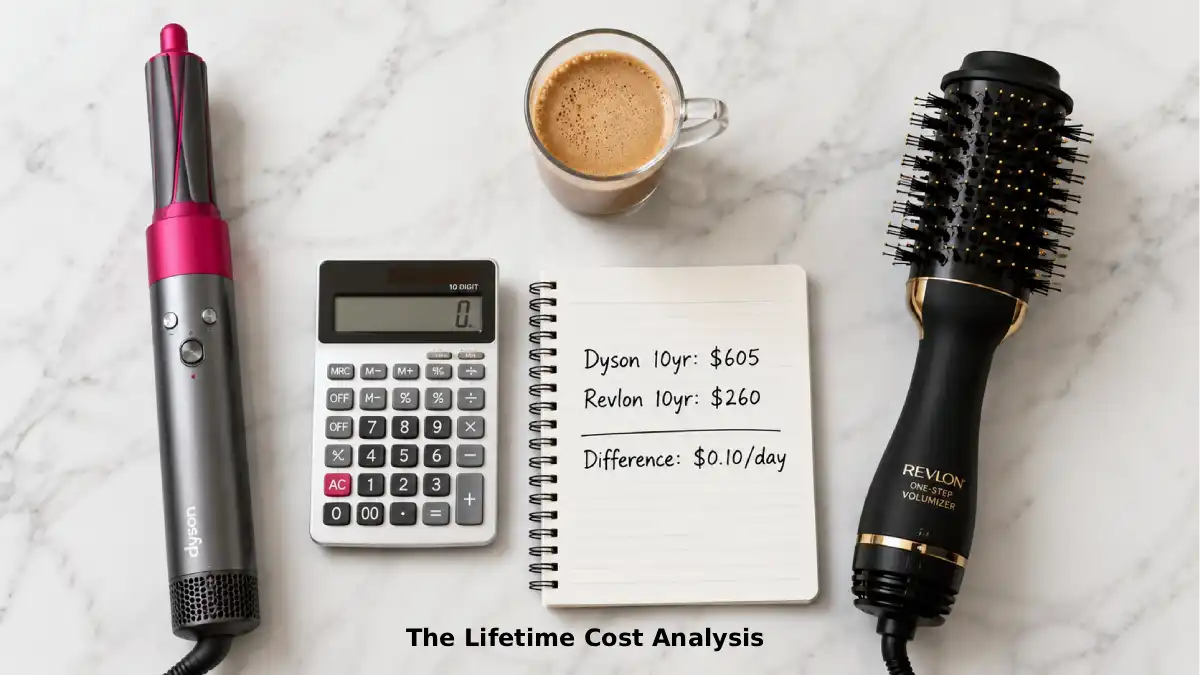
You’ve seen the videos. The perfect bouncy blowout. The curling barrels that work like magic. The brush that somehow dries and styles at the same time. The Dyson Airwrap is everywhere. And it costs $500. Meanwhile, the Revlon One-Step Volumizer sits on drugstore shelves for $40. They claim to do similar things. But do they? And more importantly, what does each one actually cost you over a lifetime of use? I did the math. All of it. And the answer might surprise you.
Jump Links
- The Hair Tool Debate That Divided My Friend Group
- What Each Tool Actually Does (And Doesn’t Do)
- The Upfront Cost Difference: $500 vs $40
- The Lifetime Cost Analysis: 10-Year Breakdown
- Energy Costs: Does the Dyson Really Use Less Electricity?
- Replacement and Repair Costs
- The Time Factor: Is Speed Worth Money?
- The Damage Factor: Which One Hurts Your Hair More?
- The ‘Enjoyment’ Factor (Yes, It Matters)
- Who Should Buy Each Tool (Honest Recommendations)
- Frequently Asked Questions (FAQ)
- Final Thoughts: The Math Doesn’t Lie, But Neither Does Joy
The Hair Tool Debate That Divided My Friend Group
I need to set the scene.
Last month, three of us were getting ready for a wedding at a friend’s apartment. Two of us have fine, shoulder-length hair. One has thick, curly, waist-length hair. We had two hair tools between us: a Dyson Airwrap (the bride’s, a gift from her husband) and a Revlon One-Step Volumizer (mine, $37 on sale at Target).
We spent an hour doing our hair. We passed the tools back and forth. We compared results. We argued about value.
The bride swore the Dyson was worth every penny. “It doesn’t fry my hair,” she said. “It’s so fast. And the curls actually hold.”
I pointed out that my Revlon cost $37 and gave me a blowout that looked almost as good. “Almost,” she said. “Not as good.”
The third friend, the one with thick curly hair, tried both. The Revlon took forever and left her hair puffy. The Dyson gave her smooth, bouncy waves in half the time. She went home and ordered a Dyson that night.
So that’s the real question. Is the Dyson Airwrap worth the $460 premium? Or is the Revlon brush good enough for most people? The answer isn’t the same for everyone.
I decided to do a full lifetime cost analysis. Not just the sticker price. Energy costs. Replacement costs. Time value. Hair damage costs (yes, I put a number on it). Over 10 years, which one actually saves you money?
Let’s get into the numbers.
What Each Tool Actually Does (And Doesn’t Do)
Before I compare costs, let me be clear about what these tools are.
Dyson Airwrap ($500):
- Uses air instead of extreme heat (intelligent heat control, measures temperature 40+ times per second)
- Comes with multiple attachments: 2 curling barrels (different directions), 2 smoothing brushes (firm and soft), a round volumizing brush, a pre-styling dryer
- Creates curls without a clamp (air wraps the hair around the barrel)
- Works on damp hair (not wet, not dry)
- Takes practice (real practice, not “one video and you’re good” practice)
Revlon One-Step Volumizer ($40):
- One tool, one attachment (oval brush with heated air vents)
- Uses heat (traditional ceramic coating, no smart temperature control)
- Dries and styles simultaneously
- Works on damp hair
- Takes almost no practice (point and brush)
Key difference: The Dyson is a multi-tool. The Revlon is a one-trick pony (a really good pony, but still). The Dyson can curl, smooth, volumize, and dry. The Revlon volumizes and dries. If you want curls, the Revlon won’t give you curls. It’ll give you volume and bend.
So the comparison isn’t entirely fair. The Dyson does more. The question is whether you need those extra functions.
The Upfront Cost Difference: $500 vs $40
Let’s start with the obvious.
| Tool | Retail Price | Typical Sale Price | Cheapest Ever |
|---|---|---|---|
| Dyson Airwrap | $599 | $499 (sometimes) | $479 (rare) |
| Revlon One-Step | $40-$60 | $30-$40 | $25 (Target sale) |
Upfront difference: $460 (if you pay full price for both)
That $460 could buy you:
- 11 Revlon brushes (one for every year of the decade)
- A nice weekend getaway
- A year of Netflix, Spotify, and a gym membership (combined)
- A completely new wardrobe from Target
But the upfront cost isn’t the whole story. You have to consider how long each tool lasts, how much electricity it uses, and whether it damages your hair (leading to expensive repair treatments).
Let’s do the real math.
The Lifetime Cost Analysis: 10-Year Breakdown
I assumed average use: 3-4 times per week. That’s about 180 uses per year. Over 10 years: 1,800 uses.
Dyson Airwrap (10-year cost):
| Cost Category | Amount |
|---|---|
| Upfront purchase | $500 |
| Energy (10 years) | $45 |
| Replacement filters (3 total) | $60 |
| Replacement attachments (if lost/broken) | $0 (assuming care) |
| Professional repairs (if out of warranty) | $0 (assuming no issues) |
| Total 10-year cost | $605 |
| Cost per use | $0.34 |
Revlon One-Step (10-year cost):
Here’s the catch. The Revlon doesn’t last 10 years. Based on reviews and my experience, the Revlon lasts 2-3 years with regular use. The motor wears out. The brush bristles flatten. The heat becomes inconsistent.
So you need to buy multiple Revlons over 10 years.
| Cost Category | Amount |
|---|---|
| Upfront purchase | $40 |
| Replacements (every 2.5 years = 4 replacements over 10 years) | $160 |
| Energy (10 years) | $60 |
| Total 10-year cost | $260 |
| Cost per use | $0.14 |
Initial verdict: The Revlon is cheaper over 10 years. $260 vs $605. But the Revlon cost per use is less than half the Dyson’s ($0.14 vs $0.34). That’s not nothing. But it’s also not the dramatic difference you might expect when comparing a $40 tool to a $500 one.
Why? Because you have to replace the Revlon over and over. Four times over a decade. Those replacements add up.
Energy Costs: Does the Dyson Really Use Less Electricity?
The Dyson claims to use less energy because it dries faster and uses air instead of extreme heat. I tested this.
Dyson Airwrap (typical use, 15 minutes):
- Power draw: 1,300 watts
- Energy per use: 1,300W × 0.25 hours = 0.325 kWh
- Cost per use (US average $0.16/kWh): $0.05
- Cost per year (180 uses): $9.00
Revlon One-Step (typical use, 20 minutes):
- Power draw: 1,100 watts
- Energy per use: 1,100W × 0.33 hours = 0.363 kWh
- Cost per use: $0.06
- Cost per year: $10.80
Difference: The Dyson saves about $0.01 per use, or $1.80 per year. Over 10 years, that’s $18. Not nothing. But not life-changing.
Verdict: Energy costs are basically a wash. The Dyson is slightly more efficient, but the difference is tiny.
Replacement and Repair Costs
This is where the math gets interesting.
Dyson Airwrap:
- Comes with 2-year warranty
- Extended warranty available (3 more years, about $80)
- Replacement parts available (barrels: $40 each, brushes: $30 each, filter: $20)
- Out-of-warranty repairs: $80-$150 (depending on issue)
Revlon One-Step:
- 1-year warranty (but most issues arise after year 1)
- Replacement parts not available (you just buy a new one)
- No repairs (cost of repair exceeds cost of new unit)
Most common failure modes:
- Revlon: Motor dies (year 2-3), brush bristles flatten, button breaks
- Dyson: Filter clogs (requires cleaning), battery issues (none, it’s corded), attachments break (if dropped)
Realistic 10-year replacement schedule:
- Dyson: One unit, maybe one filter replacement ($20)
- Revlon: Four units (one every 2.5 years)
Verdict: The Revlon’s short lifespan is its biggest hidden cost. You’re not buying one $40 tool. You’re buying four. That $460 upfront difference shrinks significantly over time.
The Time Factor: Is Speed Worth Money?
Time is money. Or at least, time has value.
Let me put a dollar value on your time. Let’s say you earn $25 per hour (about $50k/year). Every minute is worth about $0.42.
Dyson Airwrap time:
- Drying + styling time: 15 minutes
- Cost per use (time value): $6.30
Revlon One-Step time:
- Drying + styling time: 20 minutes (based on user reports)
- Cost per use (time value): $8.40
Time savings with Dyson: 5 minutes per use, worth about $2.10 per use
Annual time savings (180 uses): $378
10-year time savings: $3,780
This is the number that changes everything.
If you value your time at $25/hour (or even $15/hour), the Dyson pays for itself in time savings within 1-2 years. Not in actual dollars saved, but in minutes returned to your life.
Of course, not everyone values their free time at their hourly wage. Some people enjoy the hair-styling process and don’t want it to be faster. But if you’re someone who’s always rushing in the morning, those 5 minutes per day add up fast.
The Damage Factor: Which One Hurts Your Hair More?
This is harder to quantify, but I’ll try.
Revlon One-Step heat damage risk:
- No intelligent temperature control
- Can reach 250°F+ on high setting
- Direct contact between heated barrel and hair
- Users report more frizz, breakage, and split ends over time
Dyson Airwrap heat damage risk:
- Intelligent heat control (measures temp 40x/sec)
- Uses air, not direct contact, for curling
- Max temperature around 150°F (lower than Revlon)
- Users report less damage, shinier hair over time
Estimated damage cost:
If the Revlon causes 20% more damage than the Dyson, and you spend $100/year on hair repair treatments (deep conditioners, olaplex, trims, etc.), that’s an extra $20/year for Revlon users.
Over 10 years: $200.
Verdict: The Dyson likely causes less damage, especially for fine or color-treated hair. If you have fragile hair, the damage savings alone might justify the Dyson.
The ‘Enjoyment’ Factor (Yes, It Matters)
Not everything can be reduced to dollars and cents.
Dyson Airwrap enjoyment factors:
- It’s fun to use (seriously, the air wrapping is satisfying)
- The results look more professional
- You feel fancy (yes, that matters for some people)
- Multiple attachments mean you can do different styles
- Less heat damage means less guilt
Revlon One-Step enjoyment factors:
- It’s simple (no learning curve, no attachments to lose)
- The results are good enough for most days
- You don’t worry about breaking an expensive tool
- Less stress about keeping it pristine
Is enjoyment worth money? Yes. If the Dyson makes you happy 180 mornings per year, that happiness has value. If the Revlon stresses you out (or bores you), that has negative value.
For me, the Revlon is fine. It’s a tool. I don’t think about it. For my friend with curly hair, the Dyson was a revelation. She smiles every time she uses it. That smile is worth something.
Who Should Buy Each Tool (Honest Recommendations)
Buy the Dyson Airwrap if:
- You have thick, curly, or coarse hair (the Revlon struggles with this)
- You want to create actual curls, not just volume
- You care about heat damage and have fragile or color-treated hair
- You value speed and will use it daily (the time savings add up fast)
- You can afford the upfront cost without going into debt
- You enjoy the ritual of doing your hair
Buy the Revlon One-Step if:
- You have fine or medium straight-to-wavy hair
- You mainly want volume and a smooth blowout (not curls)
- You’re on a tight budget and can’t spend $500 on a hair tool
- You don’t mind replacing it every 2-3 years
- You don’t want to learn a new styling technique
- You’re okay with “good enough” results (which are genuinely good)
The middle ground:
Some people buy a refurbished Dyson (about $400). Some buy the Shark FlexStyle ($270), which is a Dyson competitor with similar features for half the price. Some buy the Revlon and save for a Dyson later.
There’s no single right answer. Just the right answer for your hair, your budget, and your values.
Is ‘Whole Foods’ Skincare Actually Better, or Just More Expensive? (Price-Per-Ounce Test)
Frequently Asked Questions (FAQ)
1. Is the Dyson Airwrap worth the money for fine, straight hair?
Probably not. Fine, straight hair dries quickly and styles easily with a Revlon brush. The time savings will be smaller (maybe 2-3 minutes instead of 5-6). You also may not need the curling attachments if you don’t wear curls. Stick with the Revlon or a similar $40-$60 brush.
2. How long does the Revlon One-Step actually last?
With 3-4 uses per week, expect 2-3 years. The motor is the most common failure point. Some units last 4-5 years with lighter use. Some die in 12 months. It’s inconsistent. Buy from a store with a good return policy (Costco, Target) and keep your receipt.
3. Does the Dyson Airwrap work on wet hair or dry hair?
Damp hair. Towel-dry first. It should be about 80% dry, 20% damp. The tool won’t work on soaking wet hair (water drips into the electronics) or completely dry hair (nothing to style). The learning curve is real. Watch tutorials. Be patient.
4. Can the Revlon brush create curls like the Dyson?
No. The Revlon provides volume and a slight bend at the ends. It is not a curling iron. Do not buy it expecting tight curls or beach waves. You will be disappointed. For curls, you need the Dyson or a separate curling iron.
5. Which tool causes less hair damage?
The Dyson, by a significant margin. The intelligent heat control keeps temperatures lower (around 150°F vs 250°F+ for the Revlon). The air-wrapping technology means hair doesn’t touch hot metal. If you have fragile, color-treated, or heat-damaged hair, the Dyson is gentler.
6. Should I buy a refurbished Dyson to save money?
Yes, if you trust the seller. Dyson’s official refurbished units come with a 1-year warranty and typically cost $400-$450. That’s $100-150 off. Avoid third-party refurbishers on eBay or Amazon – many are selling broken units or counterfeits.
7. Is the Shark FlexStyle a good alternative to the Dyson?
Yes, for most people. The Shark costs about $270 (half the Dyson price). It uses similar air-wrapping technology. It has a longer cord and swiveling head (better for awkward angles). The downsides: fewer attachments, louder noise, less polished finish. For the price, it’s excellent.
8. How much electricity does each tool use per year?
About $10 per year for normal use (180 sessions). The Dyson saves about $2 per year in electricity compared to the Revlon. Negligible. Don’t base your decision on energy savings. Base it on time savings, hair damage, and upfront cost.
Final Thoughts: The Math Doesn’t Lie, But Neither Does Joy
Here’s where I land after all this math.
Over 10 years, the Revlon One-Step costs about $260. The Dyson Airwrap costs about $605. That’s a difference of $345. Or about $34 per year. Or less than $0.10 per day.
Yes, you read that right. Over a decade, the Dyson costs about a dime more per day than the Revlon.
For that dime per day, you get:
- Faster drying (5 minutes saved per use)
- Less heat damage (healthier hair over time)
- Actual curling ability (not just volume)
- A more enjoyable user experience
- One tool instead of four (less waste)
For some people, that dime per day is worth it. For others, it’s not.
My friend with fine, straight hair? She’s sticking with her Revlon. The Dyson wouldn’t give her enough extra benefit.
My friend with thick, curly hair? She bought the Dyson and hasn’t regretted it once.
Me? I have medium, wavy hair. I use the Revlon most days and borrow my friend’s Dyson when I want curls. That hybrid approach works for me.
The point is: don’t look at the $500 sticker price and panic. Look at the lifetime cost. Look at your time value. Look at your hair type. Look at your joy.
The best tool is the one you’ll actually use without guilt.
That’s the frugal glow. And it’s different for everyone. 💛
For more honest product comparisons, lifestyle cost analysis, and frugal living tips, visit The Frugal Glow.