

The ‘No-Sew’ Revolution: 5 Ways to Hem Your Thrifted Pants Using Only a $4 Tape
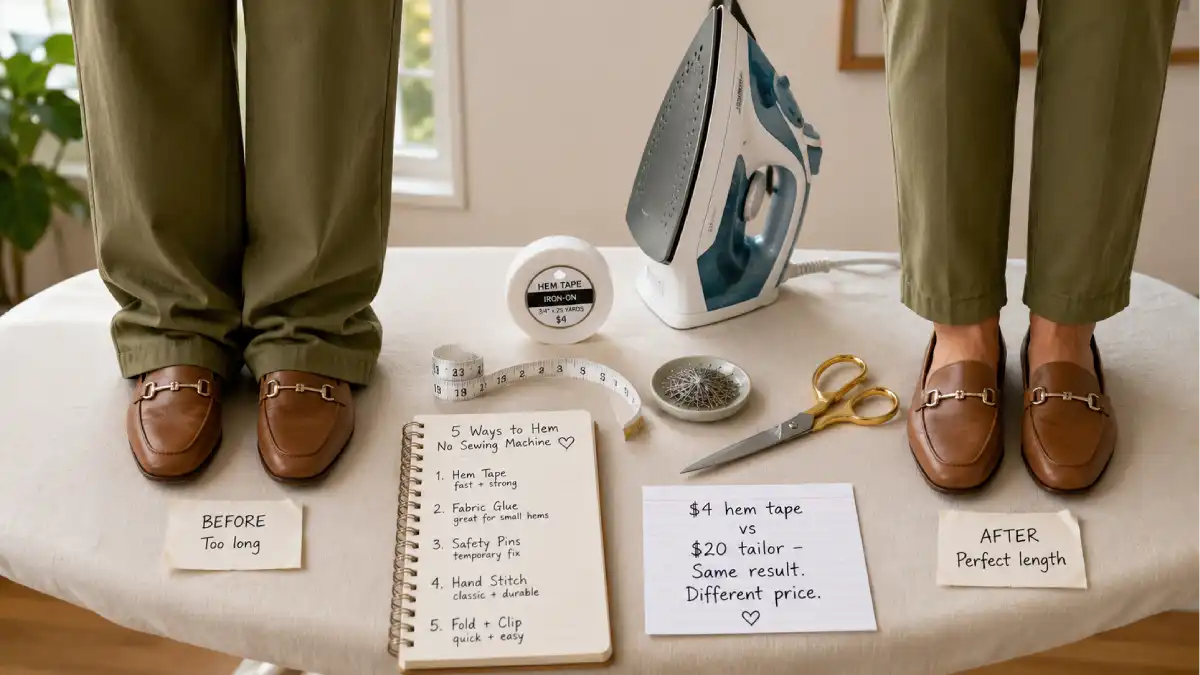
Let me tell you about the $6 pants that sat in my closet for two years.
I found them at a thrift store. Perfect color. Perfect material. Perfect fit everywhere except the length. They were three inches too long. I can’t sew. I don’t own a sewing machine. I don’t know anyone who does.
I told myself I would learn to hem them. I bought thread. I bought needles. I watched YouTube videos. I tried once. It looked terrible. The stitches were crooked. The hem was bumpy. I gave up.
Those pants sat in my closet for two years. Every time I saw them, I felt guilty. A $6 waste.
Then a friend told me about hem tape. It’s a double-sided adhesive tape that bonds fabric when you apply heat. An iron. That’s it. No sewing. No needles. No thread.
I bought a roll of hem tape for $4 at the fabric store. I went home. I measured the pants. I folded the hem. I inserted the tape. I pressed with an iron. Ten minutes later, I had perfectly hemmed pants.
I wore them the next day. The hem held. It survived the washer and dryer. It still looks perfect.
That was three years ago. I’ve hemmed over twenty pairs of pants and skirts using hem tape. I’ve saved hundreds of dollars in tailoring fees. And I still don’t know how to sew.
Today, I’m sharing the no-sew revolution. Five ways to hem your thrifted pants using only a $4 tape. No sewing machine. No experience. No frustration.
Let’s get into it.
Jump Links
- The $6 Pants That Made Me Feel Like a Failure
- What Is Hem Tape (And Why It’s a Game Changer)
- What You Need (The $4 Toolkit)
- Method #1: The Basic Fold (For Most Pants)
- Method #2: The Blind Hem (For Dress Pants)
- Method #3: The Cuff Hem (For Jeans)
- Method #4: The Temporary Hem (For Trying Length)
- Method #5: The Tapered Hem (For Wide-Leg Pants)
- How to Make Hem Tape Last (Washing & Drying Tips)
- What to Do If the Hem Tape Fails (Fix It in 5 Minutes)
- The Math: What I Saved in Three Years
- Frequently Asked Questions (FAQ)
- Final Thoughts: You Don’t Need to Sew to Save Money on Clothes
The $6 Pants That Made Me Feel Like a Failure
I need to describe that feeling of defeat.
I found these amazing olive green trousers at Goodwill. They were from a brand I liked. The fabric was thick and soft. The fit was perfect through the waist and hips. The length? Disaster. They pooled around my ankles. I looked like a kid playing dress-up.
But they were $6. I bought them anyway. I told myself I would hem them. How hard could it be?
I bought a sewing kit. I watched a beginner’s hemming tutorial. I threaded the needle. I made my first stitch. It was crooked. I pulled it out. I tried again. Still crooked. I tried a third time. The thread tangled. The fabric puckered. I stabbed myself with the needle.
I put the pants in my closet. I told myself I would try again later.
Two years later, they were still there. Unhemmed. Unworn. A $6 monument to my inability to sew.
Then a friend came over. She saw the pants hanging in my closet. She asked why I never wore them. I told her the story. She laughed.
“Hem tape,” she said.
“What?”
“Hem tape. It’s double-sided adhesive. You fold the pants, put the tape inside, and iron it. No sewing. Ten minutes.”
I went to the fabric store. I bought a roll of hem tape for $4. I went home. I measured, folded, taped, and ironed. Ten minutes later, I had perfectly hemmed pants.
I wore them the next day. I’ve worn them dozens of times since. The hem is still perfect.
That $4 roll of tape has hemmed over twenty pairs of pants and skirts. I’ve saved over $500 in tailoring fees. And I still don’t know how to sew.
What Is Hem Tape (And Why It’s a Game Changer)
Let me explain what hem tape is and why it works.
What it is:
Hem tape is a double-sided fusible adhesive tape. It’s made of heat-activated glue sandwiched between two paper layers. When you iron it, the glue melts and bonds fabric together.
What it looks like:
A thin strip of white or off-white tape, usually 0.5 to 1 inch wide. It comes in a roll, like tape. The paper backing peels off on both sides.
Why it works:
The glue is designed to melt at ironing temperatures (about 300°F). When it cools, it hardens and creates a permanent bond. It’s strong enough to survive washing and drying.
Where to buy it:
- Fabric stores (Joann, Michael’s, Hobby Lobby)
- Walmart (craft section, near sewing supplies)
- Amazon (search “heat n bond hem tape” or “fusible hem tape”)
- Target (craft section, sometimes)
How much it costs: $3-5 for a roll that will hem 20-30 pairs of pants.
What it works on:
- Cotton, linen, wool, polyester, blends
- Jeans (denim)
- Dress pants
- Skirts
- Curtains
What it DOES NOT work on:
- Leather (heat damages it)
- Vinyl or plastic fabrics (they melt)
- Very delicate fabrics (silk, chiffon – test first)
- Fabrics that can’t be ironed (check the care label)
The difference between cheap and quality hem tape:
Cheap hem tape (Dollar Tree) can fail after a few washes. Quality hem tape (Heat n Bond, Dritz, Unique Stitch) lasts for years. Spend the extra $2.
What You Need (The $4 Toolkit)
You probably already have most of this.
Essential items (cost: $4 for hem tape, everything else is free if you own it):
| Item | Purpose | Where to Find |
|---|---|---|
| Hem tape (1 roll) | The adhesive that does the work | Fabric store, Walmart, Amazon |
| Measuring tape or ruler | Measuring how much to fold | Sewing kit, desk drawer |
| Iron | Activates the adhesive | Your laundry room |
| Ironing board (or towel on a table) | Flat surface for ironing | Laundry room |
| Scissors | Cutting the hem tape | Desk drawer |
| Pins or clips (optional) | Holding the fold in place while ironing | Sewing kit |
What to look for when buying hem tape:
| Brand | Price | Quality | Where to Buy |
|---|---|---|---|
| Heat n Bond Ultrahold | $5 | Excellent | Joann, Walmart, Amazon |
| Dritz Hem Tape | $4 | Good | Joann, Michael’s |
| Unique Stitch | $4 | Good | Amazon, craft stores |
| Generic (store brand) | $3 | Fine | Walmart, Target |
| Dollar Tree brand | $1.25 | Poor (fails quickly) | Dollar Tree |
My recommendation: Spend $5 on Heat n Bond Ultrahold. It’s worth the extra dollar. A roll will hem 20-30 pairs of pants.
Pro tip: If you don’t have an ironing board, use a towel on a hard table. The towel provides padding. The table provides a flat surface.
Method #1: The Basic Fold (For Most Pants)
This is the method for straight-leg pants, trousers, chinos, and most casual pants. It’s the easiest and most common.
Best for: Straight-leg pants, trousers, chinos, khakis, casual pants
Time: 10 minutes
Step-by-step:
- Try on the pants. Mark where you want the hem to fall. Use a pin, a piece of tape, or just remember.
- Take off the pants. Turn them inside out. This hides the fold on the inside.
- Measure the fold. Fold the bottom of the pants up to your mark. The amount you fold is the amount you’re removing. For example, if the pants are 3 inches too long, you’ll fold up 3 inches. Use a measuring tape to make it even.
- Pin the fold in place. Use pins or clips to hold the fold. This keeps it from shifting while you iron.
- Press the fold with your iron. Don’t use steam yet. Just press to create a crease. This makes the next step easier.
- Cut strips of hem tape. Cut enough to go across the width of the pants. You’ll need 2 strips per pant leg (one for the outer edge, one for the inner edge, about 0.5 inches apart).
- Peel off one side of the hem tape backing. Place the sticky side against the inside of the fold. The tape should be between the folded fabric and the pant leg.
- Peel off the second side of the backing. Close the fold. The tape is now sandwiched between the two layers of fabric.
- Iron the hem. Press firmly. Hold the iron on each section for 10-15 seconds. The heat activates the glue. Don’t slide the iron – lift and place.
- Let it cool for 5 minutes. Don’t move the pants while the glue is still hot.
- Turn the pants right side out. Try them on. The hem should be clean and invisible from the outside.
Pro tip: Before ironing the whole hem, test a small section. Iron a 2-inch piece. Let it cool. Check if the bond is strong. If it pulls apart, your iron isn’t hot enough.
Method #2: The Blind Hem (For Dress Pants)
Dress pants often have “blind hems” – hems that are invisible from the outside. You can replicate this with hem tape.
Best for: Dress pants, slacks, formal trousers
Time: 15 minutes
What makes it different: In a blind hem, the fold is smaller and the edge is turned under twice. This creates a clean, invisible finish.
Step-by-step:
- Try on the pants. Mark the desired length.
- Turn the pants inside out.
- Make the first fold. Fold the bottom up to your mark. This is the same as the basic fold.
- Make the second fold. Now fold the raw edge under, toward the inside of the pants. You’re folding the edge under so it’s hidden. The second fold should be about 0.5 to 1 inch.
- Pin both folds in place.
- Press with an iron to create creases.
- Cut hem tape strips. You’ll place the tape between the second fold and the pant leg (not between the first and second fold).
- Peel and place the tape. Put the tape in the “valley” of the second fold.
- Iron. Press firmly for 10-15 seconds per section.
- Let cool. Turn right side out. The hem should be invisible from the outside.
Why this method is better for dress pants: The raw edge is hidden. The hem looks professional. No one will know you used tape.
Method #3: The Cuff Hem (For Jeans)
Jeans look great with a cuff. You can use hem tape to make the cuff permanent.
Best for: Jeans, casual pants, pants where you want a visible cuff
Time: 10 minutes
Step-by-step:
- Try on the jeans. Decide how tall you want the cuff. A 1.5 to 2 inch cuff is standard.
- Take off the jeans. Turn them inside out.
- Fold up the bottom to create the cuff. The fold should be the height you want the cuff to be. For a 2-inch cuff, fold up 2 inches.
- Press the fold with an iron. Create a crease.
- Cut hem tape strips. You’ll place the tape between the folded fabric and the pant leg.
- Peel and place the tape. Put the tape along the inside of the fold.
- Iron. Press firmly for 10-15 seconds per section.
- Let cool. Turn right side out.
- Create the second fold (the visible cuff). Now fold the cuff up one more time, but this time to the outside. The height of the outer cuff can be slightly less than the inner fold. For example, if you folded up 2 inches on the inside, fold up 1.5 inches on the outside. The extra 0.5 inches on the inside creates tension that keeps the cuff in place.
- Press the outer cuff with an iron. The hem tape holds the inside fold. The outer cuff is held by friction (no tape needed).
Pro tip: For a distressed look, don’t iron the outer cuff perfectly. Leave it slightly wrinkled. It looks more authentic.
Method #4: The Temporary Hem (For Trying Length)
Not sure how short you want your pants? Use hem tape temporarily.
Best for: Testing length before committing, adjusting for different shoes
Time: 5 minutes
What makes it different: You don’t iron the tape. You just press it in place. The bond is strong enough to hold while you wear the pants, but it can be removed later.
Step-by-step:
- Turn the pants inside out.
- Fold the pants to the length you want to test.
- Cut a small piece of hem tape (1-2 inches). Don’t use the full width – just a small strip.
- Peel off one side of the backing. Press the tape onto the fold. Don’t iron. Just press with your fingers.
- Peel off the second side of the backing. Close the fold. Press with your fingers.
- Wear the pants for a day. See if you like the length.
- To remove: Peel off the tape. It should come off easily since you didn’t iron it. Wash the pants to remove any residue.
Pro tip: Use this method to test different lengths with different shoes. The same pants might look great at ankle length with flats, but you might want them longer with heels. Test before committing.
Method #5: The Tapered Hem (For Wide-Leg Pants)
Wide-leg pants sometimes need a slight taper at the hem. You can create this with hem tape.
Best for: Wide-leg pants, palazzo pants, culottes
Time: 15 minutes
What makes it different: You’re not just folding the hem straight across. You’re creating a slight angle so the pants taper inward at the bottom.
Step-by-step:
- Try on the pants. Pin the hem where you want it. Also pin the side seams to create a taper. The goal is to make the opening slightly narrower than the knee.
- Take off the pants. Turn them inside out.
- Mark the new hemline. Use chalk or a pin to mark where you want the hem. The line should be angled, not straight.
- Fold the hem along the angled line. This is trickier than a straight hem. Work slowly. Use pins to hold the fold.
- Press with an iron to create a crease.
- Cut hem tape strips. Because the hem is angled, you’ll need to cut the tape at an angle too.
- Peel and place the tape. Press into place.
- Iron. Hold for 10-15 seconds per section.
- Let cool. Turn right side out.
- Try on. The hem should be narrower than the original wide leg. If you want more taper, repeat the process higher up the leg.
Pro tip: Don’t taper too much. You still need to get your foot through the opening. Leave at least 8-10 inches of circumference at the hem.
How to Make Hem Tape Last (Washing & Drying Tips)
Hem tape is strong, but it needs proper care.
Washing:
- Turn pants inside out before washing. This protects the hem from abrasion.
- Wash in cold water. Hot water can weaken the adhesive over time.
- Use a gentle cycle. High agitation can stress the bond.
- Don’t use fabric softener. It coats fibers and can cause the hem tape to release.
Drying:
- Air dry when possible. Heat from dryers can weaken the adhesive over time.
- If using a dryer, use low heat. High heat can melt the glue.
- Remove pants while slightly damp. Let them finish drying flat.
What to expect:
Quality hem tape (Heat n Bond, Dritz) will last through 20-30 washes before showing signs of wear. That’s 1-2 years of weekly wear.
Signs the hem tape is failing:
- The fold is separating at the edges
- You can see the tape peeking out
- The hem is puckering or bubbling
When that happens: Remove the old tape (peel it off – it will come off with some effort) and apply new tape. It’s a 10-minute fix.
What to Do If the Hem Tape Fails (Fix It in 5 Minutes)
Even quality hem tape can fail eventually. Here’s how to fix it.
Problem #1: The edges of the hem are coming apart.
Cause: The tape didn’t bond at the very edge of the fold.
Fix: Cut a small piece of hem tape (1 inch). Peel off one side. Slide it between the layers at the open edge. Iron for 10 seconds. Fixed.
Problem #2: The hem tape is visible from the outside.
Cause: The fold isn’t flat. The tape is bulging.
Fix: This usually means the fabric is too thick for the tape to hold cleanly. Remove the tape (peel it off). Use a thinner hem tape or use the “blind hem” method (which hides the tape deeper inside the fold).
Problem #3: The hem tape pulled apart in the wash.
Cause: The water was too hot, or the dryer was too hot.
Fix: Remove the old tape. Apply new tape. Wash in cold water and air dry going forward.
Problem #4: The fabric is fraying at the raw edge.
Cause: The raw edge wasn’t folded under. This happens with loosely woven fabrics.
Fix: Remove the old tape. Fold the raw edge under (creating a second fold) so the raw edge is hidden. Apply new tape to the second fold. This is the “blind hem” method.
The ultimate fix: If hem tape keeps failing on a particular pair of pants, the fabric may not be compatible. In that case, take them to a tailor. It’s worth the $15-20. But that’s rare. I’ve only had to do this once.
The Math: What I Saved in Three Years
Let me break down the actual dollars.
Professional tailoring costs (if I had paid for alterations):
| Item | Tailoring Cost | Number Done | Total Cost |
|---|---|---|---|
| Hem pants (basic) | $15 | 12 pairs | $180 |
| Hem dress pants (blind hem) | $20 | 6 pairs | $120 |
| Hem jeans (cuff) | $12 | 5 pairs | $60 |
| Taper wide-leg pants | $25 | 3 pairs | $75 |
| Total tailoring cost | $435 |
What I actually spent:
| Item | Cost |
|---|---|
| Hem tape (Heat n Bond, one roll) | $5 |
| Iron (already had) | $0 |
| Measuring tape (already had) | $0 |
| Scissors (already had) | $0 |
| Total spent | $5 |
Total saved over 3 years: $430
Cost per hem: $0.25 (for the tape used)
Professional tailoring per hem: $15-25
Savings per hem: $14.75-24.75
What I did with the savings:
- Bought a nicer iron (my old one was dying – $40)
- Took a friend out for a nice dinner ($60)
- Put the rest into savings
And I have pants that fit perfectly.
How to Turn Your Grandma’s Vintage Scarves Into a $60 ‘Reformation’ Style Halter Top
Frequently Asked Questions (FAQ)
1. Does hem tape really last after washing?
Yes, quality hem tape (Heat n Bond, Dritz) lasts through 20-30 washes. That’s 1-2 years of weekly wear. Cheap hem tape (Dollar Tree) may fail after 1-2 washes. Spend the extra $2. To extend the life, wash pants inside out in cold water and air dry or use low heat.
2. Can I use hem tape on jeans (thick denim)?
Yes, but use a heavy-duty hem tape (Heat n Bond Ultrahold is best). Denim is thick, so you need strong adhesive. Also, use a hotter iron setting (cotton/denim setting). Press firmly and hold for 15-20 seconds per section. For very thick denim (raw selvedge, heavy-weight), the cuff method works better than a basic fold because the cuff distributes stress differently.
3. Will hem tape damage my iron?
No. The glue is designed to melt and bond to fabric, not to your iron. That said, don’t iron directly over exposed tape. Always make sure the tape is sandwiched between two layers of fabric. If glue does get on your iron, let it cool, then wipe with a cloth dampened with rubbing alcohol.
4. Can I remove hem tape if I make a mistake?
Yes. If you haven’t ironed it yet, just peel it off. If you have ironed it, re-iron the area to soften the glue, then peel off the tape while it’s still warm. Any residue can be removed with rubbing alcohol or a product called “Goo Gone” (test on an inconspicuous spot first).
5. How do I know how much to fold?
Try on the pants with the shoes you plan to wear most often (flats, sneakers, or heels). The hem should hit at your ankle bone for cropped pants, or just above the floor for full-length pants. If you’re unsure, start longer. You can always fold more. You can’t unfold and reattach fabric.
6. Can I use hem tape on delicate fabrics like silk?
Maybe, but test first. Silk can be heat-sensitive. Use a low heat setting (silk setting on your iron). Test a small piece of hem tape on an inside seam or hem allowance. If the fabric discolors or puckers, don’t use hem tape. Take silk pants to a tailor instead.
7. Will hem tape work on polyester?
Yes. Polyester is heat-sensitive, so use a medium heat setting (polyester setting). Test first on an inside seam. Some polyesters can melt at high temperatures. When in doubt, use the “temporary hem” method (no iron) and then take the pants to a tailor if you like the length.
8. How long does a hem tape hem take to set?
The bond is strong immediately after ironing and cooling (5 minutes). But for best results, wait 24 hours before washing. The glue continues to cure over time. I’ve washed pants the same day and been fine, but waiting is safer.
9. Can I use hem tape to hem curtains?
Yes! Hem tape is great for curtains because they don’t get washed as often as clothes. The basic fold method works perfectly. Measure carefully – curtain hems need to be straight. Use a level or measure from the floor.
10. Is hem tape cheaper than taking pants to a tailor?
Yes. A tailor charges $15-25 per hem. A $5 roll of hem tape will hem 20-30 pairs of pants. That’s $0.20-0.25 per hem. Even if you factor in your time (10 minutes per hem), you’re still saving money unless you earn more than $120 per hour.
Final Thoughts: You Don’t Need to Sew to Save Money on Clothes
Here’s what I want you to take away.
Those $6 pants sat in my closet for two years because I thought I needed to sew. I didn’t. I needed $4 of hem tape and ten minutes of patience.
Hem tape is not a compromise. It’s not “good enough for now.” It’s a permanent solution that works for years. I have pants I hemmed three years ago that still look perfect. You can’t tell they were hemmed with tape.
The no-sew revolution is real. You don’t need a sewing machine. You don’t need to learn a new skill. You don’t need to spend $20 on alterations. You need a $4 roll of tape and the courage to try.
So next time you find a great pair of pants at a thrift store and they’re too long, don’t put them back. Don’t tell yourself you’ll learn to sew. Don’t let them sit in your closet for two years.
Buy the pants. Buy the hem tape. Go home. Spend ten minutes.
Then wear them the next day.
That’s the frugal glow. And it’s holding your hem in place. 👖💛
For more no-sew fashion hacks, thrift store tips, and money-saving style strategies, visit The Frugal Glow.