I used to buy my skincare and makeup the moment I ran out. If my moisturizer was empty, I drove to Ulta and paid full price. If I saw a new lipstick on TikTok, I ordered it from Sephora that night. I thought I was being efficient. I was actually just donating money to retailers.
Then I started tracking the sales. I noticed a pattern. The exact same bottle of serum I paid $65 for in June was $32.50 in September. The mascara I bought full price in April was part of a 50% off “Beauty Steal” in March. I was consistently buying at the worst possible times.
The fix wasn’t complicated. It was just a calendar. Ulta and Sephora both run predictable sales cycles. Once you know when they happen, you stop paying full price. You stop guessing. You just wait for the window and buy.
This is that calendar.
Jump Links
- The Truth About Beauty Retail Pricing
- Ulta’s Big Guns: 21 Days of Beauty and the Semi-Annual Event
- Sephora’s Playbook: The Savings Event and Rouge Perks
- The Loyalty Math: Points vs. Prestige
- The Black Friday and Holiday Gauntlet
- The Monthly and Quarterly Checkpoints
- The “Stacking” Strategy: How to Layer Savings
- The Math: What I Saved by Waiting
- Frequently Asked Questions (FAQ)
- Final Thoughts: The Best Time to Buy Is When You’re Ready
The Truth About Beauty Retail Pricing
Before we get into the specific dates, let’s be clear about how this works. Neither Ulta nor Sephora is a discount store. Their business model relies on people buying at full price. The sales exist to drive volume and clear inventory, but they are not the default.
The list price is the ceiling, not the floor. A $70 serum is $70 because the brand says so. The retailer isn’t doing you a favor by charging that. They’re holding the line on margin. When they run a sale, they’re sacrificing some margin to get you in the door or to move a specific product.
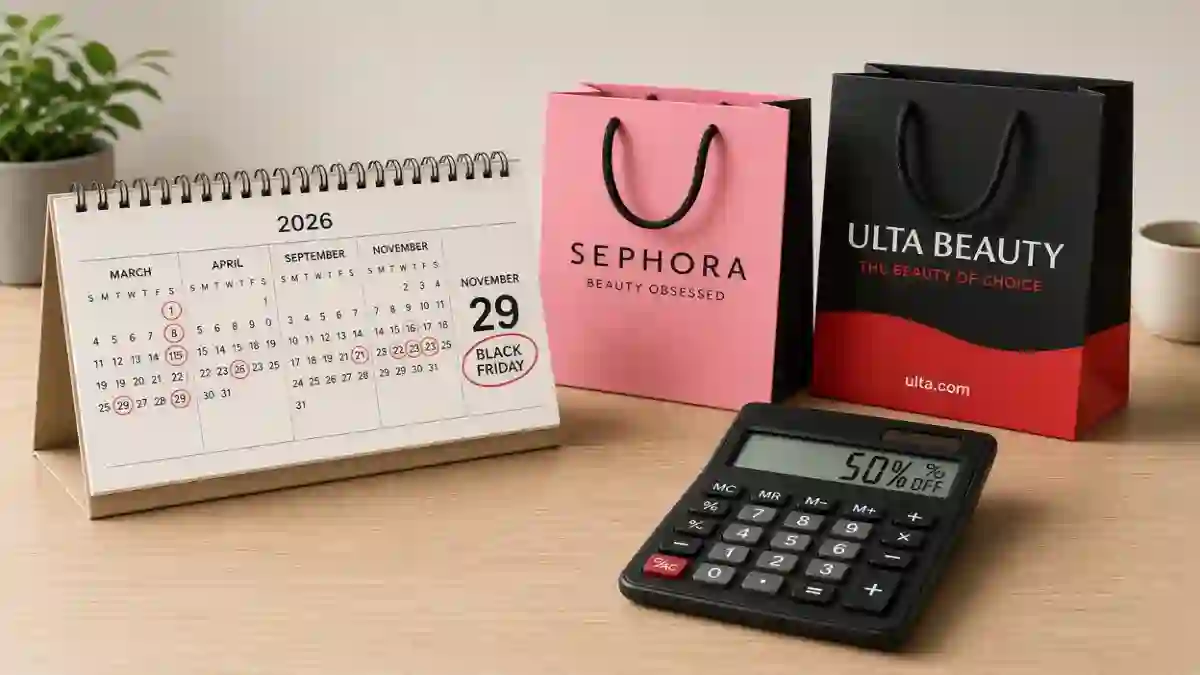
The sales are cyclical, not random. Ulta’s biggest event happens twice a year, in March and September . Sephora’s biggest sitewide discount happens in April and November . Black Friday and Cyber Monday are universal. Once you internalize the rhythm, you can plan around it.
The loyalty programs are where the real value hides. Ulta points are effectively cash. Sephora points are effectively samples and experiences. The strategy for each is different . We’ll get into that.
What this means for you: If you need a product today, you’re going to pay full price. That’s the cost of poor planning. If you can wait a few weeks or a couple of months, you can almost always get a discount. The key is knowing how long you have to wait.
Ulta’s Big Guns: 21 Days of Beauty and the Semi-Annual Event
Ulta’s most famous sale is the 21 Days of Beauty. It used to happen twice a year, in March and September, and it lasted for three weeks . The format was simple: every day, a new set of “Beauty Steals” went live at 50% off . Over 250 products across the three weeks. Some days were duds. Some days were the entire reason you waited.
The catch: The daily steals are only available for 24 hours, from midnight to midnight Central Time . If you slept on a day, you missed it. The best strategy was to preview the calendar, circle the days you cared about, and set an alarm.
The update: Ulta has since evolved the 21 Days of Beauty into the Semi-Annual Beauty Event . The format is similar—deep discounts on a rotating schedule, twice a year, in spring and fall—but it now includes more categories and occasional deals on staples like shampoo and conditioner pairs. If you see “21 Days of Beauty” branding, it’s the same DNA. If you see “Semi-Annual Beauty Event,” it’s the current iteration. Either way, it’s the single best time to buy high-end makeup and skincare at Ulta.
What to buy during this event: Prestige skincare (Elemis, Lancôme, Clinique), high-end makeup (Benefit, Tarte), and hair tools (Dyson, Shark) . These are the products that almost never go on sale otherwise. A 50% off Beauty Steal on a $60 serum is the difference between a splurge and a smart purchase.
What to skip: Drugstore brands. Ulta carries mass-market lines like Maybelline and L’Oréal, but those brands are frequently on sale at drugstores and Target. You don’t need to burn a Beauty Steal day on a $10 mascara.
Sephora’s Playbook: The Savings Event and Rouge Perks
Sephora’s model is different. They don’t do daily rotating steals the way Ulta does. They do sitewide percentage-off events a few times a year, and the discount depends on your loyalty tier.
The Savings Event: This is Sephora’s biggest sale. It typically happens in April and November . The discount is tiered:
- Insider (free to join): 10% off .
- VIB ($350 annual spend): 15% off .
- Rouge ($1,000 annual spend): 20% off .
The catch: The discount applies to almost everything sitewide, including prestige brands that rarely go on sale. But the best discount—20%—is reserved for Rouge members. If you’re not Rouge, you’re looking at 10-15%. That’s still better than full price, but it’s not the 50% off you might see at Ulta.
The strategy: If you buy a lot of prestige skincare and fragrance, Sephora’s Rouge tier is worth aiming for. The 20% sitewide discount on a $200 fragrance is $40 back in your pocket. If you buy a mix of drugstore and prestige, Ulta’s points system is usually more valuable .
What to buy at Sephora during the Savings Event: Fragrance. Sephora has the best fragrance selection, and the sitewide discount applies to almost everything. Also: prestige skincare bundles and holiday gift sets. The discount stacks with the value of the set.
What to skip: Sephora Collection. The house brand is decent, but it’s frequently on sale outside of the Savings Event. Don’t waste your 20% on a $10 eyeliner.
The Loyalty Math: Points vs. Prestige
This is the part most people get wrong. They join both programs, collect points randomly, and never redeem them for maximum value. Here’s the honest breakdown.
Ulta Beauty Rewards: Ulta points are cash. 100 points = $3 off. But the value increases at higher redemption levels. If you save up to 2,000 points, they’re worth $125 . That’s roughly 6.25 cents per point, versus 3 cents at the 100-point level. The lesson: don’t redeem your Ulta points until you hit a higher tier. Let them accumulate.
Ulta’s tiers: Platinum ($350 spend) gives you 1.25 points per dollar and early sale access. Diamond ($1,200 spend) gives you 1.5 points per dollar, free shipping on orders over $25, and an annual $25 beauty service reward . If you’re a regular Ulta shopper, Diamond is the sweet spot.
Sephora Beauty Insider: Sephora points are not cash. 500 points gets you $10 off (Beauty Insider Cash). The rest of the value is in the Rewards Bazaar—deluxe samples, trial sets, and “money-can’t-buy” experiences . If you want cash back, Ulta wins. If you want to try expensive products before committing, Sephora wins.
The verdict: Use Ulta for your staples. Use Sephora for prestige skincare and fragrance. Don’t try to force one to be the other.
The Black Friday and Holiday Gauntlet
Black Friday is the wild card. Both retailers participate, but the format is different.
Ulta’s Early Black Friday: Starts in late October and runs through November, with new deals added weekly . The discounts are “up to 50% off,” but they’re spread across categories—makeup, skincare, hair tools, fragrance, wellness. It’s not a single sitewide discount. It’s a rotating set of offers.
Sephora’s Black Friday: Sephora typically runs a smaller Black Friday event, often focused on specific categories or value sets rather than a sitewide discount. The Savings Event in November is usually the bigger deal for prestige products.
The holiday gift sets: This is where both retailers shine. Holiday sets are often priced lower than buying the individual products, and they frequently include deluxe samples or travel sizes. If you’re shopping for gifts—or for yourself—the holiday season is the best time to buy value sets. But don’t buy a set just because it’s a “deal.” Check the price per ounce against the full-size product. Sometimes the set is a markup, not a markdown .
The Monthly and Quarterly Checkpoints
You don’t need to monitor sales every day. That’s exhausting and counterproductive. You need a rhythm.
Monthly (5 minutes): Look at your empties. What’s about to run out in the next six to eight weeks? Write it down. Check if any of those items are likely to be in an upcoming sale. If your moisturizer is running low and Ulta’s Semi-Annual Event is in three weeks, wait. If the event is in three months, buy it now and accept the full price .
Quarterly (15 minutes): At the start of each season, review your categories. Winter is for rich moisturizers and repair masks. Spring is for lighter textures and sunscreen. Summer is for after-sun care and lightweight makeup. Fall is for hair repair and cozy fragrances . Align your purchases with the seasonal sales. If you need a heavy cream, buy it in the fall or winter when the sales are focused on those categories.
The “never buy” list: Never buy a new product at full price if you can wait two weeks. Never buy a backup of a product you haven’t finished. Never buy something just because it’s on sale. A sale is only a deal if you were going to buy the product anyway.
The “Stacking” Strategy: How to Layer Savings
The best savings don’t come from a single discount. They come from stacking.
Layer 1: The Sale. Wait for the 50% off Beauty Steal or the 20% off Sephora Savings Event.
Layer 2: The Loyalty Points. Use your Ulta points or Sephora points on top of the sale price. Ulta points are cash, so they reduce your total. Sephora points can be redeemed for samples, which means you get more product for the same price .
Layer 3: The Cashback. Use a cashback app like ShopBack or Rakuten before you check out. Both Ulta and Sephora are on these platforms, and the cashback stacks on top of the sale and the points .
Layer 4: The Credit Card. If you have the Ulta Mastercard or Sephora Visa, you earn points or cashback at the card level. This stacks on top of everything else. Just pay off the balance in full .
The result: A 50% off Beauty Steal + Ulta points + 5% cashback + 2% card rewards can bring the effective price down by 60-70%. That’s how you pay less than full price without waiting for a single massive discount.
The Math: What I Saved by Waiting
Let me show you the actual numbers from my own calendar.
The product: A $68 prestige serum.
Full price purchase (January): $68. I bought it because I ran out. I paid the ceiling.
Ulta 21 Days of Beauty (March): The same serum was a Beauty Steal at 50% off. I bought two. $68 for two bottles, or $34 each.
Sephora Savings Event (April): The same serum was 20% off for Rouge. $54.40. Still better than full price, but not as good as Ulta.
Black Friday (November): The serum was part of a value set with a full-size moisturizer. $75 for both. The moisturizer alone retails for $45. I effectively got the serum for $30.
The total savings: Over the course of a year, by waiting for the right sale and buying in multiples, I paid an average of $35 per bottle instead of $68. That’s a 48% savings on a single product. Multiply that across my entire routine, and it’s hundreds of dollars a year.
📌 YOU MIGHT ALSO LIKE:
The $100 Nordstrom Rack Capsule: How to Score High-End Brands on a Tight Budget
How to Shop the Nordstrom Anniversary Sale Without Early Access (and Still Get the Best Deals)
Frequently Asked Questions (FAQ)
1. When is the best time to shop at Ulta?
The best time is during Ulta’s Semi-Annual Beauty Event (formerly 21 Days of Beauty), which happens in March and September. It features daily 50% off Beauty Steals on high-end brands. Black Friday and Early Black Friday are also strong for specific categories .
2. When is the best time to shop at Sephora?
The best time is during the Sephora Savings Event, which typically happens in April and November. The discount is tiered based on your loyalty status: 10% for Insiders, 15% for VIB, and 20% for Rouge .
3. Are Ulta points better than Sephora points?
For cash value, yes. Ulta points are effectively cash. 100 points = $3 off, and the value increases at higher redemption levels. Sephora points are better for samples and exclusive experiences. If you want money back, use Ulta. If you want to try expensive products, use Sephora .
4. Do Ulta and Sephora have Black Friday sales?
Yes. Ulta runs an extended Early Black Friday event starting in late October, with new deals weekly. Sephora typically runs a smaller Black Friday event, often focused on value sets and specific categories .
5. Can I stack coupons with sale prices?
Generally, no. Beauty Steals and Sephora Savings Event discounts usually cannot be combined with other percentage-off coupons. However, you can stack loyalty points, cashback, and credit card rewards on top of the sale price .
6. What should I buy at Sephora vs. Ulta?
Use Ulta for your everyday staples (skincare, drugstore makeup, hair care) because of the cash-value points. Use Sephora for prestige skincare, fragrance, and exclusive brands that Ulta doesn’t carry. If a product is sold at both, compare the sale price and the loyalty value on the day you buy .
7. Is it worth waiting for a sale to buy a product I need now?
Only if you can wait. If you’re out of moisturizer, buy it. The $10 you save by waiting two weeks isn’t worth the discomfort of dry skin. But if you’re buying a backup or trying a new product, wait for the sale .
8. How often do these sales happen?
Ulta’s big event is twice a year (spring and fall). Sephora’s Savings Event is twice a year (April and November). Black Friday is once a year. Ulta also runs smaller promotions and points multipliers throughout the year, but the big events are the ones worth planning around .
Final Thoughts: The Best Time to Buy Is When You’re Ready
The calendar isn’t a magic trick. It’s a tool. It tells you when to wait and when to buy. It stops you from panic-buying at full price because you forgot to check the sale schedule.
The calendar:
- March & September: Ulta Semi-Annual Event (50% off Beauty Steals).
- April & November: Sephora Savings Event (10-20% off sitewide).
- Late October through November: Ulta Early Black Friday (weekly deals).
- December: The best month for promo codes across all beauty retailers .
That’s it. Four windows. Plan your purchases around them.
I’ve been using this calendar for two years. My bathroom cabinet is stocked. My skin is happy. And I haven’t paid full price for a prestige product in months.
That’s not cheap. That’s smart.
That’s the frugal glow. And it’s waiting for you on the calendar. 💄💛
*For more budget beauty strategies, sale calendars, and money-saving shopping guides, visit The Frugal Glow.*