

Why I’m Bulk-Buying These 3 ‘Drugstore’ Skincare Basics Before the Price Jump
Let me tell you about the moment I became a skincare prepper.
It was 11 PM. I was doom-scrolling through the news, like the responsible adult I am, when I stumbled on an article that made me sit straight up in bed. My husband groaned. I didn’t care.
The headline said something like: “Cosmetics prices expected to jump 6-10% due to oil shortage.”
I read it three times. Then I read another article. And another. And then I realized what was happening.
You know how everything is getting more expensive? Eggs, gas, rent, the weird little carton of raspberries that costs $7 now? Well, skincare is next. And not just the fancy $80 serums at Sephora. I’m talking about the drugstore basics. The stuff we actually use every single day.
Here is the connection nobody is talking about: Your moisturizer is made from oil.
Not literally. You’re not smearing crude oil on your face. But petroleum derivatives—mineral oil, petroleum jelly (Vaseline), glycerin, silicones, glycols—are in almost every skincare product you own. And crude oil prices are going up because of supply disruptions in the Middle East.
An industry expert from New Directions Australia explained it simply: “Crude oil, after extraction, is refined into petrochemical derivatives that require further chemical processing to become cosmetic ingredients.” These include glycerine, petroleum jelly, mineral oil, silicones, and glycols.
Translation: When oil prices go up, your face wash goes up.
A cosmetics industry expert told Izvestia that cosmetics could rise in price by 6-10% in 2025-2026. The reasons? “Increase in the cost of packaging and logistics, inflationary pressures, as well as currency fluctuations, as some components and raw materials remain imported.”
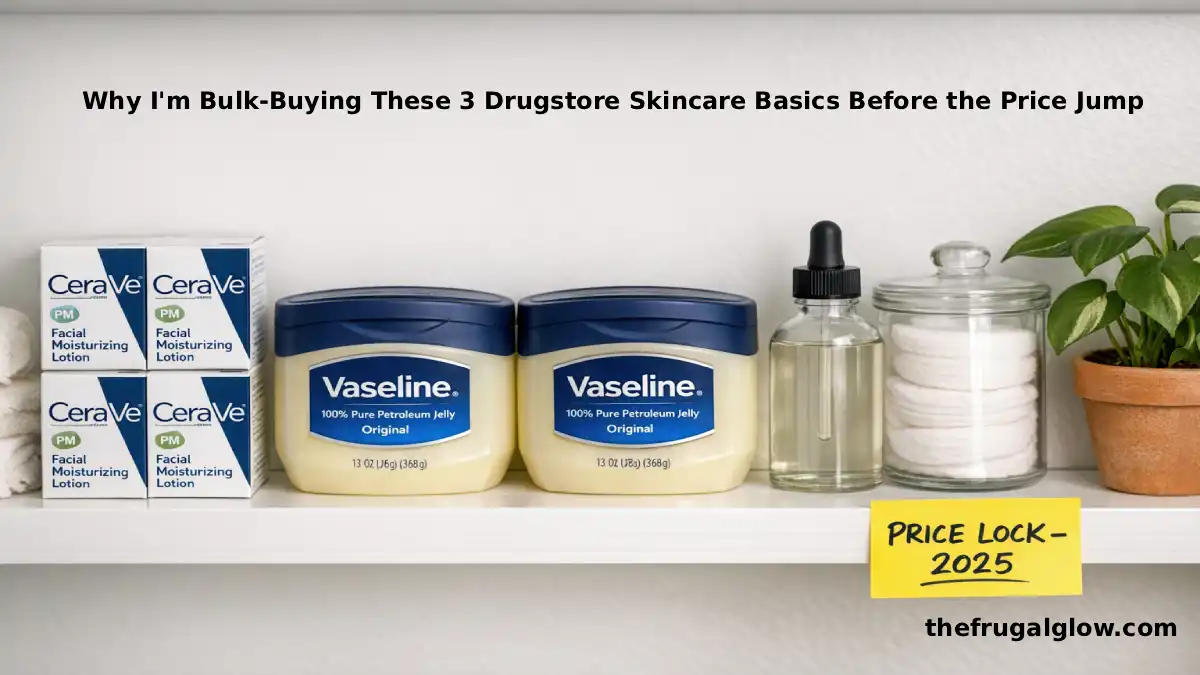
So here is what I did. I went to Target. I went to CVS. I went to Amazon. And I bought three specific skincare basics in bulk. Not because I’m a hoarder. Because I’m a mom on a budget who refuses to pay $18 for something that cost $12 last month.
Today, I’m going to tell you exactly which three products are worth stockpiling, why they’re about to get expensive, and how to store them so they last for years.
Let’s get into it.
Jump Links
- The Oil Connection: Why Your Skincare Is Tied to Gas Prices
- Product #1: CeraVe PM Facial Moisturizing Lotion (The Ceramide King)
- Product #2: Vaseline Petroleum Jelly (The Original 100% Petroleum Product)
- Product #3: Mineral Oil (The Unsung Hero of Makeup Removal)
- How to Store Skincare for Long-Term Bulk Buying
- What NOT to Bulk Buy (And Why)
- The Dupes Strategy: When to Swap and When to Stock Up
- Frequently Asked Questions (FAQ)
The Oil Connection: Why Your Skincare Is Tied to Gas Prices
Let me break this down in a way that doesn’t require a chemistry degree.
Step 1: Crude oil is extracted from the ground.
Step 2: It gets refined into petrochemicals.
Step 3: Those petrochemicals become ingredients like:
- Glycerin (in almost every moisturizer and cleanser)
- Petroleum jelly (Vaseline, Aquaphor, CeraVe Healing Ointment)
- Mineral oil (in body oils, makeup removers, some lotions)
- Silicones (in primers, serums, hair products)
- Glycols (in toners, mists, and hydrating serums)
Step 4: Those ingredients go into your $12 bottle of drugstore lotion.
Now, here is the problem. There are supply chain disruptions in the Middle East affecting crude oil availability. Even if the situation stabilizes soon, the damage is done. “Higher prices for petroleum-derived raw materials have already flowed through and will take months to normalise.”
Sebastien Jagut, procurement manager at New Directions Australia, said: “In addition, we are seeing freight surcharges introduced by distributors… reflecting the increased cost of transporting goods.” He warned that “delays, reduced availability, and longer lead times are becoming increasingly likely.”
Amina Kitching, founder of LOAEL global beauty group, added: “The cost of raw materials and plastic packaging has hit record highs, making the production of lipstick, creams and plastic containers significantly more expensive.”
So not only are the ingredients more expensive, the bottles are more expensive too. Because plastic is also made from oil.
This is not a drill, folks.
Product #1: CeraVe PM Facial Moisturizing Lotion (The Ceramide King)
This is the first product I bought in bulk. I have six bottles in my closet right now. I am not embarrassed.
Why this product: CeraVe PM is widely considered one of the best drugstore moisturizers on the market. It’s lightweight, non-comedogenic (won’t clog pores), and packed with three essential ceramides, hyaluronic acid, and niacinamide.
Cosmetic chemists have noted that CeraVe’s formulations “replicate the core philosophy” of luxury moisturizers like SkinCeuticals Triple Lipid Restore ($137) for a fraction of the cost. One analysis called CeraVe PM an effective alternative that delivers “comparable hydration and barrier repair” despite being less emollient.
Dermatologists frequently recommend CeraVe PM “for its simplicity, affordability, and proven efficacy in clinical settings.”
Why it’s vulnerable to price hikes: CeraVe PM contains petrolatum (a petroleum derivative), glycerin (petroleum-derived), and comes in a plastic bottle. Triple whammy. Every single component is tied to oil prices.
Current price: Around $12-14 for 3 ounces at Target or Amazon.
Predicted price after jump: Could hit $16-18.
My bulk-buy strategy: I bought six bottles. At my current usage (one bottle every 6-8 weeks), that’s about a year’s supply. I paid $12 each. If prices go up to $16, I just saved $24. If they go up to $18, I saved $36.
How to store it: Keep it in a cool, dark place. A bedroom closet is perfect. Not the bathroom (humidity degrades formulas). Not the fridge (temperature fluctuations cause separation). Just a shelf away from sunlight.
Pro tip: The regular CeraVe Moisturizing Cream (the one in the tub) is also great. But the PM version has niacinamide, which brightens skin and helps with redness. If you can only buy one, get the PM.
Product #2: Vaseline Petroleum Jelly (The Original 100% Petroleum Product)
This one is obvious. Vaseline is 100% petroleum jelly. It is literally refined crude oil.
Why this product: Vaseline is the ultimate multitasker. I use it for:
- Chapped lips (better than any $15 lip mask)
- Dry cuticles (my winter savior)
- Under-eye moisturizer (slugging for the under-eyes)
- Healing minor scrapes on my kids (pediatrician approved)
- Locking in moisture over my nighttime moisturizer (“slugging”)
- Taming flyaway eyebrows
- Protecting skin from windburn
There’s a reason Vaseline has been around for over 150 years. It works. And it costs almost nothing.
Why it’s vulnerable to price hikes: Because it IS petroleum. When crude oil prices go up, Vaseline prices go up. Directly. Immediately. No middleman.
Current price: The 13-ounce tub is around $8-10. The 1.75-ounce lip therapy tub is around $3.
Predicted price after jump: Could hit $11-13 for the large tub.
My bulk-buy strategy: I bought two of the 13-ounce tubs. That might sound like a lot. It’s not. Vaseline never expires (more on that below). I use it daily. A single 13-ounce tub lasts me about 8 months. Two tubs is a 16-month supply.
How to store it: Vaseline is practically immortal. It doesn’t go bad. It doesn’t need special storage. Just keep the lid on tight so dust doesn’t get in. Room temperature is fine. A bathroom cabinet is fine. A hot car is fine (though it might get melty). Vaseline does not care.
Pro tip: The name-brand Vaseline is worth it. Generic petroleum jelly works the same, but the name brand has been purified more thoroughly. For something you put on your face, spend the extra dollar.
5 Ulta Beauty Deals Under $15 That Perform Exactly Like High-End Luxury
Product #3: Mineral Oil (The Unsung Hero of Makeup Removal)
This is the product nobody talks about, and that’s exactly why you need to stock up now.
What is mineral oil: A colorless, odorless oil derived from petroleum. It’s the main ingredient in many makeup removers, cleansing oils, body oils, and hair oils.
Why this product: Mineral oil is the most effective, gentlest makeup remover I have ever used. It dissolves waterproof mascara in seconds. It doesn’t sting your eyes. It doesn’t strip your skin. And it costs almost nothing.
Here is the secret: A bottle of “facial cleansing oil” from a trendy brand costs $25-35. The ingredients are mostly mineral oil plus some fragrance and emulsifiers. Or you can buy a bottle of pure mineral oil from the drugstore for $4 and use it the exact same way.
I use mineral oil every night as my first cleanse. I put a few drops on my dry face, massage it in to dissolve makeup, and then wipe it off with a warm damp cloth. Then I follow with my regular face wash. My skin has never been clearer.
Why it’s vulnerable to price hikes: It’s pure petroleum. The same supply chain issues that affect Vaseline affect mineral oil.
Current price: A 16-ounce bottle of mineral oil from CVS or Walgreens is around $4-6. The same amount in a “cleansing oil” from Sephora would be $30-40.
Predicted price after jump: Could hit $7-9.
My bulk-buy strategy: I bought four 16-ounce bottles. That sounds excessive. But I go through a bottle every 3-4 months. Four bottles is a year’s supply. At $4 each, I spent $16. If prices double, I just saved $16. That’s not life-changing. But it’s also not nothing.
How to store it: Mineral oil is very stable. Keep it in a cool, dark place. It doesn’t freeze well (it gets cloudy but thaws fine). A closet shelf is perfect. Do not store it in direct sunlight—light can degrade the plastic bottle.
Pro tip: Look for mineral oil in the laxative section of the drugstore. Seriously. It’s sold as a gentle laxative. It’s the exact same product as “cosmetic grade” mineral oil, but it costs half as much. The bottle will say “mineral oil USP” which means it’s pure and safe for human use. This is a frugal life hack that dermatologists actually recommend.
How to Store Skincare for Long-Term Bulk Buying
You can’t just throw everything in a bin under your sink and forget about it for two years. Skincare has enemies: heat, light, air, and humidity.
Here is my storage system. Copy it.
The Golden Rules:
1. Cool is better than cold.
Room temperature (65-72°F) is ideal. A bedroom closet is perfect. An uninsulated garage is terrible (temperature swings degrade formulas). A bathroom cabinet is not ideal (showers create humidity and heat).
2. Dark is better than light.
Sunlight degrades many skincare ingredients, especially things in clear bottles. If a product comes in an opaque bottle or tube, that’s a good sign. If it’s in a clear bottle, put it in a drawer or box.
3. Air is the enemy.
Once you open a product, air gets in and starts oxidizing ingredients. This is why my bulk-buy strategy only works for products I will open within the next 12-18 months. Unopened, sealed products last much longer.
4. Check expiration dates.
Most unopened skincare products have a shelf life of 2-3 years from the manufacturing date. Look for a little jar icon on the back with a number like “12M” (12 months after opening). That’s the PAO (Period After Opening). Unopened products last longer than that.
Specific Storage Guidelines:
| Product | Unopened Shelf Life | Opened Shelf Life | Storage Notes |
|---|---|---|---|
| CeraVe PM | 2-3 years | 12 months | Keep cool, away from bathroom humidity |
| Vaseline | Indefinite | Indefinite | Practically immortal; just keep lid clean |
| Mineral oil | 3-5 years | 2-3 years | Very stable; avoid light exposure |
The “First In, First Out” System:
When you bulk buy, organize your stash so you use the oldest products first. Put your new bottles at the back of the shelf and bring the older ones to the front. This is the same system restaurants use. It works.
What About the Fridge?
Some people put skincare in the refrigerator. Don’t do this unless the product specifically says to. Temperature fluctuations from taking it in and out of the fridge can cause separation. Plus, cold product doesn’t absorb as well into skin. Just keep it in a cool closet.
The Target Dollar Spot Haul: 10 Hidden Gems You Need to Grab This Week
What NOT to Bulk Buy (And Why)
I am not telling you to stockpile every single skincare product you own. Some things are not worth bulk-buying.
1. Vitamin C serums.
Vitamin C is famously unstable. It oxidizes quickly, turning from clear to orange to brown. An oxidized vitamin C serum doesn’t work and can even irritate your skin. Only buy vitamin C serums that you will use within 3-6 months.
2. Sunscreen.
Sunscreen has a shelf life of about 3 years unopened, and the SPF protection degrades over time. A sunscreen that expired last year might not protect you from UV rays. Buy enough for one summer plus a little extra. Don’t buy a five-year supply.
3. Products with “natural” preservatives.
The “clean beauty” movement has pushed brands to use weaker preservatives. These products expire faster. If a product says “paraben-free” and “preserved with natural ingredients,” it might only last 6-12 months. Don’t bulk buy these.
4. Anything with water as the first ingredient (which is most things).
Water-based products are more prone to bacterial growth. Once opened, they have a shorter lifespan. The dry, oil-based, or petroleum-based products I recommended above are much more stable.
5. Products you haven’t tried before.
Do not bulk buy something you’ve never used. You might hate it. You might be allergic to it. Buy one bottle first. Use it for two weeks. Then decide if you want more.
The Dupes Strategy: When to Swap and When to Stock Up
Here is the thing about the upcoming price hikes: They will affect ALL petroleum-based products, not just the drugstore brands. That $80 luxury serum contains the same petroleum-derived glycerin as the $12 drugstore serum.
But some products are better “dupes” than others. If your favorite product is about to get expensive, here is how to find a cheaper alternative before the price jump.
What is a dupe? A product that has similar ingredients and performance to a more expensive product, at a lower price point. The skincare market is full of effective dupes that use the same active ingredients without the fancy packaging or marketing budget.
The Best Skincare Dupes to Consider:
| Luxury Product | Price | Drugstore Dupe | Price | Key Similarity |
|---|---|---|---|---|
| SkinCeuticals Triple Lipid Restore | $137 | CeraVe PM Lotion | $12 | Ceramides, barrier repair |
| Glossier Super Pure | $22 | The Ordinary Niacinamide 10% + Zinc 1% | $6 | Niacinamide for oil control |
| Drunk Elephant A-Passioni Retinol | $74 | The Inkey List Retinol | $11 | 1% retinol in squalane |
| Laneige Lip Mask | $24 | Trader Joe’s Vanilla Lip Mask | $6 | Hydrating lip treatment |
| Supergoop! Sunscreen | $38 | Trader Joe’s Daily Facial Sunscreen | $9 | Lightweight SPF |
| Clinique Black Honey Lipstick | $25 | e.l.f. Hydrating Core Lip Shine | $7 | Sheer berry tint |
The “Clean Beauty” Warning:
Some people are hoping that rising petroleum costs will push the industry toward “greater adoption of sustainable alternatives.” That sounds nice in theory. In practice, “clean beauty” products without petroleum-based preservatives have shorter shelf lives and are harder to store long-term.
Amina Kitching, a beauty industry researcher, said she hopes the price hikes will push the industry toward “sustainable and reusable packaging options” and that “people need to learn to live without petrochemicals.”
I respect that sentiment. But I also live in the real world where I need my moisturizer to work and my makeup remover to remove makeup. For now, I’m sticking with the petroleum-based staples that work, last, and cost almost nothing.
Restock Alert: 5 Essential Skincare Basics to Bulk-Buy Now to Save Money
The Night I Became a Skincare Prepper
I want to tell you about the night I bought my six bottles of CeraVe.
It was a Thursday. The kids were asleep. I was standing in the skincare aisle at Target at 9:30 PM, holding two bottles of CeraVe PM in each hand, trying to do the mental math of “how much is too much?”
A Target employee walked by and asked if I needed help.
I said, “No, I’m just trying to figure out if buying six moisturizers makes me insane.”
She looked at my cart. She looked at the shelf. She grabbed a bottle and handed it to me.
“Honey,” she said, “I’ve worked here for eight years. I remember when this stuff was $9. Last week it went up to $13. Buy the six.”
I bought the six.
And you know what? She was right. When I checked online last month, the price had gone up another dollar.
This is not about being paranoid. This is about being smart. The supply chain is fragile. The world is unpredictable. And your face wash doesn’t need to cost $20.
The three products I’m bulk-buying—CeraVe PM, Vaseline, and mineral oil—are the workhorses of my skincare routine. They are affordable, effective, and stable. They do not go bad. They do not need refrigeration. They sit in my closet, waiting patiently, while prices climb around them.
I am not a prepper. I am a mom with a Costco card and a Google alert for “petroleum prices.” And I refuse to pay more than I have to for the privilege of having moisturized skin.
You don’t have to buy six bottles of anything. Buy two. Buy three. Buy whatever fits your budget and your storage space. But buy something. Because prices are going up. And the best time to buy was yesterday.
Frequently Asked Questions (FAQ)
Q: Is this “price jump” real or just fear-mongering?
It’s real. Multiple industry sources have confirmed that crude oil supply disruptions are affecting the cost of petroleum-derived cosmetic ingredients. An expert from Avon Russia predicted a 6-10% price increase in 2025-2026. Whether that exact number materializes or not, prices are trending up. Buying now locks in current prices.
Q: How much should I actually buy?
A 6-12 month supply is reasonable for most people. Don’t go overboard. You don’t need a five-year supply. For CeraVe PM, that’s 6-8 bottles. For Vaseline, 2 large tubs. For mineral oil, 3-4 bottles. Adjust based on how fast you use products.
Q: Can I bulk buy other drugstore brands like Cetaphil or La Roche-Posay?
Yes, with caveats. Cetaphil contains similar petroleum-derived ingredients and will also be affected. La Roche-Posay’s Cicaplast Baume B5 is a fantastic product but check its expiration date before bulk buying. The same rules apply: look for stable formulas, avoid products with short shelf lives, and store everything properly.
Q: What about Trader Joe’s skincare dupes? Should I buy those instead?
Trader Joe’s has some excellent affordable skincare options, including a popular $5-6 vanilla lip mask that fans compare to Laneige’s $24 version. They also offer facial sunscreens that are solid budget alternatives to Supergoop! However, board-certified dermatologist Dr. Brendan Camp notes that “ingredient similarity on a label does not always translate to equivalent performance.” For basic hydration and sun protection, TJ’s products are great. But don’t assume every viral dupe is identical to the luxury original.
Q: How long do unopened skincare products really last?
Most unopened products last 2-3 years from the manufacturing date. Vaseline and pure mineral oil last longer—essentially indefinitely if stored properly. Products with active ingredients like vitamin C or retinol have shorter shelf lives. Always check for a “period after opening” symbol (a little jar icon with a number like “12M”). That’s how many months the product lasts once opened. Unopened, it lasts longer.
Q: I’m on a tight budget. What’s the single most important product to buy now?
Vaseline. It costs $8-10 for a tub that lasts a year. It has dozens of uses. It will never expire. And it is 100% petroleum, so it is the most directly impacted by oil price changes. A $10 tub of Vaseline is a better investment than a $15 bottle of fancy lotion that will expire in 12 months. Start with Vaseline. Then add mineral oil. Then add CeraVe if your budget allows.
Q: Will “clean beauty” products avoid these price hikes?
No. “Clean beauty” products still need packaging (plastic), shipping (fuel), and often contain plant-based oils that are also affected by supply chain disruptions. Some ingredients might even be more expensive because they aren’t produced at the same massive scale as petroleum derivatives. The idea that “natural” products are immune to inflation is a myth.
Q: Is it ethical to bulk buy if supply is limited?
This is a fair question. I’m not advocating for hoarding or buying every bottle on the shelf. Buy what you will reasonably use in the next year. Leave products for other people. The goal is to protect your own budget, not to create a shortage. Be a smart shopper, not a shelf-clearer.
Q: What about products that aren’t petroleum-based? Should I switch?
If you can find effective alternatives that work for your skin and fit your budget, go for it. But don’t assume that “petroleum-free” means “immune to price hikes.” All consumer goods are affected by inflation, supply chain issues, and increased transportation costs. The best strategy is to buy what works for you, at the best price you can find, today.
Q: I already have a stockpile. How do I organize it?
Use the “first in, first out” system. Put newer products at the back of your storage area and older products at the front. Write the purchase date on each bottle with a Sharpie. Check your stash every few months to rotate products and make sure nothing is expired. A little organization goes a long way.
The Bottom Line
You don’t need to panic. You don’t need to spend $500 at CVS. But you should pay attention.
The connection between crude oil and your moisturizer is real. The supply chain is stressed. The prices are trending up. And the best time to buy the basics is before the jump, not after.
CeraVe PM. Vaseline. Mineral oil.
Those three products cost me about $50 total for a year’s supply. Fifty dollars. That’s two takeout dinners. That’s one trip to Target where you walk out with a candle you didn’t need and a bag of pretzels.
If I’m wrong and prices stay flat? I have a year’s worth of moisturizer. I’ll use it. No harm done.
If I’m right? I just saved $30-50. And I don’t have to think about buying moisturizer again until 2026.
That’s not hoarding. That’s foresight.
Now go check your bathroom cabinet. See what’s running low. And maybe buy an extra bottle of CeraVe before everyone else figures out what’s happening.
Your face will thank you. Your wallet will thank you. And next year, when your friend complains about $18 drugstore moisturizer, you can smile and say, “I bought mine last year.”
This article was written with spreadsheet-level price tracking, three news alerts for “petroleum prices,” and a very understanding husband who stopped asking why there are six bottles of moisturizer in the hall closet.
Proudly published by The Frugal Glow — where we believe that taking care of your skin shouldn’t require taking out a loan. Smart shopping, strategic stockpiling, and never paying full price for something you can buy on sale. Keep glowing, keep saving, and keep one step ahead of the price hikes.