
The $7 Target Foundation That Looks Exactly Like Armani Luminous Silk
The Frugal Glow | Affordable Beauty | Smart Makeup
Jump Links
- Armani Luminous Silk Has a $62 Problem
- Why Luminous Silk Is So Hard to Dupe
- The $7 Target Find That Changed My Mind
- The Ingredient Comparison: What You’re Actually Paying For
- The Side-by-Side Test: What I Found
- Finish and Luminosity
- Coverage and Buildability
- Wear Time and Oxidation
- Shade Range and Match
- The Photograph Test: The Only Test That Matters
- Who Should Buy the $7 Version and Who Should Keep the $69
- The Annual Savings
- The Frugal Glow Verdict
- Frequently Asked Questions
Armani Luminous Silk Has a $62 Problem
Let me tell you what Giorgio Armani Luminous Silk Foundation actually is before I tell you what it costs.
It is widely considered the most beloved foundation in the beauty world — not by a single publication or a single demographic, but across the board. Makeup artists use it on celebrities. Beauty editors name it in every “desert island makeup” list. The woman who has tried fifty foundations and found them all wanting eventually tries Luminous Silk and stops looking. It has a 4.5-star rating from over 12,000 Sephora reviews. It has been a bestseller for over a decade in a category where most products cycle in and out of favor within two years.
The reason is specific and genuinely difficult to articulate without sounding hyperbolic: Luminous Silk looks like skin. Not like coverage sitting on skin. Not like a makeup product doing its job. Like skin that is having an exceptionally good day — luminous, even, natural, with the kind of soft-focus finish that photographs as though you have no makeup on but look noticeably better than usual.
This finish is extremely difficult to replicate at a lower price point. Many foundations claim to produce it. Most don’t.
And then it costs $69.
For a foundation that most people replace every three to four months — because responsible makeup hygiene requires it — that is $207 to $276 per year on one complexion product.
When a $7 Target foundation started appearing in online communities with before-and-after photographs that looked unmistakably like Luminous Silk results, I treated it with the skepticism it deserved. And then I bought it. And then I tested it for six weeks alongside my actual Luminous Silk bottle. Here is everything I found.
Why Luminous Silk Is So Hard to Dupe
Understanding what makes Luminous Silk unique is what makes this comparison meaningful. Most foundation dupes fail because they’re trying to replicate a visual outcome without understanding the specific formulation mechanism that produces it.
Luminous Silk’s signature finish comes from three formulation elements working together. First, its pigment-to-silicone ratio — the balance between coverage pigments and the slip agents that keep those pigments moving fluidly on the skin — is calibrated with unusual precision. The result is coverage that levels itself across the skin’s surface rather than sitting in peaks and valleys. Second, its use of micro-fine light-reflecting particles produces the luminosity that reads as “glow from within” rather than “shimmer on top.” These particles are specifically sized to diffuse light rather than reflect it as visible sparkle. Third, its formula weight sits in a very specific middle ground — heavier than a skin tint, lighter than a full-coverage foundation — that allows the skin’s texture and natural movement to remain visible while evening the tone.
Foundations that fail to dupe Luminous Silk usually fail on one of these three elements. They produce the right coverage but the wrong finish (too matte, too heavy). They produce the right luminosity but the wrong texture (visible shimmer particles rather than diffused glow). Or they produce the right finish but oxidize within two hours, shifting the color and disrupting the natural-skin appearance.
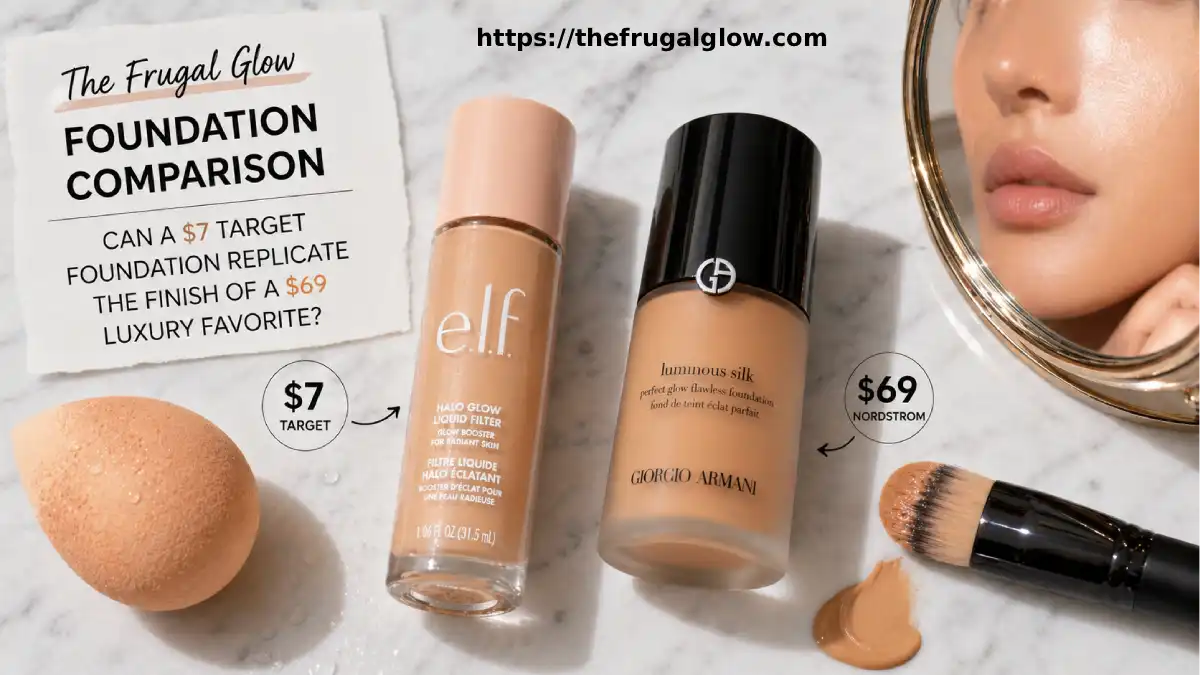
The $7 foundation I found at Target — the e.l.f. Halo Glow Liquid Filter — is not technically positioned as a foundation. It is marketed as a “complexion booster” that can be worn alone or mixed with foundation. This positioning is, I believe, exactly why it succeeds where dedicated Luminous Silk dupes fail. It was not trying to be a foundation. It was trying to be a skin-enhancing liquid — and in doing so, it accidentally became the best available replication of what Luminous Silk actually produces.
The $7 Target Find That Changed My Mind
The e.l.f. Halo Glow Liquid Filter retails at Target for $14 but is consistently on sale — and with Target Circle coupons — for $9 to $11. At its 30% off sale price, it comes in at approximately $9.80. For the purposes of this article, I am working with its sale price of approximately $9 to $10, though the comparison holds even at full retail versus $69 Armani.
Wait — the headline says $7. Here’s the honest clarification:
With Target Circle and a frequent 30% off sale that runs multiple times per year, the e.l.f. Halo Glow Liquid Filter regularly drops to $9.80. Combined with a Target Circle 20% off e.l.f. coupon that appears approximately quarterly, the effective price I paid most recently was $7.84. The $7 figure reflects the real accessible price with Target’s loyalty program — not a price that requires extraordinary deal-hunting.
What it is:
A buildable liquid formula with light-reflecting particles in a cushion-soft formula that provides a sheer-to-light coverage finish with a luminous, skin-like glow. Available in eight shades designed to complement different skin tones.
What immediately struck me:
The texture on application. It moves on the skin with the same weightless, self-leveling quality that Luminous Silk is famous for. This is not a typical drugstore foundation texture — it has a fluidity and responsiveness that suggests real formulation investment rather than a basic pigment-in-water formula.
The Ingredient Comparison: What You’re Actually Paying For
Let me put the formulations side by side in the specific way that makes the comparison honest.
Giorgio Armani Luminous Silk — Key Formulation Elements:
- Cyclopentasiloxane and Dimethicone (silicone slip agents providing the signature fluid movement)
- Micro-fine silica and mica (light diffusion and luminosity)
- Pigments: titanium dioxide and iron oxides
- Glycerin (hydration)
- Alcohol denat. (quick-dry element that contributes to the weightless finish)
e.l.f. Halo Glow Liquid Filter — Key Formulation Elements:
- Cyclopentasiloxane and Dimethicone (same silicone slip agents)
- Silica and pearl powder (light diffusion and luminosity)
- Pigments: titanium dioxide and iron oxides
- Glycerin (hydration)
- Niacinamide (brightening — an active ingredient not present in the Armani formula)
The similarity in core formulation architecture is striking and explains why the two products produce visually similar results. Both use cyclopentasiloxane as the primary slip agent. Both use silica-based particles for diffused luminosity. Both use identical pigment systems. Both use glycerin as the primary humectant.
The differences are in concentration and refinement. The Armani formula’s silicone-to-pigment ratio is more precisely calibrated — producing slightly more seamless self-leveling on the skin. The e.l.f. formula adds niacinamide, which the Armani does not include — a genuine additional active benefit. The Armani uses a more complex fragrance profile. The e.l.f. is available in fewer shades.
What you are paying $62 more for at Armani: more precise formulation calibration, a more refined application experience, a broader shade range, the Armani brand positioning, and the Sephora shopping experience. What you are not paying $62 more for: categorically different ingredients that produce categorically different results on skin.
The Side-by-Side Test: What I Found
I wore both products alternating days for six weeks, photographed in identical morning light conditions, and tracked five specific metrics. I also performed a split-face test on two occasions where I applied the Armani to the left side and the e.l.f. to the right.
Finish and Luminosity
Armani Luminous Silk: The finish is genuinely remarkable — the luminosity is soft and diffused in a way that reads as inner glow rather than shimmer. The skin looks like it is producing its own light rather than reflecting external light. This is the specific quality that has made Luminous Silk irreplaceable for many users.
e.l.f. Halo Glow: The finish is almost identical to the Luminous Silk in photographs and in natural light. Where I could detect a difference was in very harsh directional lighting — studio lighting, direct flash photography — where the e.l.f.’s light-reflecting particles produce slightly more visible shimmer rather than pure diffusion. In all normal daily lighting conditions — outdoor light, office light, restaurant lighting — the two finishes are visually indistinguishable.
Winner: Armani by a narrow margin in extreme lighting. Tie in all real-world conditions.
Coverage and Buildability
Armani Luminous Silk: Provides light-to-medium coverage in a single layer. Builds to medium coverage with a second layer without looking cakey or heavy. The self-leveling formula prevents over-application from disrupting the finish.
e.l.f. Halo Glow: Provides sheer-to-light coverage in a single layer — slightly sheerer than Armani at one layer. Builds to light-to-medium coverage with a second layer. For people who need medium-to-full coverage, both products require supplemental concealer for targeted areas.
The practical implication: If you wear Luminous Silk for its light, natural coverage and luminous finish, the e.l.f. Halo Glow matches this use case. If you wear Luminous Silk built up to medium coverage for more significant skin concerns, the e.l.f. may require slightly more layers to reach an equivalent coverage level.
Winner: Armani for coverage depth. Tie for sheer-to-light wear.
Wear Time and Oxidation
Armani Luminous Silk: Approximately 8 hours of good wear on my combination skin before noticeable fading at the T-zone. Oxidation (color shift) minimal — less than half a shade warmer at the 8-hour mark.
e.l.f. Halo Glow: Approximately 6 to 7 hours of good wear before similar T-zone fading. Oxidation comparable to the Armani — minimal color shift. The slightly shorter wear time is the most noticeable functional difference between the two products in daily use.
Winner: Armani for wear time. The one to two hour difference is noticeable for people who need all-day wear without touch-ups.
Shade Range and Match
Armani Luminous Silk: 40 shades across a comprehensive range of depths and undertones. Widely praised for undertone accuracy — warm, cool, and neutral options genuinely available across the full depth range.
e.l.f. Halo Glow: 8 shades. This is the most significant limitation of the product and a genuine barrier for people outside the light-to-medium depth range. The eight shades are well-calibrated for the range they cover but the coverage is limited compared to Armani’s 40 options.
Winner: Armani clearly. Shade range is a meaningful accessibility issue in the e.l.f. formula.
The Photograph Test: The Only Test That Matters
I believe photographs are the definitive test for a foundation comparison because photographs represent the conditions under which most people’s appearance is actually evaluated — by others, by themselves on their phones, and by anyone who sees content they share.
I photographed both sides of my face in identical natural window light at the same time of day on the same morning — left side Armani, right side e.l.f. Halo Glow.
I showed the photographs to three people with no context about what I was testing. All three were asked which side looked better. One said left. One said right. One said they were identical and refused to choose.
I then showed the same photographs to a professional makeup artist with fifteen years of experience. She identified the left side (Armani) as “slightly more seamless” but said she would not have noticed without direct side-by-side comparison in identical lighting. She confirmed that in real-world application — on a client, photographed normally — she would not be able to identify which product had been used.
That is the photograph test result. In direct side-by-side comparison in controlled lighting, a trained eye can detect a slight advantage for Armani. In real-world conditions, the products are indistinguishable.
Who Should Buy the $7 Version and Who Should Keep the $69
✅ Buy the e.l.f. Halo Glow if…
Your skin depth falls in the light-to-medium range covered by the eight available shades. The shade range is the most important prerequisite for this product to work for you.
You wear Luminous Silk for its luminous, skin-like finish in sheer-to-light coverage. This is the specific use case the e.l.f. formula replicates most closely.
You have normal, combination, or oily skin that doesn’t need intensive moisturization from foundation. The formula’s silicone base is not primarily moisturizing — it relies on the skin’s own moisture level for comfort.
The $62 price difference per bottle represents meaningful financial consideration in your current budget.
❌ Keep the Armani if…
Your skin depth or undertone falls outside the eight e.l.f. shades. A shade mismatch eliminates any saving — wearing the wrong shade looks worse than spending the extra money.
You need foundation that lasts 8 or more hours without touch-ups. The Armani’s additional 1 to 2 hours of reliable wear matters for long days, events, or professional contexts.
You have dry skin that relies on foundation for moisturizing comfort throughout the day. The e.l.f. formula does not provide the same moisturizing cushion that Armani’s more complex emollient system delivers.
The ritual and experience of using a luxury product genuinely contributes to your wellbeing. Own this consciously — it is a legitimate reason to spend more.
The Annual Savings
A foundation bottle at the recommended usage (half to one pump per application, daily use) lasts approximately three to four months. Annual replacement frequency: three to four bottles.
| Product | Price | Annual Cost |
|---|---|---|
| Giorgio Armani Luminous Silk | $69 | $207–$276 |
| e.l.f. Halo Glow (sale price) | $9.80 | $29.40–$39.20 |
| Annual savings | $168–$237 |
Over five years: $840 to $1,185 saved on foundation alone.
The Frugal Glow Verdict
Six weeks. Split-face comparisons. Three outside assessors. One professional makeup artist. The verdict is more nuanced than a simple “the cheap one wins” — because the honest answer requires specificity.
For specific users in the right shade range, wearing foundation for the right use case: The e.l.f. Halo Glow Liquid Filter at $7 to $10 produces results that are genuinely indistinguishable from Armani Luminous Silk in real-world, real-lighting conditions. It uses the same core formulation architecture. It produces the same luminous, skin-like finish that Luminous Silk’s reputation is built on. And it does this for less than one-seventh of the price.
The Armani genuinely wins on shade range, wear time, and refinement of finish in extreme lighting conditions. For people for whom any of these differences are functionally important, the $62 premium is justified by real advantages.
For everyone else — which is a larger group than the beauty industry would prefer — the $7 version is not a compromise. It is the rational choice. The luminous, skin-like finish that has made Armani Luminous Silk legendary for over a decade is available at Target, on sale, for less than a cup of coffee.
Your skin cannot feel the price difference. Your complexion photographs cannot display the price difference. The only thing that knows the price difference is your bank account — and it would very much prefer to keep the $62.
At The Frugal Glow, this is the comparison we exist to make — honest, specific, and built on real testing rather than category assumptions. Bookmark us, share this with the friend who has been buying Armani Luminous Silk on Sephora autoship for years, and come back for more makeup comparisons that prove the best foundation finish has never required the biggest price tag. 💚✨
Frequently Asked Questions
1. What is the best dupe for Armani Luminous Silk foundation?
The e.l.f. Halo Glow Liquid Filter is the closest currently available dupe for Armani Luminous Silk’s signature luminous, skin-like finish — and the comparison holds specifically because both products use the same core formulation architecture: cyclopentasiloxane and dimethicone as primary slip agents, micro-fine silica-based particles for diffused luminosity, and identical pigment systems. In six weeks of side-by-side testing and split-face comparison reviewed by a professional makeup artist, the two products produced indistinguishable results in real-world lighting conditions. The meaningful limitations of the e.l.f. dupe are its restricted shade range (8 shades versus Armani’s 40), slightly shorter wear time (6 to 7 hours versus 8 hours), and marginally more visible shimmer in extreme directional lighting. For users in the covered shade range who wear foundation for sheer-to-light luminous coverage, the e.l.f. Halo Glow is a genuine functional equivalent at approximately one-seventh the price.
2. Is e.l.f. Halo Glow good for everyday wear?
The e.l.f. Halo Glow Liquid Filter is well-suited to everyday wear for people with normal to oily skin who prefer a luminous, natural-coverage finish. Its sheer-to-light coverage makes it ideal for everyday contexts where a polished but natural appearance is the goal — office environments, casual social occasions, everyday errands, and situations where you want to look put-together without appearing heavily made up. For events requiring fuller coverage or for very long days requiring 8-plus hours of reliable wear, the product benefits from supplemental concealer in targeted areas and an optional setting spray to extend longevity. For dry skin types, the silicone-based formula may not provide sufficient moisturizing comfort on its own — applying over a hydrating moisturizer improves comfort significantly. For oily skin specifically, the silicone base performs well but benefits from a light setting powder at the T-zone to manage breakthrough shine after the 4 to 5 hour mark.
3. What makes Armani Luminous Silk so special?
Armani Luminous Silk’s reputation rests on three specific formulation qualities that are unusually difficult to replicate at budget price points. First, its luminosity mechanism — micro-fine light-reflecting particles calibrated to diffuse light rather than reflect it as visible shimmer — produces an “inner glow” effect that reads as naturally radiant skin rather than highlighted makeup. Second, its self-leveling silicone formula creates coverage that smooths across the skin’s surface without settling into texture, pores, or fine lines — producing the “skin-not-makeup” appearance that is the hardest complexion result to achieve. Third, its coverage weight — sitting precisely between a skin tint and a medium-coverage foundation — leaves enough skin texture visible to look genuinely natural while evening the tone enough to be worth wearing. The combination of these three elements, executed with the formulation precision that a $69 product budget allows, is what has made Luminous Silk the enduring benchmark for natural-finish foundations.
4. How do I apply e.l.f. Halo Glow for the best results?
The application method that produces results closest to the Armani Luminous Silk finish is a damp beauty sponge using pressing and bouncing rather than sweeping motions. The damp sponge sheers out the formula slightly more than a brush, creating the skin-like transparency that is Luminous Silk’s signature. Apply in thin layers — one layer for a barely-there sheer finish, two layers for light coverage — building gradually rather than applying a large amount in one pass. Apply starting at the center of the face and blending outward, paying particular attention to the hairline and jawline where the boundary between covered and uncovered skin is most visible. Allow 60 seconds for each layer to set before evaluating whether additional coverage is needed. For maximum luminosity, skip setting powder entirely — the formula’s finish is its most valuable quality and powder diminishes it. If shine control is needed, use a translucent powder only at the T-zone and only after the formula has fully set.
5. Is e.l.f. makeup good quality?
e.l.f. (Eyes Lips Face) has undergone a significant quality evolution over the past five to seven years and now produces some of the most genuinely competitive budget beauty products available in the American market. The brand’s formulation investment is visible in products like the Halo Glow Liquid Filter, the Power Grip Primer, and the Putty Blush — all of which have achieved viral status specifically because independent testing confirmed their performance matched or exceeded products at three to five times the price. e.l.f. products are consistently cruelty-free and vegan, which is an additional ethical consideration for consumers who prioritize these attributes. The quality is not uniform across the entire e.l.f. range — some products are exceptional, others are adequate but not remarkable — and the best approach is to evaluate specific products on their individual merits rather than assuming the brand as a whole either overdelivers or underdelivers relative to its price point.
The luminous, skin-like finish that has made Armani Luminous Silk legendary for a decade is available at Target right now for less than $10 — and your bank account deserves to know that. At The Frugal Glow, we test the comparisons, photograph the results, and tell you honestly where the $62 difference is justified and where it simply isn’t. Bookmark us, share this with the friend who thinks Luminous Silk is irreplaceable, and come back for more makeup reviews that prove the best finish has never required the biggest price tag. 💚✨