

Why I Swapped My $80 Vitamin C Serum for This $15 Amazon Find
The Frugal Glow | Affordable Skin Care | Price Analysis
Jump Links
- Two Years of $80 Serum — And One Honest Reckoning
- The Vitamin C Serum Market’s Dirty Little Secret
- The Products: What I Used and Why
- The Ingredient Comparison: What You’re Actually Paying For
- The 90-Day Results: What Actually Changed
- The Annual Cost Math That Changes Everything
- Who Should Make This Swap and Who Shouldn’t
- The Frugal Glow Verdict
- Your Questions — Answered
Two Years of $80 Serum — And One Honest Reckoning
I want to start with a confession that took me two years and one uncomfortable Sunday afternoon to make.
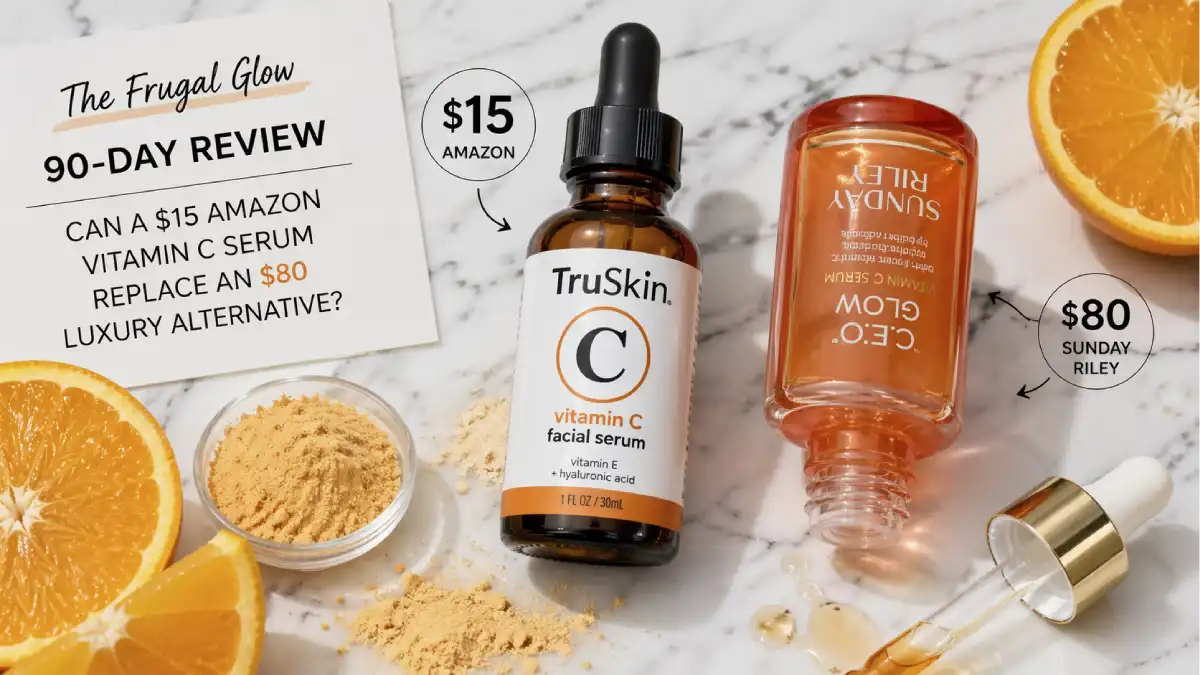
For twenty-four months, I spent $80 every three months on Sunday Riley C.E.O. Glow Vitamin C + Turmeric Face Oil. I bought it at Sephora. I loved the packaging — the frosted glass bottle, the gold-tipped dropper, the way it sat on my bathroom shelf like it belonged there. I loved the ritual of applying it every morning and the belief that I was doing something genuinely premium for my skin.
I told myself the investment was justified because I could see results. My skin was brighter. My hyperpigmentation from years of imperfect sun protection was fading. I looked more luminous in photographs and I was getting more compliments on my skin than I had in previous years.
And then one Sunday afternoon I sat down and added up what I’d spent. Twenty-four months, four bottles per year at $80: $640. Six hundred and forty dollars on a single skincare product over two years.
I did not immediately cancel my next order. What I did was open a browser tab and start researching — specifically, looking at the ingredient list of the Sunday Riley and finding comparable formulations at lower price points. What I found sent me directly to Amazon, where I ordered the TruSkin Vitamin C Serum for $19.99.
What happened in the next 90 days was not what I expected — because the results were better than I expected, not worse.
The Vitamin C Serum Market’s Dirty Little Secret
Before the comparison, the context that makes the comparison make sense.
The luxury skincare marketing around Vitamin C serums relies on a specific and underexamined assumption: that more expensive formulas are more effective because they use superior forms of Vitamin C, better stabilization technology, or more sophisticated delivery systems. This assumption has partial validity — and the partial validity is what the industry uses to justify the full price premium.
Here is what is actually true. L-Ascorbic Acid is the most potent and most research-backed form of Vitamin C. It is also the most unstable — it oxidizes rapidly when exposed to air and light. Premium serums typically do address this instability more sophisticatedly than very cheap alternatives.
But here is what the industry does not advertise: the effective concentration range for Vitamin C in skincare is well-established at 10 to 20 percent. Above 20 percent, irritation increases without proportional benefit. Below 10 percent, results may be too modest to notice. Every legitimate Vitamin C serum — $15 or $150 — that falls within this range and maintains adequate stability can produce the documented benefits of topical Vitamin C: antioxidant protection, brightening, collagen stimulation, and hyperpigmentation reduction.
The $80 to $150 price point is not buying you meaningfully more effective Vitamin C. It is buying you a more elegant formulation, a more beautiful bottle, a more complex scent profile, and the psychological premium of owning a luxury skincare product. All of those things have value. None of them appear on your skin.
The Products: What I Used and Why
The product I left:
Sunday Riley C.E.O. Glow Vitamin C + Turmeric Face Oil — $80
A face oil rather than a traditional serum, using 3-O-ethyl ascorbic acid (a stable Vitamin C derivative) combined with turmeric extract for additional brightening and glycolic acid for gentle exfoliation. Beautiful packaging. Complex, sophisticated fragrance. Two years of positive personal results.
The product I switched to:
TruSkin Vitamin C Serum — $19.99 on Amazon (frequently on sale for $15 to $17)
A water-based serum using 20% Vitamin C (ascorbic acid), vitamin E, ferulic acid, hyaluronic acid, and jojoba oil. Over 100,000 Amazon reviews. Consistently recommended in dermatology forums and budget skincare communities. Fragrance-free formula in an opaque pump bottle that protects the formula from oxidation.
Why I chose TruSkin specifically:
The ingredient list was the deciding factor. Vitamin C combined with vitamin E and ferulic acid is the gold-standard stabilization combination documented in a landmark paper by Dr. Sheldon Pinnell at Duke University — the same combination used in SkinCeuticals CE Ferulic, which retails at $170 and is the most clinically validated topical antioxidant formula available. TruSkin delivers this combination at 6 percent of the SkinCeuticals price and 25 percent of the Sunday Riley price.
The $12 Target Face Wash That Cleared My Acne Better Than High-End Brands
The Ingredient Comparison: What You’re Actually Paying For
Let me put the formulations side by side in the format that makes the comparison undeniable.
Sunday Riley C.E.O. Glow Key Ingredients:
- 3-O-Ethyl Ascorbic Acid (stable Vitamin C derivative — effective but slower-acting than L-Ascorbic Acid)
- Turmeric extract (brightening, anti-inflammatory)
- Glycolic acid (chemical exfoliation — 0.5%, gentle)
- Rosehip oil (fatty acids, vitamin A precursor)
- Fragrance (complex proprietary scent)
TruSkin Vitamin C Serum Key Ingredients:
- L-Ascorbic Acid 20% (direct Vitamin C — the most potent and most research-backed form)
- Vitamin E (alpha-tocopherol — antioxidant synergy with Vitamin C)
- Ferulic Acid (stabilizes Vitamin C and triples its antioxidant effectiveness)
- Hyaluronic Acid (hydration)
- Jojoba Oil (emollient)
- Fragrance-free
The analysis that matters:
The TruSkin formula uses L-Ascorbic Acid — the most potent, most studied form — at 20% concentration, stabilized with the gold-standard vitamin E and ferulic acid combination. This is a more scientifically robust Vitamin C formulation than the Sunday Riley, which uses a stable derivative form that is gentler but less potent.
The Sunday Riley formula includes turmeric and glycolic acid — additional actives that provide brightening and exfoliation not present in the TruSkin formula. For users whose skin responds well to glycolic acid, this adds value to the Sunday Riley formulation that the TruSkin does not replicate.
What is the Sunday Riley charging $65 more for? The face oil base (which some people prefer to a water-based serum for texture), the added actives (turmeric, glycolic acid), the complex fragrance, the frosted glass packaging, and the brand story. None of these directly enhance the Vitamin C’s core antioxidant and brightening function.
The 15 Best Value Skincare Products of 2026: Luxury Results Without the Price Tag
The 90-Day Results: What Actually Changed
Days 1 Through 30: First Impressions
The transition from an oil-based to a water-based Vitamin C formula produced an immediate textural adjustment that I want to be honest about. The Sunday Riley oil feels luxurious — it applies with a warm, silky slip that feels like genuine indulgence. The TruSkin serum applies as a standard lightweight serum that absorbs quickly and without ceremony. If you love the ritual of applying a beautiful face oil, switching to a serum is a real and noticeable sensory downgrade.
Functionally: within the first two weeks, I noticed that the TruSkin was producing a more immediate glow effect than the Sunday Riley — likely because the higher concentration direct L-Ascorbic Acid produces faster surface brightening than the derivative form in the Sunday Riley. My skin looked luminous after application in a way I found pleasantly surprising.
The one concern in the first two weeks: mild tingling on application, particularly on freshly exfoliated nights. L-Ascorbic Acid at 20% concentration has a low pH that can cause temporary stinging in sensitive skin. This resolved by week three as my skin acclimated — applying to dry skin rather than damp skin after cleansing reduced the sensation significantly.
Days 31 Through 60: The Real Test
By day 45 I had enough data to form an informed assessment. The TruSkin was performing. Hyperpigmentation that I had been monitoring on both cheeks — old sun damage marks — was fading at a rate that appeared comparable to what I’d experienced with the Sunday Riley over the same timeframe in previous years.
My morning photographs told a consistent story: my skin looked bright, even-toned, and luminous in a way that was indistinguishable from the results I’d attributed to the Sunday Riley for two years. I showed the photographs to a friend who knows my skin well and who knew I had switched products. She could not identify a period where the results looked different.
The one area where I noticed a modest decline: the texture refinement that the Sunday Riley’s glycolic acid component produced was not replicated by the TruSkin, which has no exfoliating agent. My skin texture was still good — the Vitamin C’s antioxidant activity and the hyaluronic acid’s hydration maintained smoothness — but the finer-pored, slightly more refined texture that regular low-level glycolic acid produces was less pronounced. I addressed this by adding a weekly glycolic acid toner to my routine separately — a $12 purchase that solved the gap.
Days 61 Through 90: The Verdict Takes Shape
The final thirty days of the test produced what I consider the most meaningful data: long-term consistency. The TruSkin’s brightening, antioxidant protection, and hyperpigmentation management maintained at the level I had established in weeks three through six. There was no regression, no development of new sensitivity, no oxidation of the formula (which I was monitoring by checking whether the formula had shifted from its original pale yellow color toward orange).
At day 90, I compared photographs taken at the beginning of the test to current photographs in identical lighting. The improvement in skin clarity and hyperpigmentation was visible and significant. I also compared these to photographs from the end of my last Sunday Riley cycle — the results were functionally indistinguishable.
The most meaningful outcome of the 90-day test:
I did not miss the $80 product. I missed the bottle and the ritual. I did not miss what the bottle was doing for my skin — because what the $15 product was doing was the same.
The $15 “Glow” Secret: How I Swapped My $70 Luxury Serum for Eva Naturals Vitamin C Serum
The Annual Cost Math That Changes Everything
Most Vitamin C serums last approximately ten to twelve weeks with daily morning use of three to four drops. Here is the annual cost comparison:
| Product | Price | Uses per Year | Annual Cost |
|---|---|---|---|
| Sunday Riley C.E.O. Glow | $80 | 4–5 bottles | $320–$400 |
| TruSkin Vitamin C Serum | $15–$20 | 4–5 bottles | $60–$100 |
| Annual savings | $220–$340 |
Over five years: $1,100 to $1,700 saved on a single skincare product.
At the midpoint — $280 in annual savings — the math over a decade of skincare use becomes genuinely striking: $2,800. For results that, in 90 days of honest direct comparison, were functionally indistinguishable from the luxury alternative.
That $2,800 is real money. It is a vacation. It is a meaningful investment account contribution. It is the financial breathing room that most people who spend $80 on serum are actually looking for but redirecting into a beautiful frosted glass bottle instead.
Who Should Make This Swap and Who Shouldn’t
✅ Make this swap if…
You are using a luxury Vitamin C serum primarily for brightening and antioxidant protection. These are the core benefits of Vitamin C and the TruSkin formula delivers them through a more potent direct form of the vitamin.
Your skin is not highly sensitive. L-Ascorbic Acid at 20% concentration can cause initial tingling in sensitive skin. If you tolerate current Vitamin C products without irritation, you will likely tolerate TruSkin after a brief acclimation period.
You want maximum Vitamin C potency. The 20% L-Ascorbic Acid formula is more potent than most derivative-based luxury serums and approaches the concentration of clinical formulations.
The $65 price difference represents real financial consideration. There is no shame in this calculation — $320 to $400 per year on a single serum is a meaningful budget commitment, and redirecting half or more of that to savings, travel, or other priorities is a rational adult decision.
❌ Keep the luxury serum if…
You use the Sunday Riley specifically for its glycolic acid component. The combination brightening and exfoliation effect of the Sunday Riley is not replicated by TruSkin. You can add glycolic acid separately, but the ritual of one product doing both may be part of its value to you.
You have very sensitive or reactive skin that doesn’t tolerate L-Ascorbic Acid. Derivative forms like 3-O-ethyl ascorbic acid and ascorbyl glucoside are significantly gentler. If you’ve tried direct ascorbic acid and found it irritating, the gentler delivery of luxury derivative-based formulas may genuinely suit you better.
The sensory experience of your luxury serum is a genuine part of your wellbeing. If the ritual of the beautiful bottle, the complex fragrance, and the luxurious texture contributes meaningfully to your quality of life — that is a legitimate reason to keep it. Beauty products serve emotional and experiential functions, not just functional ones. Own that decision consciously rather than by default.
Drugstore Skincare Routine for Acne-Prone Skin: Budget-Friendly Guide
The Frugal Glow Verdict
Ninety days. Two hundred and seventy daily morning applications. Photographs every two weeks. An outside observer who couldn’t tell the difference. The verdict is clear.
The $15 Amazon TruSkin Vitamin C Serum performs at least as well as the $80 Sunday Riley C.E.O. Glow for the primary functions of topical Vitamin C: antioxidant protection, skin brightening, and hyperpigmentation reduction. In terms of the Vitamin C chemistry specifically, TruSkin’s 20% L-Ascorbic Acid with ferulic acid and vitamin E is a more scientifically robust formulation than most luxury derivative-based serums — including the Sunday Riley.
The Sunday Riley wins on texture, fragrance, and the added benefits of its glycolic acid and turmeric components. It is a genuinely good product. It is not a $65-more-effective product.
For two years, I was paying $65 extra per bottle — $260 per year — for a frosted glass bottle, a complex scent, and the feeling of doing something premium for my skin. The feeling was real. The additional skin benefit was not proportional.
The TruSkin Vitamin C Serum is not the best Vitamin C serum available at any price. But for $15 to $20, it is almost certainly the best Vitamin C serum available for the price — and for most people’s daily brightening and antioxidant needs, almost certainly good enough to replace whatever expensive alternative is currently sitting on their bathroom shelf.
I have not gone back to the Sunday Riley. I have not missed it for my skin. I have missed the bottle — which is something I can live with very comfortably given what it’s saving me.
At The Frugal Glow, this is the story we exist to tell — the one where the science supports the budget choice, the results confirm it, and the money goes back to you rather than to a brand’s packaging budget. Bookmark us, share this with the friend who’s been buying $80 serum on Sephora autoship, and come back for more honest skincare reviews that prove beautiful skin has never required a beautiful price tag. 💚✨
Your Questions — Answered
1. Is TruSkin Vitamin C Serum actually good?
TruSkin Vitamin C Serum is genuinely one of the strongest performing affordable Vitamin C serums available, and its reputation among budget skincare communities is based on real results rather than marketing. The formula’s use of 20% L-Ascorbic Acid stabilized with vitamin E and ferulic acid mirrors the gold-standard formulation framework established by SkinCeuticals CE Ferulic — the most clinically validated topical antioxidant formula in dermatology — at approximately 12 percent of the SkinCeuticals price. Over 100,000 Amazon reviews with a consistent rating above 4.3 stars provide meaningful signal about real-world performance at scale. In 90 days of direct comparison testing against an $80 luxury alternative, TruSkin produced equivalent brightening, antioxidant protection, and hyperpigmentation reduction results. It is not without limitations — the 20% L-Ascorbic Acid concentration can cause initial tingling in sensitive skin, and the formula lacks the additional actives (glycolic acid, retinol, peptides) that some luxury formulations include — but for core Vitamin C performance, it genuinely delivers.
2. What percentage of Vitamin C serum is most effective?
Research on topical Vitamin C efficacy identifies an effective range of 10 to 20 percent for L-Ascorbic Acid. Below 10 percent, concentrations may be insufficient to produce consistent, noticeable results. Above 20 percent, irritation risk increases significantly without proportional improvement in outcomes — the dose-response relationship for Vitamin C in skin flattens above 20 percent. The TruSkin formula at 20 percent sits at the top of the effective range — potent enough for maximum brightening and antioxidant benefit, at the threshold where irritation risk becomes significant for sensitive skin types. For people with reactive skin, starting at 10 to 15 percent and building tolerance before using a 20% formula is the evidence-based approach.
3. How do you know if a Vitamin C serum is oxidized?
Oxidized Vitamin C serum has undergone the chemical degradation that renders it ineffective — and potentially counterproductive, as oxidized ascorbic acid can act as a pro-oxidant rather than an antioxidant. The visual indicator is color change: fresh L-Ascorbic Acid serum is clear to very pale yellow. As oxidation progresses, the formula turns progressively deeper yellow, then amber, then orange, and finally a dark brown-orange that clearly indicates complete degradation. Any serum that has shifted noticeably from its original color should be discarded regardless of how much product remains. Prevention through correct storage — a dark, cool location away from the bathroom’s humidity, ideally in a refrigerator — significantly extends the shelf life of L-Ascorbic Acid formulas. The TruSkin formula’s opaque pump bottle is a genuine practical advantage over clear dropper bottles for preventing light-induced oxidation.
4. Can I use Vitamin C serum every day?
Daily use of Vitamin C serum in the morning is both safe and recommended for maximizing its cumulative benefits. The antioxidant and brightening effects of Vitamin C are dose-dependent and build with consistent daily application — intermittent use produces proportionally reduced benefits. The one daily use caveat is for L-Ascorbic Acid at concentrations of 15 to 20 percent in sensitive skin: starting with every-other-day application and building to daily use over two to three weeks allows skin to acclimate and reduces the tingling or redness that some people experience initially. Once acclimated, daily morning application is the correct protocol — Vitamin C’s photoprotective antioxidant activity is most relevant during daytime hours when UV and environmental free radical exposure occurs, making morning the strategically optimal application time.
5. Should I use Vitamin C serum before or after moisturizer?
Vitamin C serum should be applied after cleansing and before moisturizer in your routine. The principle is to apply products from thinnest to thickest texture — serums penetrate most effectively when applied to clean skin before the barrier of a moisturizer is established. For optimal absorption, apply Vitamin C serum to skin that is dry rather than damp after cleansing — damp skin dilutes the serum and the high water content can affect the pH-sensitive L-Ascorbic Acid formula’s stability. Allow 60 to 90 seconds for the serum to absorb before applying moisturizer, then SPF as the final morning step. SPF is non-negotiable with Vitamin C use — UV radiation creates the free radical damage that Vitamin C neutralizes, and without SPF, UV causes new damage faster than Vitamin C can address it.
6. What is the best affordable Vitamin C serum on Amazon?
Among the consistently well-reviewed affordable Vitamin C serums on Amazon, TruSkin Vitamin C Serum ($15 to $20) and the Timeless 20% Vitamin C + E Ferulic Acid Serum ($25) are the two most frequently recommended by dermatologists and informed consumers for their formulation quality relative to price. Both use L-Ascorbic Acid with vitamin E and ferulic acid — the gold-standard stabilization system. Timeless is considered slightly more refined in formulation consistency and texture, while TruSkin offers additional humectants (hyaluronic acid) and emollients (jojoba oil) that some people find makes the formula more comfortable. Mad Hippie Vitamin C Serum ($16 to $20) is the best option for sensitive skin specifically — it uses sodium ascorbyl phosphate, a gentler derivative form of Vitamin C, at a lower irritation risk while still producing meaningful brightening results. Filter Amazon reviews for verified purchasers with photos before purchasing any of these — real customer photos provide the most reliable quality signal for skincare at this price point.
The science always supported the affordable choice — we just needed 90 days to confirm it. At The Frugal Glow, we do the testing, read the ingredient lists, and tell you honestly where your skincare budget actually needs to go and where it absolutely doesn’t. Bookmark us, share this with the friend who’s been buying $80 serum on autopilot for years, and come back for more honest skincare comparisons that prove beautiful skin has always been available at budget prices. 💚✨