

The ‘Cost Per Wear’ Formula: Why a $100 Coat is Cheaper Than a $30 Fast-Fashion One
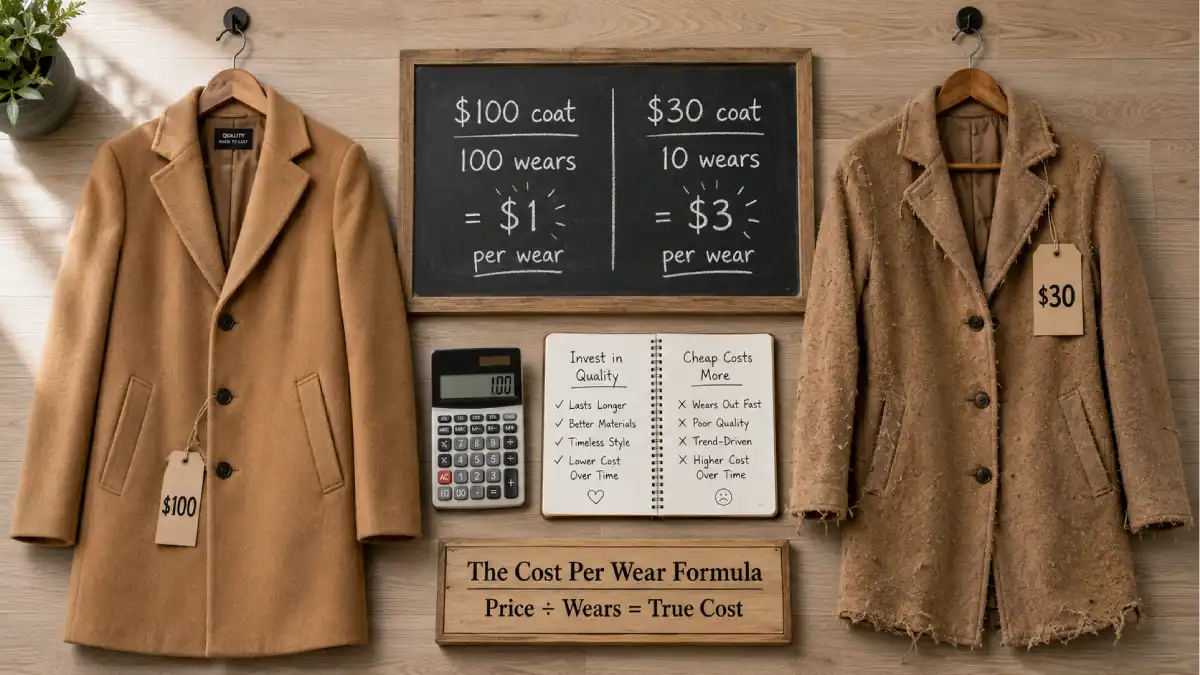
Let me tell you about the $100 coat I almost didn’t buy.
I was standing in a department store, holding a beautiful wool-blend coat. It was $100. On sale from $180. I had the money. I loved the coat. But I couldn’t pull the trigger.
A hundred dollars felt like so much money for one item of clothing. I could buy three $30 fast-fashion coats for that price. I could buy a whole outfit. I could buy groceries for two weeks.
I put the coat back and walked away.
I went home. I opened my closet. I looked at the fast-fashion coat I had bought last year for $30. It was pilling. The lining was torn. The buttons were loose. I had worn it maybe 10 times. It looked terrible. I couldn’t wear it anymore.
That $30 coat cost me $3 per wear. And it was dead.
Then I looked at the wool coat I had bought five years ago for $80. I had worn it over 100 times. It still looked great. That coat cost me $0.80 per wear. And it was still going strong.
I drove back to the store. I bought the $100 coat. I’ve worn it over 50 times already. That’s $2 per wear. And it will last for years. By the time I’m done with it, the cost per wear will be under $1.
That’s the “cost per wear” formula. It’s the secret to spending less on clothes while looking better. It’s the reason a $100 coat is cheaper than a $30 fast-fashion one.
Today, I’m sharing the cost per wear formula. How to calculate it. How to use it. And why it’s the only way to shop that actually makes financial sense.
Let’s get into it.
Jump Links
- The $100 Coat I Almost Didn’t Buy
- What Is Cost Per Wear (And Why It Matters)
- The Math: $100 Coat vs. $30 Fast-Fashion Coat
- How to Calculate the Cost Per Wear of Any Item
- The ‘Wearability’ Factor: Why Some Clothes Last Longer
- How to Apply the Cost Per Wear Formula When Shopping
- The ‘$3 Rule’: A Quick Mental Shortcut
- Common Mistakes People Make with Cost Per Wear
- The 80/20 Rule: Why You Wear 20% of Your Clothes 80% of the Time
- Cost Per Wear for Shoes, Bags, and Accessories
- The Math: What I Saved in One Year
- Frequently Asked Questions (FAQ)
- Final Thoughts: Cheap Clothes Are Expensive. Good Clothes Are Cheap.
The $100 Coat I Almost Didn’t Buy
I need to describe that moment of hesitation.
I was holding the coat. It was a classic camel wool-blend. Timeless. Versatile. It would go with everything. I knew I would wear it for years. But $100 felt like so much.
I put it back. I went home. I opened my closet. I looked at my fast-fashion coats. One was pilling. One had a broken zipper. One was a color I had bought on impulse and never worn.
I counted the cost per wear of each.
- The $30 fast-fashion coat: worn 10 times = $3 per wear
- The $50 fast-fashion coat: worn 5 times = $10 per wear
- The $20 clearance coat: worn 2 times = $10 per wear
Then I looked at my high-quality wool coat from five years ago.
- The $80 wool coat: worn 120 times = $0.67 per wear
I drove back to the store. I bought the $100 coat. I’ve worn it 50 times already. That’s $2 per wear. And it will last for years.
Fast fashion is expensive. Good clothes are cheap. You just have to do the math.
What Is Cost Per Wear (And Why It Matters)
Let me define cost per wear.
Cost Per Wear (CPW): The total cost of an item divided by the number of times you wear it.
The formula is simple:
Cost Per Wear = (Purchase Price + Alterations + Repairs) / Number of Times Worn
The lower the cost per wear, the better the value. A $100 item worn 100 times has a cost per wear of $1. A $30 item worn 5 times has a cost per wear of $6. The $100 item is cheaper.
Why it matters:
It changes how you see “expensive.” A $100 coat seems expensive. But if you wear it 100 times, it’s $1 per wear. A $30 coat seems cheap. But if you wear it 5 times, it’s $6 per wear. The “expensive” coat is actually cheaper.
It helps you make better buying decisions. Instead of asking “Can I afford this?” ask “Will I wear this enough to make it worth it?” If the answer is yes, buy it. If no, skip it.
It encourages quality over quantity. When you think about cost per wear, you naturally gravitate toward higher-quality items. They last longer. They look better. They have lower cost per wear.
It reduces impulse purchases. When you ask “Will I wear this 30 times?” the answer is often no. That $20 impulse blouse? You’ll wear it twice. That’s $10 per wear. Not worth it.
It aligns with sustainability. Buying fewer, better things is better for the planet. Cost per wear thinking reduces waste. It’s good for your wallet and good for the environment.
The Math: $100 Coat vs. $30 Fast-Fashion Coat
Let me show you the real numbers.
Scenario 1: $30 fast-fashion coat from a popular brand
| Factor | Number |
|---|---|
| Purchase price | $30 |
| Times worn before falling apart | 10 |
| Cost per wear | $3.00 |
Scenario 2: $100 quality coat from a good brand
| Factor | Number |
|---|---|
| Purchase price | $100 |
| Times worn (projected over 5 years) | 100 |
| Cost per wear | $1.00 |
Scenario 3: $100 quality coat (continued use)
| Factor | Number |
|---|---|
| Purchase price | $100 |
| Times worn (projected over 10 years) | 200 |
| Cost per wear | $0.50 |
The comparison:
| Item | Cost | Times Worn | Cost Per Wear | Total Cost at 100 Wears |
|---|---|---|---|---|
| Fast-fashion coat | $30 | 10 | $3.00 | $300 (need 10 coats) |
| Quality coat | $100 | 100 | $1.00 | $100 (only need 1) |
You need ten fast-fashion coats to match one quality coat. That’s $300 vs $100. The quality coat is $200 cheaper.
But wait, there’s more.
The quality coat looks better. It fits better. It feels better. You get compliments in it. You feel confident in it. The fast-fashion coat looks cheap. It pills. It fades. It doesn’t fit as well.
The quality coat is cheaper, looks better, and feels better.
That’s not a trade-off. That’s a win.
How to Calculate the Cost Per Wear of Any Item
Here’s how to calculate the cost per wear of anything in your closet.
Step 1: Find the price you paid.
Check your receipt. Check your bank statement. If you bought it years ago, estimate (be honest).
Step 2: Add any alteration costs.
Did you get it hemmed? Did you have it tailored? Add that to the total cost.
Step 3: Estimate the number of times you’ve worn it.
Be honest. If you’re not sure, count how many times you’ve worn it in the past month and multiply by 12.
Step 4: Do the math.
Cost Per Wear = (Purchase Price + Alterations + Repairs) / Number of Times Worn
Examples:
| Item | Price | Alterations | Total Cost | Times Worn | CPW |
|---|---|---|---|---|---|
| Jeans | $80 | $10 (hem) | $90 | 120 | $0.75 |
| Blazer | $120 | $20 (sleeves) | $140 | 60 | $2.33 |
| Evening dress | $200 | $0 | $200 | 8 | $25.00 |
Interpretation:
- CPW under $1: Amazing value
- CPW $1-3: Good value
- CPW $3-5: Average value
- CPW over $5: Poor value (consider why)
What to do with this information:
For items you already own:
- If CPW is under $1: Wear them more. They’re your most valuable pieces.
- If CPW is $1-3: You’re doing fine. Keep wearing them.
- If CPW is over $5: You’re not wearing them enough. Either start wearing them or consider why you bought them.
For items you’re considering buying:
- Estimate how many times you’ll wear it.
- If the CPW will be under $1, it’s a great investment.
- If the CPW will be over $5, it’s probably not worth it.
The ‘Wearability’ Factor: Why Some Clothes Last Longer
Not all clothes are created equal. Here’s what makes an item worth buying.
Fabric quality:
- Natural fibers (wool, cotton, linen, silk) last longer than synthetics.
- Higher thread counts = more durable.
- Look for terms like “heavyweight,” “double-knit,” “canvas,” “twill.”
Construction:
- Look at the seams. Are they straight? Are they finished (no loose threads)?
- Check the lining. Is it attached? Is the fabric quality comparable to the outer fabric?
- Look at the buttons. Are they sewn on securely? Are there spare buttons included?
Brand reputation:
- Some brands are known for quality. Others are known for trendiness.
- Research brands before you buy. Check reviews. Check forums (r/BuyItForLife).
Versatility:
- A neutral-colored item goes with everything. You’ll wear it more.
- A trendy item goes with nothing. You’ll wear it less.
- Buy versatile colors: black, navy, camel, gray, white, olive. Skip neon, pastels, and loud prints unless you’re sure.
Fit:
- If it fits perfectly, you’ll wear it more.
- If it fits poorly, you’ll wear it less.
- Buy items that fit now. Don’t buy items you’ll “fit into later.”
The wearability score:
Rate each item from 1-10 on these factors:
- Fabric quality (1-10)
- Construction (1-10)
- Brand quality (1-10)
- Versatility (1-10)
- Fit (1-10)
Add them up. Over 40 is a great purchase. Under 30 is a red flag.
How to Apply the Cost Per Wear Formula When Shopping
Here’s how to shop using cost per wear.
Before you buy, ask:
- How many times will I realistically wear this?
- If it’s a neutral coat or jacket: 50-100 times per year
- If it’s a basic top or pants: 30-50 times per year
- If it’s a special occasion dress: 2-5 times per year
- If it’s a trendy item: 10-20 times (if you’re lucky)
- What’s the quality?
- Good quality: It will last for years.
- Poor quality: It will wear out quickly.
- What’s the cost per wear estimate?
- Do the quick mental math.
- Price divided by estimated times worn.
- If it’s under $3, it’s probably a good purchase.
- If it’s over $5, it’s probably not worth it.
Real examples:
| Item | Price | Estimated Wears | CPW | Buy? |
|---|---|---|---|---|
| Winter coat | $150 | 150 | $1.00 | Yes |
| Trendy print blouse | $40 | 10 | $4.00 | Maybe (if you love it) |
| Special occasion dress | $80 | 3 | $26.67 | No (rent instead) |
| Basic white t-shirt | $25 | 50 | $0.50 | Yes |
The 30-wear rule:
Before buying any item, ask: “Will I wear this 30 times?” If the answer is no, don’t buy it. Even if it’s cheap.
The ‘$3 Rule’: A Quick Mental Shortcut
Here’s a quick shortcut for evaluating purchases.
The $3 Rule:
If the item costs more than $3 per wear, it’s probably not worth it. If it costs less than $3 per wear, it’s probably a good investment.
How to use it:
- Estimate how many times you’ll wear the item.
- Divide the price by that number.
- If the answer is over $3, think carefully.
- If the answer is under $3, it’s probably a good buy.
Examples:
| Item | Price | Estimated Wears | CPW | $3 Rule Says |
|---|---|---|---|---|
| Winter coat | $150 | 100 | $1.50 | ✓ Good value |
| Trendy top | $40 | 10 | $4.00 | ✗ Think twice |
| Sneakers | $80 | 80 | $1.00 | ✓ Good value |
| Evening dress | $100 | 5 | $20.00 | ✗ Rent instead |
Exceptions to the rule:
- Wedding dress: CPW will be high. That’s fine.
- Formal wear: CPW will be high. Rent instead.
- Winter coat: CPW will be low. Buy the best you can afford.
The $3 rule is a guideline, not a rule. Use it as a quick sanity check.
Common Mistakes People Make with Cost Per Wear
Here are the most common mistakes I see.
Mistake #1: Only looking at the price, not the cost per wear.
A $30 coat seems cheap. But if it falls apart after 5 wears, it’s $6 per wear. A $100 coat worn 100 times is $1 per wear. Don’t be fooled by the sticker price.
Mistake #2: Buying for “one day.”
“I’ll wear this when I lose weight.” “I’ll wear this when I have a special occasion.” No you won’t. Buy for the body you have now, not the body you want. Buy for the life you have now, not the life you want.
Mistake #3: Ignoring maintenance costs.
Dry cleaning, alterations, and repairs add to the cost. A $200 dry-clean-only wool coat worn 100 times costs $200 + (100 × $15 dry cleaning) = $1,700. That’s $17 per wear. Suddenly it’s not a good deal.
Mistake #4: Not counting the cost of waste.
Fast fashion has hidden costs. Shipping. Returns. The cost of storing unworn clothes. The cost of guilt. These aren’t financial, but they’re real. Quality clothes reduce waste. They reduce guilt.
Mistake #5: Not factoring in enjoyment.
Some clothes bring you joy. That’s worth something. A $100 dress worn 10 times that makes you feel amazing has value beyond the math. Don’t ignore it.
Mistake #6: Buying just because it’s on sale.
“Look at this. 50% off. I’m saving $50.” No. You’re spending $50 on something you don’t need. That’s not saving. That’s spending.
Mistake #7: Not tracking your actual wears.
Track your outfits for a month. You’ll be surprised. Most of us wear 20% of our clothes 80% of the time. The rest sits in the closet. That’s expensive real estate.
The 80/20 Rule: Why You Wear 20% of Your Clothes 80% of the Time
The Pareto Principle applies to your wardrobe. You wear 20% of your clothes 80% of the time.
What this means:
- You have 100 items in your closet.
- You wear 20 of them regularly.
- You rarely wear the other 80.
Why this matters:
- If you spend money on the 20% you wear, it’s a good investment.
- If you spend money on the 80% you don’t wear, it’s a waste.
How to use this:
- Identify your 20%. What do you wear most often? Invest in those.
- Stop buying things that will join the 80%. They’re not worth it.
What to do about your 80%:
- Donate them.
- Sell them.
- Give them away.
- Keep only what you actually wear.
My experience:
When I did this, I donated 40 items. I didn’t miss them. I didn’t even remember them. Now my closet is half-full. And I can find everything I need.
The 20% rule for shopping:
Only buy items that will join your 20%. Buy items that you will wear at least 30 times per year. Those items are worth investing in. Everything else is clutter.
Cost Per Wear for Shoes, Bags, and Accessories
The same formula works for shoes, bags, and accessories.
Shoes:
| Item | Price | Wears | CPW |
|---|---|---|---|
| Quality leather boots | $200 | 150 | $1.33 |
| Cheap synthetic boots | $50 | 20 | $2.50 |
| Quality sneakers | $120 | 100 | $1.20 |
| Cheap sneakers | $40 | 15 | $2.67 |
Handbags:
| Item | Price | Wears | CPW |
|---|---|---|---|
| Quality leather tote | $300 | 200 | $1.50 |
| Cheap pleather tote | $50 | 30 | $1.67 |
| Crossbody bag (quality) | $200 | 100 | $2.00 |
| Crossbody bag (cheap) | $30 | 10 | $3.00 |
Accessories (belts, scarves, hats):
| Item | Price | Wears | CPW |
|---|---|---|---|
| Quality leather belt | $50 | 100 | $0.50 |
| Cheap belt | $15 | 10 | $1.50 |
| Wool scarf | $40 | 80 | $0.50 |
| Polyester scarf | $10 | 5 | $2.00 |
The pattern: Quality always wins on cost per wear. Even if the upfront cost is higher.
What this means for your wardrobe:
- Invest in items you’ll wear often: shoes, outerwear, handbags.
- Save on items you’ll wear less: trendy accessories, special occasion items.
The Math: What I Saved in One Year
Let me show you the actual numbers from my wardrobe transformation.
Before (buying cheap, trend-driven pieces):
| Category | Number of Items | Total Cost | Items Worn Regularly | CPW of Regular Items |
|---|---|---|---|---|
| Tops | 30 | $600 | 6 | $5.00 |
| Pants | 15 | $450 | 5 | $6.00 |
| Dresses | 10 | $300 | 2 | $7.50 |
| Outerwear | 8 | $240 | 2 | $8.00 |
| Shoes | 12 | $360 | 3 | $6.00 |
| Total | 75 | $1,950 | 18 | Avg $6.50 |
After (buying quality, versatile pieces):
| Category | Number of Items | Total Cost | Items Worn Regularly | CPW of Regular Items |
|---|---|---|---|---|
| Tops | 15 | $450 | 12 | $1.50 |
| Pants | 8 | $400 | 7 | $1.75 |
| Dresses | 5 | $250 | 4 | $2.50 |
| Outerwear | 4 | $300 | 3 | $2.00 |
| Shoes | 6 | $300 | 5 | $1.50 |
| Total | 38 | $1,700 | 31 | Avg $1.85 |
Annual savings:
- Cost of before wardrobe: $1,950
- Cost of after wardrobe: $1,700
- Upfront savings: $250
But wait, there’s more.
The after wardrobe will last longer. The before wardrobe needed replacement every 1-2 years. The after wardrobe will last 5-10 years. Over 10 years:
Before over 10 years:
- $1,950 × 5 replacements = $9,750
After over 10 years:
- $1,700 × 1.5 replacements = $2,550
Total savings over 10 years: $7,200
Subscription Audit 2026: Why Your ‘Beauty Box’ is Actually Costing You More Than You Think
Frequently Asked Questions (FAQ)
1. How do I calculate cost per wear for items I already own?
Find the price you paid. Check your email receipts or bank statements. If you can’t find it, estimate (be honest). Count or estimate how many times you’ve worn it. Then divide the price by the number of wears. A $100 jacket worn 50 times = $2 per wear.
2. What’s a good cost per wear?
Under $1 is excellent. $1-3 is good. $3-5 is average. Over $5 is poor. For special occasion items, the number will be higher. That’s fine. Just be aware.
3. Does cost per wear apply to all items?
Yes, but some items have different standards. Winter coats have low CPW because you wear them often. Evening dresses have high CPW because you wear them rarely. That’s fine. Just be intentional. For evening dresses, consider renting instead of buying.
4. How many wears should I estimate for a new item?
For a neutral jacket or coat: 50-100 wears per year. For basic tops and pants: 30-50 wears per year. For special occasion dresses: 2-5 wears per year. For trendy items: 10-20 wears (if you’re lucky). Be realistic, not optimistic.
5. Is it ever worth buying something with a high cost per wear?
Yes. Wedding dresses, formal wear, and items that bring you genuine joy can have high CPW and still be worth it. Just know what you’re getting into. Don’t buy an expensive evening dress and expect it to be a good investment. Buy it because you love it.
6. What should I do with high-cost-per-wear items I already own?
Identify why you’re not wearing them. If it’s fit, get them tailored. If it’s style, consider selling or donating them. If it’s “not the right season,” wait for the season. But if you haven’t worn an item in a year and you don’t plan to, let it go.
7. How do I avoid impulse purchases with cost per wear?
Before buying, ask: “Will I wear this 30 times?” If the answer is no, don’t buy it. If the answer is yes, buy it (if you can afford it). This simple question eliminates most impulse purchases.
8. How do I make cost per wear easier to calculate on the go?
Use the $3 Rule. If you think you’ll wear an item fewer than 30 times, it’s probably not worth it. If you’ll wear it more than 30 times, it’s probably worth it. For a $90 jacket, 30 wears = $3 per wear. That’s the threshold.
9. What’s the best way to track how often I wear items?
Use an app (Stylebook, Whering, or Acloset). Or do a manual audit: hang your clothes with hangers facing the same direction. When you wear something, turn the hanger around. After 3 months, see what’s still unworn. That’s your 80%.
Final Thoughts: Cheap Clothes Are Expensive. Good Clothes Are Cheap.
Here’s what I want you to take away.
I almost didn’t buy that $100 coat. I thought it was too expensive. I thought I was being extravagant. I thought I should save money by buying cheaper clothes.
I was wrong.
The $30 fast-fashion coat cost me $3 per wear. The $100 quality coat costs me $1 per wear. The quality coat is cheaper. It looks better. It fits better. It makes me feel better.
Fast fashion is expensive. It costs you in money, time, and frustration. You buy cheap clothes. They fall apart. You buy more cheap clothes. They fall apart. You’re stuck in a cycle of spending.
Quality clothes are cheap. They cost more upfront. But they last. They look better. They fit better. They make you feel better. They’re cheaper in the long run.
The cost per wear formula is simple. But it’s powerful. It changes how you shop. It changes how you spend. It changes how you think about clothes.
Use it. You’ll save money. You’ll look better. You’ll feel better.
That’s the frugal glow. And it’s waiting for you in your closet. 👗💛
For more fashion finance tips, wardrobe audits, and money-saving style strategies, visit The Frugal Glow.