
The 3-Color Palette Formula: How to Mix and Match Any 10 Closet Pieces Seamlessly
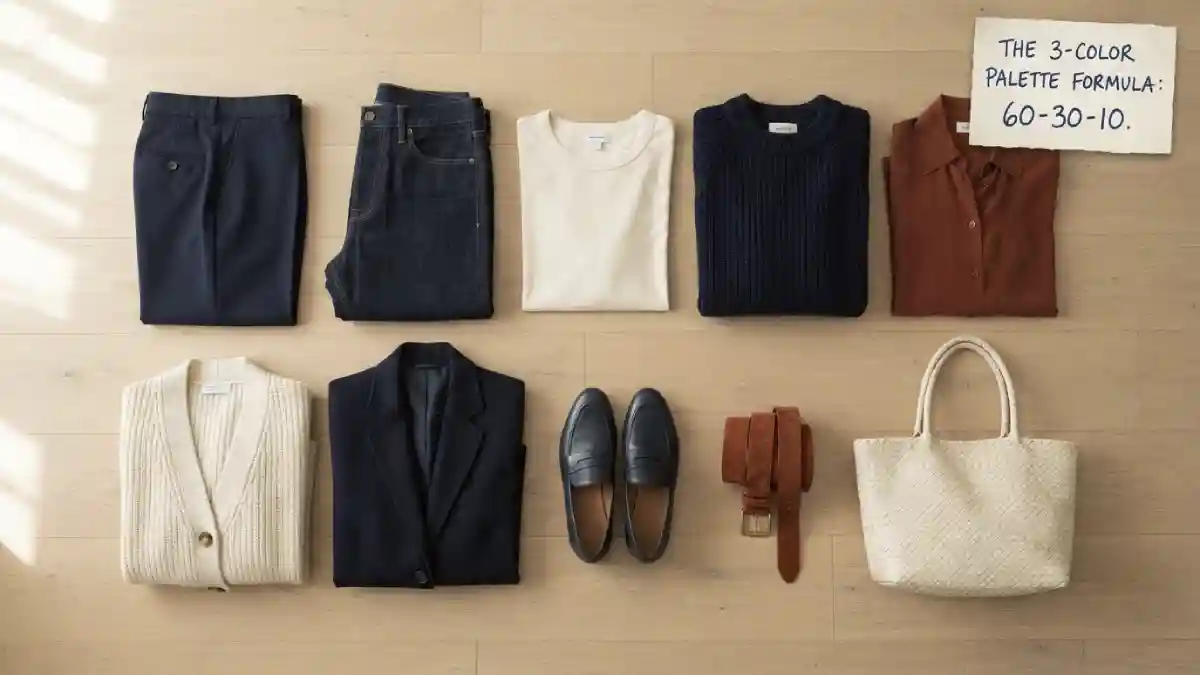
Standing in front of a full closet and feeling like you have nothing to wear usually isn’t a quantity problem. It’s a coordination problem. Pieces you love don’t go together, a bright top fights with a patterned skirt, and the outfits that work end up being the same three you always wear. Stylists have a simple fix for this, and it comes straight from interior design: limit each outfit to three colors and divide them up using a 60-30-10 ratio.
The best part is that it works with whatever you already own. You don’t need a new wardrobe, a color analysis appointment, or a big budget. You need a way to sort your pieces, a plan for which colors play which role, and a few guardrails so things don’t clash. This guide walks through the whole system, including how to sort any ten closet pieces into a working palette, a full sample capsule with outfit formulas, and the mistakes that make a palette fall apart.
Jump Links
- Why Three Colors Works
- The Two Versions of the Rule
- The 60-30-10 Formula
- How to Choose Your Three Colors
- Sample Palette Table
- How to Sort Any 10 Closet Pieces
- A Sample 10-Piece Capsule
- 10 Outfit Formulas From Those 10 Pieces
- How Many Outfits Do You Really Get?
- Using the Color Wheel (Without Overthinking It)
- Patterns, Textures, and Metals
- Swapping Seasons Without Rebuilding
- Shopping With a Palette on a Budget
- Common Mistakes
- The 30-Second Outfit Check
- FAQ
- The Bottom Line
Why Three Colors Works
Outfits that look “put together” tend to share one trait: the colors feel intentional. Too many colors, especially in similar amounts, compete for attention. A small, controlled palette lets the eye rest, which is why the three-color rule is so popular with stylists. As one fashion retailer’s styling guide puts it, the idea is to limit yourself to three main colors and spread them using the 60-30-10 principle, a method that ties directly to the color wheel and color theory.
A few practical benefits make it especially useful for a small wardrobe:
- Fewer decisions. When every piece belongs to one of three colors, you can grab almost any top and any bottom without second-guessing.
- Less clashing. Limiting your palette removes most of the combinations that look off.
- Smarter shopping. Knowing your palette makes it easy to say no to pieces that won’t pair with what you own.
- More outfits from fewer pieces. A coordinated set multiplies, while a random collection doesn’t.
The Two Versions of the Rule
There are two common ways people apply the three-color rule, and it helps to know the difference so you pick the one that works for you.
Strict version: Every color in the outfit counts, including neutrals. If you wear black pants, a cream top, and a rust scarf, that’s your three.
Flexible version: You use up to three colors, and neutrals (like black, white, gray, navy, tan, and cream) are free extras that blend things together. Some stylists say neutrals don’t count against your limit, because they work as connectors between colors.
For beginners, the flexible version is easier and more forgiving. This guide uses a middle path: choose three colors as your palette, treat your base neutral as one of them, and allow a few extra neutral basics, like denim or white sneakers, to float freely.
The 60-30-10 Formula
The 60-30-10 rule divides your outfit into three roles:
- 60% dominant color: The largest share of the outfit, usually a neutral.
- 30% secondary color: A supporting shade that complements the base.
- 10% accent color: A small pop that adds interest.
Stylists note that the ratios aren’t exact measurements, and there’s gentle flex within them. What matters is the proportion: one color leads, one supports, and one adds a finishing touch.
A helpful way to apply it is to map the percentages to your actual garments. Your pants or dress usually carry the 60 percent, your top or jacket carries the 30 percent, and your bag, shoes, scarf, or jewelry carries the 10 percent.
| Role | Share of outfit | Usually carried by | Example |
|---|---|---|---|
| Base (dominant) | ~60% | Pants, skirt, dress, or a large layer | Navy trousers |
| Supporting | ~30% | Top, jacket, or cardigan | Cream sweater |
| Accent | ~10% | Bag, shoes, scarf, belt, jewelry | Rust scarf |
A simple example from a styling publication: 60 percent black, 30 percent tan, and 10 percent green makes a neutral-forward look that adds subtle color without feeling too bright. It’s especially useful for people with an overwhelmingly black or dark wardrobe. A bolder version might be 60 percent pink, 30 percent blue, and 10 percent black.
How to Choose Your Three Colors
Building a palette is easier than it sounds, and the order matters.
Step 1: Pick your base neutral. This is the color you’ll wear the most. Navy, black, charcoal, camel, olive, and gray are all strong choices. Choose the one you already own the most of, since it shortens your shopping list.
Step 2: Choose your supporting color. This should be another neutral or a soft color that complements your base. Cream and white pair with almost everything, while tan works well with black and olive.
Step 3: Add a single accent. Choose one color that coordinates with your neutrals and that you genuinely love. Wardrobe-building guides recommend choosing your neutrals first, then selecting one or two accent colors that complement them, and buying mostly in your neutrals.
Step 4: Check the temperature. Keep your colors in the same temperature family, either warm or cool. Mixing a cool, icy gray with a warm, golden mustard can look off, while staying in one family looks cohesive. Stylists also recommend keeping the same level of saturation across your colors, so one bright piece doesn’t overpower muted ones.
Step 5: Test the accent before committing. One wardrobe guide suggests testing a new accent color with small accessories first, like a scarf or earrings, and upgrading to larger investment pieces if you love it.
Sample Palette Table
Here are several ready-made palettes. Each follows the base-supporting-accent structure.
| Palette | Base (60%) | Supporting (30%) | Accent (10%) | Mood |
|---|---|---|---|---|
| Classic | Navy | Cream | Rust | Polished and warm |
| Neutral-forward | Black | Tan | Olive green | Modern and understated |
| Cool and crisp | Charcoal | Light gray | Burgundy | Sophisticated |
| Soft and light | Taupe | Ivory | Dusty blue | Gentle, easy |
| Warm and earthy | Chocolate brown | Cream | Mustard | Cozy |
| Bold | Pink | Blue | Black | Playful |
A styling guide’s seasonal suggestion for winter is similarly structured: anchor the outfit with charcoal or black, add a secondary navy or forest green, and finish with a metallic accent like silver or pewter.
How to Sort Any 10 Closet Pieces
This is where the system pays off. Even if your ten pieces were bought at random, you can usually organize them into a working palette. Here’s the process.
- Lay out ten pieces you wear or want to wear. Include tops, bottoms, and layers. Leave shoes and accessories aside for now.
- Group them by color. Notice which colors appear most often. That’s likely your base.
- Choose your three colors. Pick the most common neutral as the base, the next most common neutral or soft color as the supporting shade, and one color you love as the accent.
- Label each piece. Mark every piece as Base, Supporting, Accent, or Orphan (a piece that doesn’t fit the palette).
- Check balance. You want most pieces in your base and supporting colors, with only one or two in the accent color.
- Handle the orphans. Pieces that don’t fit can often be saved by pairing them with neutrals only, or by treating them as a second mini-palette. If a piece clashes with everything else and you rarely wear it, consider selling or donating it.
- Identify the gaps. If you have three tops but no bottom in your base color, that’s your next purchase.
A helpful ratio for ten pieces: roughly five to six in your base color, three to four in your supporting color, and one to two in your accent color. That mirrors the 60-30-10 logic at the closet level. Some styling resources suggest building a wardrobe that’s about 80 percent neutrals, with one to three accents, for maximum combinability.
| Piece type | Suggested count in a 10-piece set |
|---|---|
| Base-color pieces | 4–5 |
| Supporting-color pieces | 3–4 |
| Accent-color pieces | 1–2 |
| Orphans (kept only if they pair with neutrals) | 0–1 |
A Sample 10-Piece Capsule
Here’s what the system looks like in practice using the Classic palette: navy (base), cream (supporting), and rust (accent).
| # | Piece | Role |
|---|---|---|
| 1 | Navy trousers | Base |
| 2 | Dark navy jeans | Base |
| 3 | Cream trousers | Supporting |
| 4 | Navy knit sweater | Base |
| 5 | Cream tee | Supporting |
| 6 | Navy-and-cream striped top | Base and supporting |
| 7 | Rust blouse | Accent |
| 8 | Cream cardigan | Supporting |
| 9 | Navy blazer | Base |
| 10 | Rust scarf | Accent |
Three bottoms, four tops, two layers, and one accessory, all in three colors. Notice that the striped top does special work: it contains both the base and supporting colors, which makes it a connector piece that ties other items together.
10 Outfit Formulas From Those 10 Pieces
Here’s how the pieces above turn into outfits, each following the 60-30-10 mapping.
| Outfit | Pieces | Base (60%) | Supporting (30%) | Accent (10%) |
|---|---|---|---|---|
| 1. Easy casual | Navy jeans + cream tee | Navy jeans | Cream tee | Rust scarf |
| 2. Smart casual | Navy trousers + cream tee + navy blazer | Navy trousers and blazer | Cream tee | Rust scarf |
| 3. Cozy | Navy jeans + navy sweater + cream cardigan | Navy jeans and sweater | Cream cardigan | Rust scarf |
| 4. Tonal soft | Cream trousers + cream tee + navy blazer | Cream trousers | Navy blazer | Rust scarf |
| 5. Accent blouse | Navy trousers + rust blouse | Navy trousers | Rust blouse | Cream cardigan, as the supporting layer |
| 6. Striped classic | Navy jeans + striped top | Navy jeans | Striped top | Rust scarf |
| 7. Office-ready | Navy trousers + striped top + navy blazer | Navy trousers and blazer | Striped top | Rust scarf |
| 8. Weekend layers | Cream trousers + navy sweater | Cream trousers | Navy sweater | Rust scarf |
| 9. Evening | Navy trousers + rust blouse + navy blazer | Navy trousers and blazer | Rust blouse | None needed |
| 10. Relaxed polish | Navy jeans + cream tee + cream cardigan | Navy jeans | Cream tee and cardigan | Rust scarf |
You can see why this works: because every piece belongs to one of three colors, almost any top-and-bottom pairing looks intentional.
How Many Outfits Do You Really Get?
Here’s the math with the sample capsule:
- 4 tops (cream tee, navy sweater, striped top, rust blouse) × 3 bottoms (navy trousers, navy jeans, cream trousers) = 12 base combinations.
- Add three layer options (none, cream cardigan, navy blazer) = 36 possible combinations.
- Add or remove the rust scarf, and the number climbs further.
Realistically, not every combination will be flattering or practical. A navy sweater under a navy blazer over navy trousers is very monotone, and some combos won’t suit the occasion. Expect around 15 to 20 genuinely good outfits from ten pieces, which is more than enough to avoid repeating a look for weeks.
Using the Color Wheel (Without Overthinking It)
You don’t need to master color theory to build outfits, but a few relationships are worth knowing, because they explain why some combinations just work.
| Method | What it means | Best for | How to use it |
|---|---|---|---|
| Monochrome | Different shades of one color | Sleek, elongated looks | Vary textures so it doesn’t look flat |
| Analogous | Colors next to each other on the wheel, like navy and teal | Calm, cohesive outfits | Keep saturation similar |
| Complementary | Colors opposite each other, like blue and orange | Bold contrast | Let one dominate, use the other as an accent |
| Split complementary | One color plus the two beside its opposite | Creative, balanced looks | Use with a neutral base |
| Triadic | Three colors evenly spaced on the wheel | Vibrant outfits | Choose one dominant, two accents |
For beginners, analogous is the safest because the colors are neighbors and rarely clash. Complementary combinations create the strongest contrast, and stylists suggest softening one or both colors, such as burgundy and olive or navy and rust, and wearing the second color only in a bag, shoes, or earrings if you’re new to color. Our sample palette (navy with rust) is a classic example of a softened complementary pairing.
Patterns, Textures, and Metals
Color is only part of the picture. A few additional rules keep outfits looking polished:
- Keep to one pattern per outfit. Some styling guides recommend letting everything else be solid. If you do wear a print, make sure its colors come from your palette.
- Use a patterned piece as a connector. A stripe that contains your base and supporting colors ties the whole outfit together.
- Vary texture. If you’re wearing similar colors, mixing textures like knit, denim, and smooth cotton adds depth, so the outfit doesn’t look flat.
- Treat metals as accents. Gold, silver, or pewter jewelry and hardware count as part of your 10 percent. Choose a metal that matches the temperature of your palette: warm palettes pair well with gold, cool palettes with silver.
- Keep saturation consistent. A neon piece among muted colors will dominate. If you want a bright accent, keep everything else soft.
Swapping Seasons Without Rebuilding
One of the best features of this system is that you don’t have to start over when seasons change. Keep your base and supporting colors and swap only the accent.
| Season | Keep | Swap the accent to | Swap the fabrics to |
|---|---|---|---|
| Winter | Navy and cream | Burgundy or forest green | Wool, knits, heavier layers |
| Spring | Navy and cream | Soft coral or sage | Light cotton, linen blends |
| Summer | Navy and cream | Sky blue or terracotta | Breathable linen and cotton |
| Fall | Navy and cream | Rust or mustard | Cozy knits, structured layers |
This keeps your closet cohesive all year while giving each season a distinct feel with a small, inexpensive change.
Shopping With a Palette on a Budget
A palette is also one of the best money-saving tools in fashion, because it makes it easy to say no. Before you buy anything, ask one question: does this belong to my base, supporting, or accent color? If it doesn’t, and it won’t pair with at least three things you already own, skip it.
A few budget-friendly habits help:
- Buy base-color pieces first. They get worn most, so their cost per wear is the lowest.
- Test accent colors with cheap accessories. A scarf or a pair of earrings lets you try a color before committing to a bigger purchase.
- Fill gaps, don’t add duplicates. Use your sort to identify what’s missing instead of buying more of what you already have.
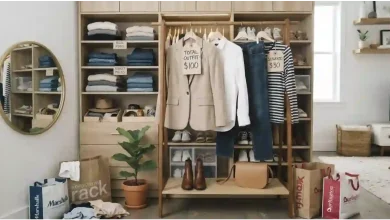
- Thrift and clearance work well. Neutrals in navy, black, cream, gray, and tan are easy to find secondhand or on clearance racks.
- Keep a short list. A written list of palette colors and missing pieces helps you avoid impulse buys when you shop.
Common Mistakes
- Using too many accents. One accent color at about 10 percent is the goal. Two or three competing accents recreate the problem you’re trying to solve.
- Making the accent the largest piece. If the accent covers most of your outfit, it’s no longer an accent. Keep bold colors small unless you want a statement look.
- Mixing temperatures. A cool gray with a warm mustard can feel off. Stay within a warm or cool family.
- Ignoring saturation. Combining very bright and very muted pieces can make one look louder than intended.
- Wearing all neutrals with no contrast. An entirely beige outfit can look flat. Vary the shades or add texture.
- Forgetting about patterns. Several prints in one outfit can look busy, so stick to one.
- Keeping orphan pieces “just in case.” A piece that doesn’t pair with anything rarely gets worn.
- Treating the ratio as exact math. The 60-30-10 split is a guideline, not a measurement, so use your eye.
The 30-Second Outfit Check
Before you leave the house, run through this quick check:
- Count your colors. Do you have no more than three, plus any neutral basics?
- Find your 60. Is there one dominant color, usually in your bottoms or largest layer?
- Find your 30. Is there a supporting color, usually your top or jacket?
- Find your 10. Is there one small accent, such as a scarf, bag, or jewelry?
- Check the temperature. Are all your colors warm or all cool?
- Check the pattern. Is there no more than one pattern?
- Look in the mirror. If something feels off, remove or swap one piece instead of adding another.
📌 YOU MIGHT ALSO LIKE:
The “Project 333” Wardrobe Rule: How to Dress with Only 33 Items for 3 Months
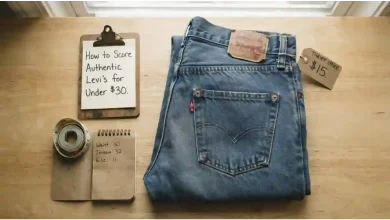
Stop Buying $110 Fast Fashion Denim: How to Score Authentic Levi’s for Under $30
FAQ
What is the 3-color rule in fashion?
It’s a styling guideline that limits an outfit to three main colors, often divided by the 60-30-10 ratio: 60 percent dominant color (usually a neutral), 30 percent secondary color, and 10 percent accent. It’s borrowed from interior design and ties into basic color theory.
Do neutrals count as one of the three colors?
It depends on which version you follow. In the strict version, every color counts. In the flexible version, neutrals like black, white, gray, navy, tan, and cream act as connectors and don’t count against your limit. Beginners often find the flexible version easier.
Can I really mix and match any 10 pieces with this method?
It works best when your pieces fit a coordinated palette. If your ten pieces are very random, sort them into base, supporting, and accent groups, set aside any orphans that don’t pair with anything, and fill the gaps over time.
What should my accent color be?
Choose a color you genuinely love that coordinates with your neutrals. Try it first in a small item like a scarf or earrings. Keeping it to about 10 percent of an outfit makes it feel like a deliberate finishing touch.
How many outfits can I get from 10 pieces?
With a coordinated palette, ten pieces can create dozens of combinations on paper. Realistically, expect around 15 to 20 good outfits once you account for combinations that aren’t flattering or practical.
Does the 60-30-10 rule apply to patterns too?
Yes, in a similar way. Some guides suggest keeping most of an outfit solid and limiting yourself to one pattern, with the pattern’s colors drawn from your palette.
The Bottom Line
A closet that “goes together” isn’t about owning more clothes. It’s about giving every piece a role. Pick a base color, a supporting color, and one accent. Sort your ten pieces into those groups, set aside the orphans, and use the 60-30-10 formula to build outfits where one color leads, one supports, and one adds a finishing touch. With ten well-chosen pieces, you can get through weeks of outfits without repeating yourself, and every item you add from here on will either strengthen the palette or tell you it doesn’t belong.
For more budget-friendly style guides and wardrobe strategies, check out more posts over at The Frugal Glow.
Sources: