

How to Build an Anti-Aging Skincare Routine on a Budget
Let me tell you about the $120 face cream I almost bought.
It promised to reverse the signs of aging, but before checking out, I remembered something a dermatologist once told me: great skincare is about using proven ingredients consistently—not buying the most expensive products.
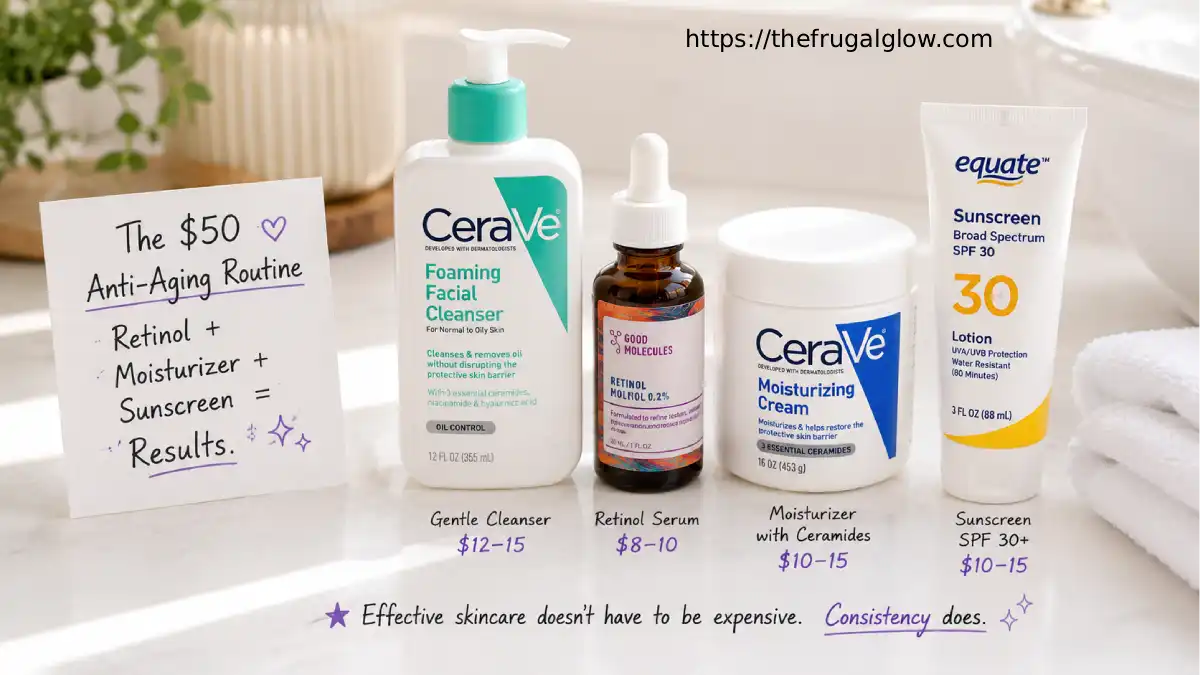
So I skipped the luxury cream and built an entire drugstore routine instead, including a retinol, moisturizer, sunscreen, and gentle cleanser. It cost less than half the price of that one jar, and my skin has never looked better.
Today, I’m sharing my budget-friendly anti-aging routine, the products worth buying, and how to get real results without spending $120 on a single face cream.
Jump Links
- The $120 Cream That Made Me See Red
- The Anti-Aging Trinity: 3 Ingredients That Actually Work
- The Budget Routine: 4 Steps, Under $50
- How to Layer Everything (Morning vs. Night)
- The Best Budget Products (Dermatologist-Approved)
- Common Anti-Aging Mistakes (And What to Do Instead)
- The Math: What I Saved in One Year
- Frequently Asked Questions (FAQ)
- Final Thoughts: Your Skin Doesn’t Know How Much You Spent
The $120 Cream That Made Me See Red
I need to describe that moment in Sephora.
I was holding the jar. It was beautiful. The packaging was heavy glass. The cream was thick and luxurious. The saleswoman told me it was “clinically proven” and “used by celebrities.” I almost handed over my credit card.
Then I looked at the ingredient list. Water. Glycerin. Shea butter. A few peptides. A tiny bit of retinol. Nothing magical. Nothing that cost $120 to produce.
I put it back. I went to CVS. I bought a CeraVe moisturizer for $15. Same ingredients. Same results. $105 saved.
That was the day I learned that expensive skincare is mostly marketing. Board-certified dermatologist Dr. Azadeh Shirazi says it best: “The cost of skin care often correlates with things that have little to do with quality, including marketing, packaging, and brand prestige rather than actual performance of ingredients”.
The best anti-aging routine is simple. It doesn’t need to be expensive. You just need three things: retinol, moisturizer, and sunscreen. That’s it.
The Anti-Aging Trinity: 3 Ingredients That Actually Work
Let me explain the three ingredients that dermatologists actually recommend.
1. Retinol (The Gold Standard)
Retinol is the most researched anti-aging ingredient in existence. “Retinoids are derivatives of vitamin A that actively impact your gene expression,” says board-certified dermatologist Dr. Hadley King. “They increase the turnover of skin cells, increase collagen production, and decrease discoloration”. Translation: they smooth wrinkles, fade dark spots, and firm your skin.
Retinol can be irritating at first, but you can start with a low concentration (0.1%) and work your way up.
2. Sunscreen (The Most Important Step)
This is non-negotiable. “Sun exposure is a primary factor in premature aging. No serum, cream, or treatment can undo consistent UV damage,” says Dr. Dendy Engelman, a board-certified cosmetic dermatologist. “Daily broad-spectrum SPF protects your skin at the source. It’s the foundation for every other anti-aging strategy”.
Use SPF 30 or higher every single day, even when it’s cloudy.
3. Moisturizer (The Barrier Protector)
As we age, our skin barrier naturally weakens. Moisturizer with ceramides and hyaluronic acid repairs and protects that barrier. “Ceramides are an important part of the skin barrier, so using a moisturizer with these included can help repair and maintain the skin barrier,” says Dr. Carmen Castilla.
The Budget Routine: 4 Steps, Under $50
Here’s my exact routine. Four steps. Under $50 total. All from the drugstore.
Step 1: Gentle Cleanser ($10-15)
Use a gentle cleanser that won’t strip your skin. Avoid harsh scrubs—they can create micro-tears in the skin and cause irritation.
| Budget Product | Price | Why It’s Good |
|---|---|---|
| CeraVe Hydrating Facial Cleanser | ~$14 | Non-irritating, soap-free formula that removes impurities without stripping moisture |
| Vanicream Gentle Facial Cleanser | ~$12 | Ideal for sensitive skin. Fragrance-free and non-irritating |
Step 2: Retinol ($8-15)
Start low and go slow. Look for products with 0.1% retinol.
| Budget Product | Price | Why It’s Good |
|---|---|---|
| Good Molecules Gentle Retinol Cream | $8 | Contains 0.1% retinol plus bakuchiol. Gentle enough for sensitive skin |
| The Ordinary Retinol 0.2% in Squalane | $10 | Moisturizing and very mild. Great for beginners |
| CeraVe Resurfacing Retinol Serum | ~$14 | Contains three types of ceramides to protect the skin barrier |
Step 3: Moisturizer ($10-15)
Look for ceramides, hyaluronic acid, or peptides.
| Budget Product | Price | Why It’s Good |
|---|---|---|
| CeraVe Moisturizing Cream | ~$15 | Replenishes ceramides, cholesterol, and fatty acids for a healthy skin barrier |
| Cetaphil Daily Oil-Free Facial Moisturizer SPF 35 | ~$13 | Multitasking—hydrates and protects in one step |
| Vanicream Daily Facial Moisturizer | ~$13 | Combines hyaluronic acid and ceramides for lasting hydration |
Step 4: Sunscreen ($10-15)
SPF 30 or higher. Broad-spectrum. Every single day.
| Budget Product | Price | Why It’s Good |
|---|---|---|
| Neutrogena Ultra Sheer Dry-Touch SPF 70 | ~$10 | Lightweight, non-greasy formula that sinks in |
| La Roche-Posay Anthelios Light Fluid Face Sunscreen SPF 60 | ~$15 | Oil-free, non-comedogenic, infused with antioxidants |
| EltaMD UV Clear Tinted SPF 46 | ~$15 | Contains niacinamide and antioxidants for extra benefits |
How to Layer Everything (Morning vs. Night)
Morning Routine:
- Gentle cleanser
- Vitamin C (optional, but nice for an extra antioxidant boost)
- Moisturizer
- Sunscreen (SPF 30 or higher)
Night Routine:
- Gentle cleanser
- Retinol (2-3 times per week to start)
- Moisturizer
The “Retinol Sandwich” (if you have sensitive skin):
- Apply moisturizer
- Apply retinol
- Apply more moisturizer
This reduces irritation without reducing effectiveness.
The Best Budget Products (Dermatologist-Approved)
Here are some dermatologist-recommended budget products:
The Ordinary Granactive Retinoid 2% Emulsion – A gentle, effective alternative to retinol with fewer side effects like peeling or redness.
Good Molecules Gentle Retinol Cream – 0.1% retinol plus bakuchiol. At $8, it’s one of the cheapest effective retinols on the market.
Palmer’s Skin Therapy Face Oil – Combines 10 natural oils with retinol and vitamin C. Good Housekeeping Seal holder with over 44,000 5-star reviews.
Neutrogena Hydro Boost + Niacinamide Serum – Pairs niacinamide with hyaluronic acid to hydrate and even out skin tone.
CeraVe Moisturizing Cream – “Replenishes ceramides, cholesterol, and fatty acids for healthy, resilient skin without clogging pores”.
Common Anti-Aging Mistakes (And What to Do Instead)
Learn from the experts—and from my mistakes.
Don’t use harsh physical scrubs. They create micro-tears in the skin and cause long-term sensitivity. Instead, use gentle chemical exfoliants with PHAs to encourage cell turnover without irritation.
Don’t use alcohol-heavy toners. They strip the skin of natural oils and disrupt the skin barrier. Instead, use a niacinamide serum, which strengthens the barrier and refines pores.
Don’t rely on makeup with SPF alone. It often provides insufficient protection. Instead, use a dedicated tinted sunscreen with broad-spectrum SPF.
Don’t skip sunscreen. This is the biggest mistake you can make. “No serum, cream, or treatment can undo consistent UV damage”.
Don’t use retinol too often when you first start. Start 1-2 times per week and build up gradually. Always apply to dry skin and follow with moisturizer.
Don’t use coconut oil on your face. It can clog pores and worsen breakouts. Instead, use barrier-repair moisturizers with ceramides.
The Math: What I Saved in One Year
Let me break down the actual dollars.
If I had bought the $120 cream:
| Item | Cost | How Often | Annual Cost |
|---|---|---|---|
| Luxury face cream | $120 | Every 2 months | $720 |
| Retinol serum | $50 | Every 3 months | $200 |
| Sunscreen | $40 | Every 2 months | $240 |
| Total | $1,160 |
What I actually spend on my budget routine:
| Item | Cost | How Often | Annual Cost |
|---|---|---|---|
| CeraVe moisturizer | $15 | Every 2 months | $90 |
| Good Molecules retinol | $8 | Every 4 months | $24 |
| Neutrogena sunscreen | $10 | Every 2 months | $60 |
| Gentle cleanser | $12 | Every 3 months | $48 |
| Total | $222 |
Annual savings: $938
Over 5 years: $4,690
And my skin looks better than it did with the expensive stuff.
Frequently Asked Questions (FAQ)
1. What age should I start using anti-aging skincare?
You can start in your mid-20s. By your late 20s to early 30s, you may notice the first appearance of fine lines and wrinkles. Starting early with sunscreen and a gentle retinol can prevent more visible signs later. But it’s never too late to start. “It’s never too late to start using them,” says Dr. Castilla.
2. Do I really need to wear sunscreen every day, even indoors?
Yes. UV rays penetrate windows. “No serum, cream, or treatment can undo consistent UV damage, but daily broad-spectrum SPF protects your skin at the source”. Use it every day.
3. Can drugstore retinol really work as well as prescription?
For most people, yes. “What started out as an Rx product is now available over the counter at a really good price,” says Boston-based dermatologist Ranella Hirsch. “It’s gentler than some of the more non-specific receptor retinoids”.
4. How long does it take to see results from retinol?
Most people see improvements in 2-3 months. Consistency is more important than speed. Use it regularly and be patient.
5. What’s the difference between retinol and bakuchiol?
Bakuchiol is a plant-based alternative to retinol. It has similar benefits (stimulating collagen production, softening fine lines) but with fewer side effects and less irritation. Research shows that bakuchiol can enhance the effectiveness of retinol while helping stabilize it.
6. Is expensive skincare ever worth it?
Rarely. “The efficacy of skin care often comes down to active ingredients, proper formulation, and consistency in use—not just the price tag”. Some luxury products have nicer textures or scents, but the active ingredients are the same.
Final Thoughts: Your Skin Doesn’t Know How Much You Spent
Here’s what I want you to take away.
That $120 cream I almost bought? It’s sitting in a Sephora display case. My $15 CeraVe is sitting on my bathroom counter. My skin looks better now than it did with any expensive product.
The ingredients that work are cheap. Retinol costs pennies to produce. Hyaluronic acid costs pennies to produce. Ceramides cost pennies to produce. You don’t need a $120 cream to get them.
You need four things: retinol, moisturizer, sunscreen, and a gentle cleanser. That’s it.
- Retinol: $8-15
- Moisturizer: $10-15
- Sunscreen: $10-15
- Gentle cleanser: $10-15
Total: Under $50. For a full anti-aging routine that dermatologists recommend.
I’ve been using this routine for two years. My skin is smoother. My fine lines are softer. My dark spots are fading. And I’ve saved nearly $1,000.
That’s not cheap. That’s smart.
That’s the frugal glow. And it’s waiting for you at the drugstore. 💛
For more budget beauty tips, product recommendations, and money-saving skincare strategies, visit The Frugal Glow.