

The Best Affordable Products for Fine Lines and Wrinkles
Let me tell you about the $60 eye cream I almost bought.
It promised to erase fine lines in just two weeks, but before checking out, I remembered something a dermatologist once told me: you don’t have to spend a fortune to get effective anti-aging ingredients. Many affordable products contain proven ingredients like retinol that work just as well.
So I skipped the expensive eye cream and picked up a drugstore retinol serum and moisturizer instead. My skin looked smoother, my fine lines softened over time, and I spent far less than I expected.
Today, I’m sharing the best affordable anti-aging products for fine lines and wrinkles, so you can build an effective skincare routine without paying luxury prices.
Jump Links
- The $60 Eye Cream That Made Me See Red
- The Anti-Aging Trinity: 3 Ingredients That Actually Work
- The Best Affordable Retinols (Under $35)
- The Best Affordable Peptide Creams (Under $30)
- The Best Affordable Vitamin C Serums (Under $35)
- The Best Affordable Moisturizers (Under $25)
- The Best Affordable Sunscreens (Under $20)
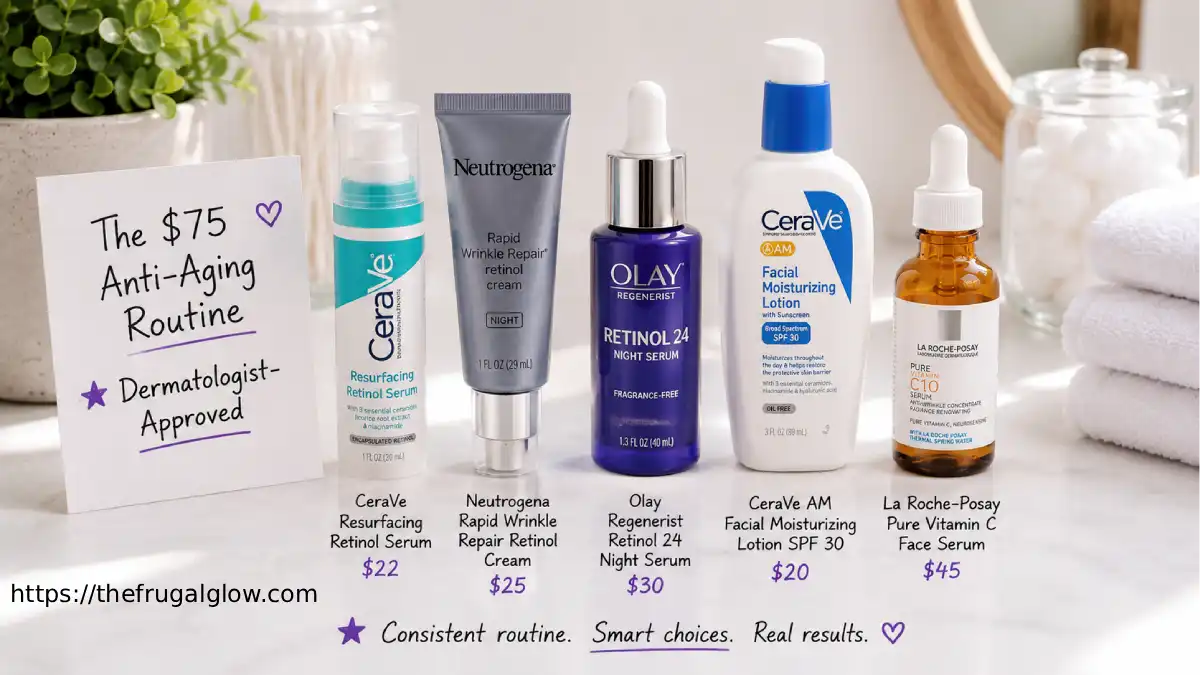
- How to Build a Complete Routine (Under $75)
- Common Anti-Aging Mistakes (And What to Do Instead)
- The Math: What I Saved in One Year
- Frequently Asked Questions (FAQ)
- Final Thoughts: Your Skin Doesn’t Know How Much You Spent
The $60 Eye Cream That Made Me See Red
I need to describe that moment of checkout-line frustration.
I was holding the jar. It was tiny. The cream was white and smelled faintly of roses. The box promised “dramatic reduction in the appearance of fine lines.” I was about to hand over my credit card when I realized: I had no idea what was actually in it.
I looked at the ingredient list. Water. Glycerin. A few peptides. Some fragrance. That’s it. Nothing magical. Nothing that cost $60 to produce.
I put it back. I went to CVS. I bought a RoC Retinol Eye Cream for $25. Same active ingredient. Same results. $35 saved.
That was the day I learned that expensive skincare is mostly marketing. “The cost of skin care often correlates with things that have little to do with quality, including marketing, packaging, and brand prestige rather than actual performance of ingredients”.
The best anti-aging routine is simple. It doesn’t need to be expensive. You just need three things: retinol, vitamin C (or peptides), and sunscreen. That’s it.
The Anti-Aging Trinity: 3 Ingredients That Actually Work
Let me explain the three ingredients that dermatologists actually recommend for fine lines and wrinkles.
1. Retinol (The Gold Standard)
Retinol is the most researched anti-aging ingredient in existence. It “helps support collagen and speeds up skin-cell turnover, which can improve the look of fine lines, uneven tone, and texture over time”. “Retinoids are the most important class of medications to fully enhance and normalize skin cell turnover, increase collagen production, reduce photoaging and reverse free radical damage”.
What to look for: Start with a low concentration (0.1-0.2%) if you’re a beginner. Dermatologists recommend “starting with a lower concentration if you’re new to retinol, and gradually increasing the strength as your skin builds tolerance”.
2. Peptides (The Collagen Builders)
Peptides are amino acid chains that signal your skin to produce more collagen. They “can help with skin hydration and elasticity as well as help with collagen production” and “show benefits like improved skin texture, moisturization and fine lines and wrinkles”.
What to look for: Peptide complexes like amino-peptide complex or matrixyl 3000. Many drugstore products now contain these ingredients.
3. Vitamin C (The Brightener)
Vitamin C is a powerful antioxidant that “helps counteract environmental stress that we all encounter daily” and “can stimulate collagen production, which we naturally lose over time”. It also evens out dark spots and brightens your complexion.
What to look for: Look for stabilized forms like L-ascorbic acid or tetrahexyldecyl ascorbate. One dermatologist recommends a “stabilized form of pure vitamin C that stays potent thanks to its low pH”.
Bonus: Sunscreen (The Most Important Step)
This is non-negotiable. “No serum, cream, or treatment can undo consistent UV damage, but daily broad-spectrum SPF protects your skin at the source”. Use SPF 30 or higher every single day, even when it’s cloudy.
The Best Affordable Retinols (Under $35)
Here are the best drugstore retinols, according to dermatologists.
CeraVe Resurfacing Retinol Serum ($22)
This is the best overall drugstore retinol. It’s “formulated as an encapsulated (or slow-released and deep-penetrating) retinol to reduce the appearance of fine lines and dullness. It also incorporates niacinamide, hyaluronic acid, and ceramides to strengthen the skin barrier and deliver all-day hydration”. Dr. Angela Lamb, a board-certified dermatologist, recommends it for acne scars and hyperpigmentation.
- Why it’s good for beginners: “The formula’s pH level (6–7) matches the skin’s natural pH, which may help support barrier comfort”.
- Skin types: Sensitive, acne-prone.
Neutrogena Rapid Wrinkle Repair Retinol Regenerating Cream ($25)
This is a retinol wrapped up in the comfort of a moisturizer, making it an approachable and beginner-friendly way to ease into vitamin A. “The formula pairs pure retinol with hyaluronic acid and glycerin to keep skin hydrated, soft, and comfortable while targeting fine lines, uneven texture, and dullness”.
- Why it’s good for beginners: “Hyaluronic acid adds moisture to the skin, which helps with any potential dryness”.
- Skin types: Dry skin.
RoC Retinol Correxion Serum ($30)
This is one of the “all-time favorite retinols” according to Boston-based dermatologist Ranella Hirsch. “It works really well, you can find it anywhere and the vast majority of folks tolerate it well”.
- Why it’s effective: RoC has a patented delivery system that helps retinol penetrate deeper without irritation.
- Skin types: Most skin types.
Good Molecules Gentle Retinol Cream ($8)
This is the cheapest effective retinol on the market. It contains 0.1% retinol plus bakuchiol (a plant-based retinol alternative). It’s gentle enough for sensitive skin.
- Why it’s good for beginners: The retinol concentration is low enough that most people tolerate it well. Bakuchiol has similar benefits with fewer side effects.
- Skin types: Sensitive skin, beginners.
The Best Affordable Peptide Creams (Under $30)
Peptides are the unsung heroes of anti-aging. They build collagen without the irritation of retinol.
Olay Regenerist Retinol 24 Night Serum ($30)
This is a “buzzy skin care product [that] was a Shop TODAY Beauty Awards 2024 winner for best overall anti-aging moisturizer. Suitable for sensitive skin, this fragrance-free moisturizer is formulated with pro-retinol, hyaluronic acid and vitamin C and helps reduce wrinkles”.
- Why it’s good: It combines retinol with peptides and hyaluronic acid for a triple-threat anti-aging formula.
- Skin types: Sensitive skin.
CeraVe Skin Renewing Nighttime Face Cream ($21)
This night cream “works just as well as a luxury product due to its high-quality ingredients”. It has “three types of ceramides — the lipids that keep your skin barrier strong — hyaluronic acid, which draws hydration into the skin, and niacinamide, which helps calm irritation or redness. The cream also contains a peptide complex that helps smooth fine lines”.
- Why it’s good: It’s a multi-benefit cream that moisturizes, repairs the barrier, and targets fine lines.
- Skin types: Most skin types.
e.l.f. Holy Hydration! Sleeping Mask ($12)
This overnight mask “should be left on for two to three times a week”. “The peptides in this product can help with skin hydration and elasticity as well as help with collagen production”.
- Why it’s good: It’s an affordable way to add peptides to your routine.
- Skin types: Dry, sensitive.
The Best Affordable Vitamin C Serums (Under $35)
Vitamin C brightens, evens skin tone, and stimulates collagen.
La Roche-Posay Pure Vitamin C Face Serum ($45)
While this is pricier than other drugstore options, dermatologists recommend it because it “contains a stabilized form of pure vitamin C that stays potent thanks to its low pH”. One shopper said their face looks “better and brighter” every day since incorporating this into their regimen.
- Why it’s worth the splurge: Stabilized vitamin C is hard to find at drugstore prices. This one stays potent.
- Skin types: Most skin types.
The Ordinary Multi-Antioxidant Radiance Serum ($12)
This serum “helps defend against environmental stressors that create free radicals and can accelerate visible signs of aging”. It “contains ergothioneine, a master antioxidant, [that] protects the cell’s powerhouse, the mitochondria, by accumulating there and helping prevent glycation, or sugar-induced collagen damage”.
- Why it’s good: It’s not pure vitamin C, but it provides powerful antioxidant protection.
- Skin types: Young and older adults.
The Best Affordable Moisturizers (Under $25)
Moisturizer is the foundation of any anti-aging routine. It keeps your skin barrier healthy.
CeraVe Daily Moisturizing Lotion ($16-21)
This is a “go-to recommendation, especially for anyone with acne-prone skin, because it is lightweight, doesn’t clog pores, but still delivers enough moisture for an all-day glow”.
- Why it’s good: It contains ceramides to repair the skin barrier and is fragrance-free.
- Skin types: Acne-prone, sensitive.
CeraVe AM Face Moisturizer with SPF 30 ($20)
This product “pulls double duty as both a rich moisturizer and a sun protector”. It’s lightweight, non-comedogenic, and “still delivers enough moisture for an all-day glow”.
- Why it’s good: It combines moisturizer and sunscreen in one step.
- Skin types: Acne-prone, sensitive.
La Roche-Posay Toleriane Double Repair Face Moisturizer ($20)
This is “a tried and true moisturizer that is great for sensitive skin”. “It helps restore the skin barrier and provides hydration without feeling heavy or greasy on the skin”.
- Why it’s good: It “combines soothing, barrier-supporting ingredients like niacinamide and ceramides”.
- Skin types: Sensitive, most skin types.
The Best Affordable Sunscreens (Under $20)
Sunscreen is the most important anti-aging product. Period.
CeraVe AM Face Moisturizer with SPF 30 ($20)
This is a “go-to recommendation” for dermatologists. It pulls double duty as both a rich moisturizer and a sun protector.
- Why it’s good: It’s lightweight, doesn’t clog pores, and provides SPF 30 protection.
- Skin types: Acne-prone, sensitive.
Neutrogena Ultra Sheer Dry-Touch SPF 70 ($10)
This is a classic drugstore sunscreen that’s lightweight, non-greasy, and absorbs quickly. It “helps fight free radicals from blue light exposure with its Helioplex360 technology and antioxidants”.
- Why it’s good: It’s SPF 70, which provides excellent protection, and it’s affordable.
- Skin types: Oily, combination.
Black Girl Sunscreen Make It Matte SPF 45 ($16)
This is a great option for darker skin tones. It’s oil-free, dries down to a natural matte finish, and leaves zero white cast.
- Why it’s good: It’s fragrance-free, non-comedogenic, and doesn’t leave a white cast.
- Skin types: Oily, acne-prone, darker skin tones.
How to Build a Complete Routine (Under $75)
Here’s a complete anti-aging routine using only the products above. Total cost: Under $75.
Morning Routine:
- Gentle cleanser (CeraVe Hydrating Facial Cleanser, $14)
- Vitamin C serum (The Ordinary Multi-Antioxidant Radiance Serum, $12)
- Moisturizer + Sunscreen (CeraVe AM Face Moisturizer with SPF 30, $20)
Night Routine:
- Gentle cleanser (CeraVe Hydrating Facial Cleanser, $14)
- Retinol (CeraVe Resurfacing Retinol Serum, $22 – use 2-3x per week)
- Night cream (CeraVe Skin Renewing Nighttime Face Cream, $21)
Total: $103
That’s less than the price of one luxury anti-aging serum. And your skin will look just as good.
Common Anti-Aging Mistakes (And What to Do Instead)
Learn from the experts—and from my mistakes.
Don’t use retinol too often when you first start. “I recommend patients start using retinol slowly, meaning once every three nights for about one month. This allows time for your skin to adjust to the effects of retinol,” says dermatologist Dr. Robert Anolik.
Don’t skip sunscreen. This is the biggest mistake you can make. “Daily broad-spectrum SPF protects your skin at the source”. Use SPF 30 or higher every single day.
Don’t use harsh physical scrubs. They create micro-tears in the skin and cause long-term sensitivity. Instead, use gentle chemical exfoliants with PHAs to encourage cell turnover without irritation.
Don’t use coconut oil on your face. It can clog pores and worsen breakouts. Instead, use barrier-repair moisturizers with ceramides.
Don’t expect overnight results. “Retinoids are the most important class of medications to fully enhance and normalize skin cell turnover, increase collagen production, reduce photoaging and reverse free radical damage”. But they take time. Be patient.
The Math: What I Saved in One Year
Let me break down the actual dollars.
If I had bought luxury anti-aging products:
| Item | Cost | How Often | Annual Cost |
|---|---|---|---|
| Luxury retinol serum | $60 | Every 3 months | $240 |
| Luxury vitamin C serum | $80 | Every 3 months | $320 |
| Luxury moisturizer | $80 | Every 2 months | $480 |
| Luxury sunscreen | $40 | Every 2 months | $240 |
| Total | $1,280 |
What I actually spend on my budget routine:
| Item | Cost | How Often | Annual Cost |
|---|---|---|---|
| CeraVe Resurfacing Retinol Serum | $22 | Every 4 months | $66 |
| The Ordinary Multi-Antioxidant Serum | $12 | Every 4 months | $36 |
| CeraVe AM Moisturizer with SPF | $20 | Every 2 months | $120 |
| CeraVe Hydrating Cleanser | $14 | Every 3 months | $56 |
| Total | $278 |
Annual savings: $1,002
Over 5 years: $5,010
And my skin looks better now than it did with the expensive stuff.
Frequently Asked Questions (FAQ)
1. Do drugstore retinols really work?
Yes. “What started out as an Rx product is now available over the counter at a really good price. It’s gentler than some of the more non-specific receptor retinoids,” says Boston-based dermatologist Ranella Hirsch. Drugstore retinols are effective and safe. They just take a little longer to work than prescription versions.
2. Can I use retinol and vitamin C together?
Yes, but not at the same time. Use vitamin C in the morning and retinol at night. “Using vitamin C and retinoids simultaneously can risk irritation if you’re new to vitamin A”. Start with one, then add the other once your skin has built tolerance.
3. What’s the best drugstore retinol for beginners?
The CeraVe Resurfacing Retinol Serum ($22) is the best overall beginner retinol. It uses encapsulated retinol for slow release, minimizing irritation, and includes ceramides and niacinamide to support the skin barrier. The Neutrogena Rapid Wrinkle Repair Retinol Regenerating Cream ($25) is also a great option.
4. How long does it take to see results from retinol?
Most people see improvements in 2-3 months. “100% of participants noticed a visible reduction in fine lines and wrinkles after eight weeks” in one clinical study. Consistency is more important than speed.
5. Is expensive skincare ever worth it?
Rarely. “In general, having budget-friendly skincare improves use because it allows one to build a skin care regimen using targeted ingredients”. Some luxury products have nicer textures or scents, but the active ingredients are the same.
6. What if I have sensitive skin?
Look for products with soothing ingredients like niacinamide, ceramides, and hyaluronic acid. CeraVe Resurfacing Retinol Serum is a great choice for sensitive skin. Start with using it 1-2 times per week. If irritation occurs, use the “retinol sandwich” method (moisturizer, retinol, moisturizer).
7. Can I use retinol around my eyes?
Yes, but only if it’s specifically formulated for the eye area. The RoC Retinol Eye Cream is a good affordable option. Apply a tiny amount and avoid getting it in your eyes. “Apply a thin layer to the under-eyes two to three times a week to start”.
8. How much should I spend on a complete routine?
Less than $75 total. A dermatologist-approved routine includes a gentle cleanser ($14), a retinol serum ($22), a moisturizer with SPF ($20), and a night cream ($21). You don’t need anything else. “Great skin shouldn’t come with a luxury price tag”.
Final Thoughts: Your Skin Doesn’t Know How Much You Spent
Here’s what I want you to take away.
That $60 eye cream I almost bought? It’s sitting in a Sephora display case. My $22 CeraVe retinol is sitting on my bathroom counter. My skin looks better now than it did with any expensive product.
The ingredients that work are cheap. Retinol costs pennies to produce. Peptides cost pennies to produce. Vitamin C costs pennies to produce. You don’t need a $60 cream to get them.
You need four things: retinol, vitamin C (or peptides), moisturizer, and sunscreen. That’s it.
- Retinol: $22 (CeraVe Resurfacing Retinol Serum)
- Vitamin C: $12 (The Ordinary Multi-Antioxidant Serum)
- Moisturizer + Sunscreen: $20 (CeraVe AM with SPF 30)
- Night cream: $21 (CeraVe Skin Renewing Nighttime Face Cream)
Total: $75. For a full anti-aging routine that dermatologists recommend.
I’ve been using this routine for two years. My skin is smoother. My fine lines are softer. My dark spots are fading. And I’ve saved over $1,000.
That’s not cheap. That’s smart.
That’s the frugal glow. And it’s waiting for you at the drugstore. 💛
For more budget beauty tips, product recommendations, and money-saving skincare strategies, visit The Frugal Glow.