

Retinol for Beginners: The Cheapest Way to Start Without Damaging Your Skin
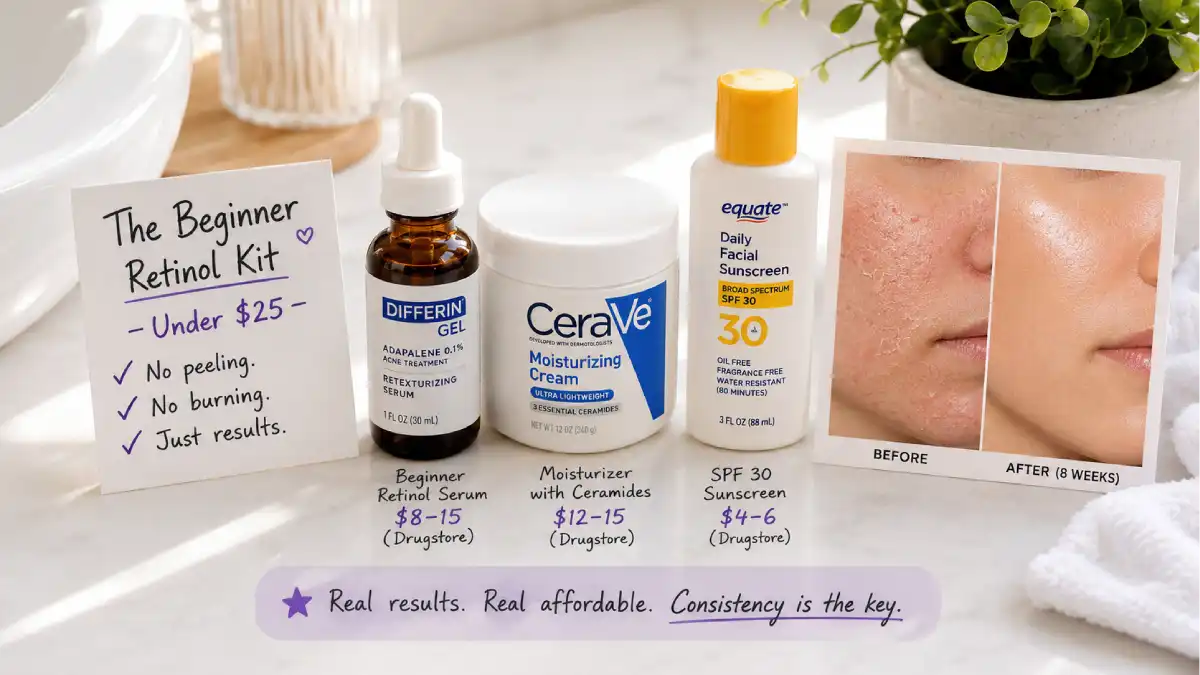
Let me tell you about the $50 retinol serum that completely changed how I use skincare.
I bought an expensive retinol serum expecting amazing results, but after using it every night, my skin became red, flaky, and irritated. I assumed retinol just wasn’t for me—until a dermatologist explained that my routine, not the ingredient, was the problem.
By switching to a gentle drugstore retinol, using it slowly, and pairing it with a good moisturizer, my skin gradually became smoother, brighter, and more even without the irritation.
Today, I’m sharing the easiest and most affordable way to start using retinol, plus the beginner-friendly products and tips that helped me get great results without spending a fortune.
Jump Links
- The $50 Mistake That Made Me Swear Off Retinol
- What Is Retinol (And Why Dermatologists Love It)
- The Cheapest Way to Start (Under $15)
- The Beginner Retinol Shopping List
- How to Start Retinol Without Damaging Your Skin (The 4-Step Plan)
- What to Expect: The Timeline
- How to Handle the ‘Retinol Purge’
- What Not to Do (Common Beginner Mistakes)
- The Math: What I Saved in One Year
- Frequently Asked Questions (FAQ)
- Final Thoughts: You Don’t Need a $50 Serum to Get Results
The $50 Mistake That Made Me Swear Off Retinol
I need to describe that moment in the mirror.
I had been using the retinol serum for three nights in a row. I thought I was being diligent. I thought more was better. I looked in the mirror on day four. My face was red, flaky, and tight. It hurt to smile. It hurt to put on moisturizer. I looked like I had a chemical burn.
I stopped using it. I threw it away. I told myself retinol wasn’t for me.
I was wrong. Retinol wasn’t the problem. My approach was the problem.
The truth is, retinol is one of the most researched, effective skincare ingredients in existence. Dermatologists call it the “gold standard” of anti-aging. It stimulates collagen production, speeds up cell turnover, and evens out skin tone. But it’s also potent. Using it incorrectly can lead to irritation, dryness, and peeling.
That’s why starting slowly is the only way to go. “Retinoids are potent, and using them incorrectly can lead to irritation or damage,” says skin expert Caroline Hirons. “Start once or twice a week, see how your skin reacts and build tolerance from there”.
I wish I had known that before I spent $50 and ruined my face for a week.
What Is Retinol (And Why Dermatologists Love It)
Let me explain what retinol actually is.
Retinol is a derivative of Vitamin A. It speeds up skin cell turnover, which helps reduce fine lines, wrinkles, and dark spots. It also unclogs pores, making it effective for treating acne.
How it works: “Once inside the cell, retinol is converted to retinal and then to retinoic acid. This conversion is crucial because retinoic acid is the active form that interacts with cellular receptors. These receptors influence gene expression and cellular response”. In plain English: it tells your skin cells to behave like younger, healthier cells.
The benefits: Retinol can reduce the appearance of fine lines and wrinkles, clear up acne, stimulate collagen production, and even out skin tone.
The catch: With great power comes great responsibility. Retinol can cause dryness, redness, peeling, and irritation if used incorrectly. That’s why starting slowly is essential.
The Cheapest Way to Start (Under $15)
You do not need a $50 serum. Drugstore retinols work just as well. Dermatologists agree. “What started out as an Rx product is now available over the counter at a really good price,” says Boston-based dermatologist Ranella Hirsch. “It’s gentler than some of the more non-specific receptor retinoids”.
Here are the best beginner-friendly retinols under $15:
| Product | Price | Why It’s Good for Beginners |
|---|---|---|
| The INKEY List Starter Retinol Serum | ~$14 | “Specially formulated for beginners or those with sensitive, reactive skin.” Uses a slow-release Dual-Retinoid complex and soothing ingredients. |
| The Ordinary Retinol 0.2% in Squalane | ~$10 | “A smart first step if you want the gentlest entry point.” Moisturizing and very mild]. |
| Good Molecules Gentle Retinol Cream | ~$8 | Contains 0.1% retinol plus bakuchiol (a plant-derived retinol alternative). Gentle enough for sensitive skin. |
| CeraVe Resurfacing Retinol Serum | ~$13-22 | Contains encapsulated retinol for slow release, plus ceramides and niacinamide to support the skin barrier. |
The cheapest option: Good Molecules Gentle Retinol Cream at $8. It’s a cream base, which is less drying than a serum. It also contains bakuchiol, which has retinol-like benefits without the harshness.
What to look for when shopping:
- Low concentration: Start with 0.1-0.2% retinol or a gentle derivative like retinyl palmitate.
- Hydrating ingredients: Look for hyaluronic acid, glycerin, ceramides, or squalane.
- Soothing ingredients: Niacinamide, allantoin, or bisabolol can help calm skin.
- Fragrance-free: If you have sensitive skin, avoid fragrances.
The Beginner Retinol Shopping List
Here’s everything you need for a beginner-friendly retinol routine:
| Item | Why You Need It | Cost |
|---|---|---|
| Beginner retinol (0.1-0.2%) | The main ingredient | $8-15 |
| Gentle cleanser | For cleansing without stripping | $5-10 |
| Basic moisturizer (with ceramides or hyaluronic acid) | The “sandwich” layers | $5-12 |
| Sunscreen (SPF 30 or higher) | Non-negotiable: retinol increases sun sensitivity | $5-15 |
Total starter cost: $23-52
What you already have: You probably already have a cleanser, moisturizer, and sunscreen. If so, you only need the retinol. That’s $8-15.
What to skip: Exfoliating acids (AHAs, BHAs), scrubs, and harsh cleansers. They will irritate your skin while you’re adjusting to retinol.
How to Start Retinol Without Damaging Your Skin (The 4-Step Plan)
Here’s the exact plan my dermatologist friend gave me. Follow it, and you’ll avoid the peeling, burning, and regret.
Step 1: Prep Your Skin Barrier First
If your skin is already irritated, tight, or breaking out, don’t start retinol yet. “If your skin is feeling tight, irritated, or breaking out regularly, it’s not ready yet,” says Skin Renew Co. “Build up your barrier first using ceramides, niacinamide, and a consistent, acne-safe moisturizer”.
Prep for 1-2 weeks: Use a gentle cleanser and a moisturizer with ceramides or niacinamide. CeraVe Daily Moisturizing Lotion or La Roche-Posay Cicaplast Baume B5 are great options. Once your skin feels calm and hydrated, you’re ready.
Step 2: The ‘Retinol Sandwich’ Method
This is the most important hack for beginners. It dramatically reduces irritation while still delivering results.
What it is: Apply moisturizer, then retinol, then moisturizer. “The retinol sandwich method minimizes the contact of retinol with the skin’s surface, thereby reducing irritation while still delivering anti-ageing benefits,” says board-certified dermatologist Dr. Rachel Nazarian.
How to do it:
- Cleanse with a gentle cleanser.
- Apply a thin layer of moisturizer (first slice of bread).
- Apply a pea-sized amount of retinol to dry skin (the filling).
- Wait a few minutes for the retinol to absorb.
- Apply another layer of moisturizer (second slice of bread).
Why it works: The first layer of moisturizer creates a buffer. The second layer locks in moisture. This reduces irritation without reducing effectiveness.
Data from the AAD: A study presented at the American Academy of Dermatology Annual Meeting showed that the full sandwich method is effective for new users to ease into retinol . It reduces retinoid bioactivity (meaning less penetration and less irritation), while the “open sandwich” (moisturizer on top only) maintains full efficacy for regular users.
Step 3: Start Slow (1-2x Per Week)
This is the most common beginner mistake. You want to see results, so you use it every night. Don’t.
The plan:
- Weeks 1-2: Use retinol once a week (e.g., every Saturday night).
- Weeks 3-4: Use retinol twice a week (e.g., Tuesday and Saturday).
- Weeks 5-6: If your skin is tolerating it well, move to every other night.
- After 8 weeks: If your skin is happy, you can move to nightly use.
What dermatologists say: “I recommend patients start using retinol slowly, meaning once every three nights for about one month. This allows time for your skin to adjust to the effects of retinol,” says Dr. Robert Anolik. The INKEY List Starter Retinol serum is designed to be used 2-3 nights a week to start, increasing as your skin builds tolerance.
The “dry skin” rule: Always apply retinol to dry skin. “Damp skin increases irritation”. After cleansing, wait 10-20 minutes for your skin to dry completely before applying retinol.
Step 4: Moisturize and Protect
Moisturizer is your best friend during the retinization process. And sunscreen is non-negotiable.
Why moisturizer matters: Retinol speeds up cell turnover, which can lead to dryness and flaking. A good moisturizer restores hydration and soothes irritation.
Why sunscreen matters: Retinol increases your skin’s sensitivity to UV rays. “Use SPF and reapply liberally throughout the day as vitamin A makes your skin more sensitive to UV rays”. Use SPF 30 or higher every morning, even on cloudy days.
What to Expect: The Timeline
Retinol takes time. You won’t see results in a week. Here’s what to expect.
| Timeframe | What Happens |
|---|---|
| Week 1-2 | No visible changes. Your skin may feel slightly drier than usual. |
| Week 3-4 | You may notice smoother, more even texture. Some people experience mild purging (breakouts coming to the surface). |
| Week 5-8 | Results become more visible: fine lines look softer, skin tone is more even, texture is smoother. The INKEY List Starter Retinol is clinically proven to smooth fine lines in just 7 days. |
| 2-3 months | Significant improvements in texture, tone, and fine lines. This is when most people see the best results. |
Important: “After using Starter Retinol consistently for eight to 12 weeks, if your skin feels comfortable, you can progress to the Advanced Retinal Serum”.
How to Handle the ‘Retinol Purge’
The “purge” is when your skin breaks out more in the first few weeks. It’s not a sign of a problem. It’s a sign that the retinol is working.
Why it happens: Retinol speeds up cell turnover. Underlying congestion surfaces all at once. It’s normal and temporary.
What to do: Stick with the plan. Don’t quit. Don’t use more retinol to try to “speed up” the purge. That will only make it worse. Use the retinol sandwich method. Moisturize. Be patient. The purge typically lasts 2-4 weeks.
If the irritation is severe: If your skin is burning, weeping, or extremely red, stop using retinol. Let your skin heal. Start again when your skin has recovered, using a lower concentration and a slower schedule.
What Not to Do (Common Beginner Mistakes)
Learn from my $50 mistake and the mistakes of others.
Don’t use retinol every night. You will irritate your skin. Start 1-2x per week.
Don’t use retinol on damp skin. It increases absorption and irritation.
Don’t use exfoliating acids (AHAs, BHAs) on retinol nights. They combine to cause redness and peeling.
Don’t use retinol near your eyes unless it’s specifically formulated for the eye area. The eye area is more fragile. “Avoid heavy creams or fragranced products, as these can clog the meibomian glands, lead to milia, or cause irritation,” says Dr. Elizabeth Hawkes.
Don’t skip moisturizer. It’s not optional. It’s essential.
Don’t skip sunscreen. Retinol makes your skin more sensitive to the sun. Skipping sunscreen is the biggest mistake you can make.
Don’t use vitamin C and retinol together at first. “Using vitamin C and retinoids simultaneously can risk irritation if you’re new to vitamin A”.
The Math: What I Saved in One Year
Let me break down the actual dollars.
Before (using expensive retinol and giving up):
| Item | Cost | How Often | Annual Cost |
|---|---|---|---|
| Fancy retinol serum | $50 | Twice (bought one, threw it out) | $100 |
After (using drugstore retinol correctly):
| Item | Cost | How Often | Annual Cost |
|---|---|---|---|
| Good Molecules Gentle Retinol Cream | $8 | Every 3 months | $32 |
| CeraVe moisturizer (already had) | $0 | – | $0 |
| Sunscreen (already had) | $0 | – | $0 |
Annual savings: $68
Over 5 years: $340
What I did with the savings: I bought a higher-quality moisturizer to go with my retinol routine.
Frequently Asked Questions (FAQ)
1. How do I know which retinol strength is right for me as a beginner?
Start with the lowest concentration available. Look for 0.1% to 0.2% retinol or a gentle derivative like retinyl palmitate. Products labeled “beginner” or “starter” are designed for this. The INKEY List Starter Retinol uses a slow-release Dual-Retinoid complex. Good Molecules Gentle Retinol Cream uses 0.1% retinol plus bakuchiol. Avoid products with “high potency” or “advanced” labels until you’ve built tolerance.
2. What’s the “retinol sandwich” method and why does it work?
The retinol sandwich is applying moisturizer, then retinol, then moisturizer. It reduces irritation by creating a buffer while still delivering benefits. Studies presented at the 2025 AAD Annual Meeting showed that the full sandwich method helps new users get accustomed to retinol. It’s the best way to start without damaging your skin.
3. How often should I use retinol when I first start?
Use it once or twice a week for the first 2-4 weeks. Dermatologists recommend starting with every third night or twice a week. The INKEY List Starter Retinol is designed to be used 2-3 nights a week initially. After your skin builds tolerance (usually 4-8 weeks), you can increase frequency.
4. Can I use drugstore retinol or do I need a prescription?
Drugstore retinol works great for beginners. Dermatologists confirm that over-the-counter retinols are effective and gentler than prescription options. “What started out as an Rx product is now available over the counter at a really good price. It’s gentler than some of the more non-specific receptor retinoids,” says Boston-based dermatologist Ranella Hirsch. Only stronger forms like tretinoin (retinoic acid) require a prescription.
5. What are the side effects of retinol and how do I avoid them?
Common side effects include dryness, redness, peeling, and irritation. To avoid them: start 1-2x per week, use the retinol sandwich method, apply to dry skin only, and moisturize diligently. Use SPF every morning. Avoid using with exfoliating acids or other actives. If irritation occurs, reduce frequency and focus on barrier repair.
6. What should I do if my skin starts peeling?
Peeling is a sign you’re overdoing it or your skin is adjusting. Don’t stop completely. Reduce frequency (go back to 1x per week). Use more moisturizer. Apply a thin layer of Vaseline or Aquaphor over your moisturizer on dry areas. If peeling is severe, stop for a week and restart with the retinol sandwich method.
7. Can I use retinol around my eyes?
Yes, but only if it’s specifically formulated for the eye area or you’re very careful. The eye area is more fragile and prone to irritation and milia. “Avoid heavy creams or fragranced products, as these can clog the meibomian glands, lead to milia, or cause irritation,” says Dr. Elizabeth Hawkes. Apply a tiny amount and avoid getting it in your eyes.
8. How long does it take to see results from retinol?
Most people see noticeable improvements in 2-3 months. The INKEY List Starter Retinol is clinically proven to smooth fine lines in just 7 days. For full effects (collagen stimulation, dark spot fading), it takes 8-12 weeks. Consistency is more important than speed.
9. Can I use retinol if I have sensitive skin?
Yes, but you need to be more careful. Choose a product specifically formulated for sensitive skin, like the INKEY List Starter Retinol or CeraVe Resurfacing Retinol Serum. Use the retinol sandwich method. Start with once a week or even every 10 days. If your skin is very sensitive, consider starting with bakuchiol (a gentler retinol alternative) before moving to retinol.
10. How do I know when to increase my retinol strength?
When you’ve been using your current retinol for 8-12 weeks without irritation and you’re not seeing further improvement, you can consider moving up. Look for a higher concentration (0.3-0.5%) or a more potent form like retinaldehyde. “After using Starter Retinol consistently for eight to 12 weeks, if your skin feels comfortable, you can progress to the Advanced Retinal Serum”. Always step up gradually (use the new product 1-2x per week initially).
Final Thoughts: You Don’t Need a $50 Serum to Get Results
Here’s what I want you to take away.
I wasted $50 on a retinol serum that made my face peel off. I thought retinol wasn’t for me. I was wrong. Retinol was for me. My approach was the problem.
The secret is simple: start low, go slow, and moisturize like crazy.
You don’t need a $50 serum. You don’t need a prescription. You need a $8-15 drugstore retinol, a basic moisturizer, and a little patience.
- Start with 0.1-0.2% retinol.
- Use the retinol sandwich method.
- Apply 1-2x per week for the first month.
- Moisturize and wear SPF every day.
In 2-3 months, your skin will be smoother, brighter, and more even. And you’ll have saved $50.
That’s the frugal glow. And it starts at the drugstore. 💛
For more budget skincare tips, product recommendations, and money-saving beauty strategies, visit The Frugal Glow.