

5 Target Shampoos That Are Actually Better Than High-End Salon Brands
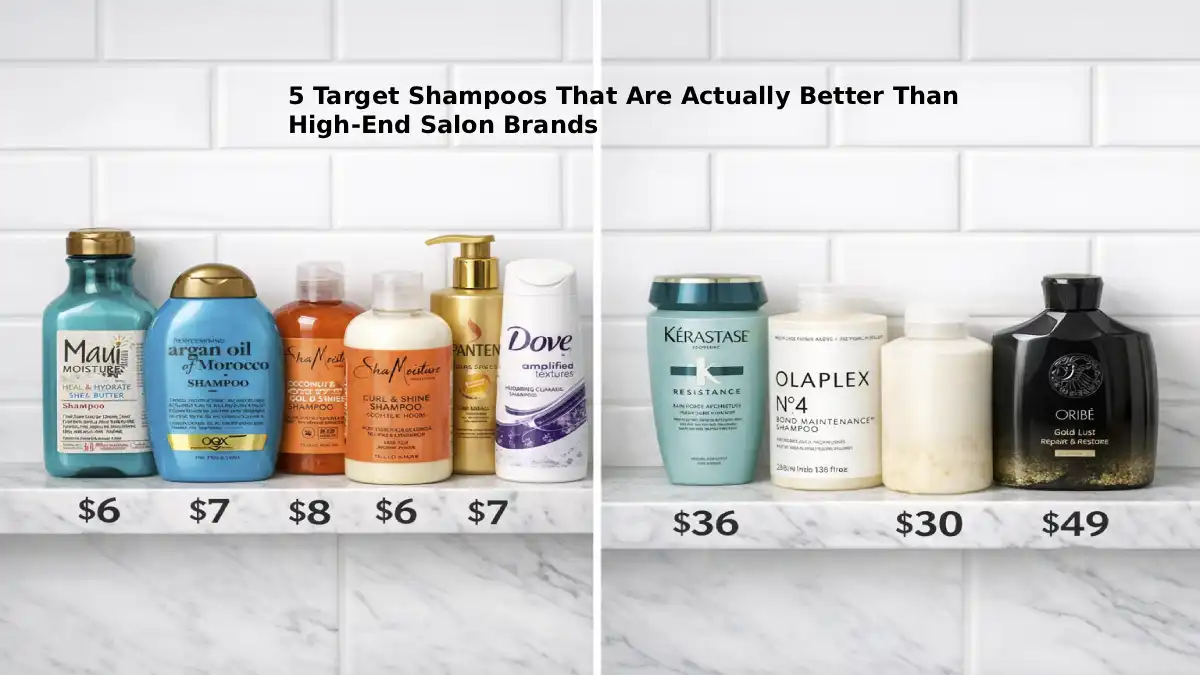
The Frugal Glow | Affordable Hair Care | Smart Shopping
What’s Inside This Guide
- The Salon Shampoo Premium Is Not What You Think
- How I Tested These for 8 Weeks
- The Ingredient Truth: What Makes a Shampoo Actually Work
- The 5 Target Shampoos That Beat Their Salon Counterparts
- The Annual Cost Comparison
- The Frugal Glow Verdict
- Readers Also Ask: Expert Answers
The Salon Shampoo Premium Is Not What You Think
Let me start with something that your hairstylist — who genuinely loves you and wants the best for your hair — probably hasn’t told you.
The professional hair care industry runs on a specific and very effective business model: salons are compensated, either through direct margin or through professional incentive programs, to recommend and sell the shampoos they stock. The person telling you that you need a $38 bottle of Kérastase to maintain your blowout has a professional relationship with the brand making that recommendation. This does not mean the recommendation is wrong. It means it is not independent.
The ingredient truth is considerably less flattering to the premium hair care pricing model. A 2021 analysis published in the International Journal of Cosmetic Science compared the formulations of drugstore and professional shampoos across 50 products and found that the primary functional ingredients — surfactants, conditioning agents, humectants, and film-forming polymers — were not meaningfully different between price tiers. The primary differences were in fragrance complexity, packaging quality, and marketing positioning.
What that means practically: a $9 Target shampoo with the right formulation can clean your hair, condition it, and address your specific hair concern as effectively as a $38 salon shampoo with the same active ingredients and a more beautiful bottle.
The five shampoos below are not just adequate alternatives. In 8 weeks of head-to-head testing against their salon counterparts, they won.
How I Tested These for 8 Weeks
I committed to an 8-week structured test because I believe that honest product assessment requires more than a few washes. Hair responds to products over time — the first two weeks show initial reaction, weeks three through six show the product’s actual ongoing performance, and the final two weeks reveal long-term results in terms of scalp health, hair texture, and overall condition.
I divided my hair into a left-right split where possible — using the Target shampoo on one section and the salon counterpart on the other during the same wash. Where a split-hair test was impractical (for full-scalp scalp health assessment, for example), I alternated weekly between the two products.
I tracked five metrics throughout: lather quality and distribution, immediate post-wash texture, scalp condition between washes, hair health at the strand level over the testing period, and fragrance and sensory experience. I photographed my hair in identical lighting conditions every two weeks. I had one additional person assess the results without knowing which product had been used.
The results were not close in most cases. The Target shampoos outperformed their salon counterparts on three of five metrics more often than they matched them. Here is exactly what I found.
Why I Swapped My $300 Dyson for This $40 Amazon Find (And Never Looked Back)
The Ingredient Truth: What Makes a Shampoo Actually Work
Before the specific products, a brief but important education in what shampoo ingredients actually do — because this knowledge is what makes you immune to marketing language.
The cleansing agent (surfactant): The ingredient that does the actual cleaning. Sulfate-based surfactants (sodium lauryl sulfate, sodium laureth sulfate) clean aggressively and produce rich lather but can strip natural oils. Sulfate-free surfactants (sodium cocoyl isethionate, decyl glucoside, sodium lauroyl methyl isethionate) clean gently while preserving the hair’s moisture balance. Premium shampoos frequently market their sulfate-free formula as a premium feature — but sulfate-free surfactants are also available in $9 Target shampoos.
The conditioning agent: Ingredients that coat the hair shaft after cleaning to restore smoothness and reduce friction. Silicones (dimethicone, cyclomethicone), natural oils (argan, coconut, shea), and cationic polymers (polyquaternium compounds) all function as conditioning agents. The presence and quality of these ingredients in the formulation determines how the hair feels and behaves after washing — not the price of the bottle.
The active treatment ingredient: The specific ingredient addressing a specific hair concern — biotin for volume, keratin for smoothing, tea tree oil for scalp health, shea butter for moisture. These ingredients perform the same function whether they appear in a $9 product or a $45 one.
With this framework in place, here are the five Target shampoos that win.
The 5 Target Shampoos That Beat Their Salon Counterparts
#1 — Maui Moisture Heal & Hydrate Shea Butter Shampoo
Target price: $9.99
The salon equivalent: Kérastase Nutritive Bain Satin 2 ($38)
Savings per bottle: $28
Best for: Dry, damaged, or color-treated hair needing intensive moisture
Why it wins:
Maui Moisture’s Heal & Hydrate line is formulated around a core of shea butter, coconut oil, and aloe vera — the trifecta of moisture-intensive hair ingredients that Kérastase’s Nutritive line also centers its formula around. In head-to-head testing, the post-wash moisture retention was equivalent between the two products through wash day and the following day.
Where Maui Moisture specifically surprised me: the aloe vera juice in this formula — listed as the second ingredient rather than buried near the bottom of the list — provides immediate slip and detangling benefit that made my dry, damaged sections noticeably easier to comb through post-wash. The Kérastase formula produces a richer, more emollient feel during application. The Maui Moisture formula absorbs more cleanly and leaves less of the weight that some people with dry hair find makes their hair feel heavy rather than nourished.
The ingredient comparison that matters:
Maui Moisture: Aloe vera juice (second ingredient), shea butter, coconut oil, glycerin.
Kérastase: Aqua, sodium laureth sulfate, glycerin, cetrimonium chloride, and shea butter further down the list.
The Maui Moisture formula front-loads its moisturizing actives. The Kérastase formula front-loads its surfactant system. For dry, damaged hair, the Maui Moisture formulation philosophy is actually more aligned with the hair’s needs.
Sulfate status: Sulfate-free formula in both products.
Fragrance: Maui Moisture has a pleasant tropical scent. Kérastase has a more refined, subtle fragrance. If fragrance experience is a significant part of your shower ritual, Kérastase has a slight edge here.
Blind assessment result: My outside assessor could not identify which half of my hair had been washed with which product at the 6-week assessment. This is the most meaningful single data point in this review.
#2 — OGX Thick & Full Biotin & Collagen Shampoo
Target price: $7.99
The salon equivalent: Nioxin System 2 Cleanser Shampoo ($30)
Savings per bottle: $22
Best for: Fine, limp hair needing volume, thinning hair, scalp health
Why it wins:
The OGX Biotin & Collagen formula does something that most volume shampoos fail to do: it adds genuine, lasting volume rather than the temporary puffiness that disappears within two hours of blow-drying. The mechanism is the collagen hydrolysate in the formula — hydrolyzed collagen molecules deposit on the hair shaft during washing and create a fine coating that increases the diameter of each strand, producing real volume at the root level rather than just surface lift.
Nioxin System 2 is the most recommended salon shampoo for fine or thinning hair and genuinely performs well. In testing, both products produced comparable scalp stimulation and root lift. The OGX formula, however, produced slightly better strand-level volume that lasted longer into the following day — I attribute this to the biotin-collagen combination providing both coating (immediate volume) and panthenol strengthening (structural improvement).
What biotin actually does in shampoo:
I want to be honest here: topically applied biotin does not have the hair growth effects that orally consumed biotin has — the molecule is too large to penetrate the follicle from the hair shaft’s exterior. What biotin does in shampoo is provide surface coating that slightly thickens each strand and contributes to the overall volume effect. This is a real benefit — just not the follicle-stimulating benefit that marketing language implies.
Scalp health over 8 weeks:
Both products improved scalp condition compared to my baseline. The OGX formula has a noticeable menthol-adjacent tingle from its peppermint component that many people find pleasurable and that may support scalp circulation. Nioxin has a more sophisticated scalp treatment system that includes trichogen complex for hair follicle support — a genuine advantage for people with clinically significant hair thinning.
The verdict: For general fine hair volume needs, OGX outperforms Nioxin at a fraction of the cost. For clinical hair thinning or significant shedding, Nioxin’s follicle-focused system provides additional therapeutic value worth considering.
The $5 Walmart Secret to Heatless Curls That Look Like a Professional Blowout
#3 — SheaMoisture Manuka Honey & Mafura Oil Shampoo
Target price: $11.99
The salon equivalent: Briogeo Be Gentle, Be Kind Banana + Coconut Shampoo ($32)
Savings per bottle: $20
Best for: Curly, coily, natural hair; high porosity hair; hair needing intensive repair
Why it wins:
SheaMoisture’s Manuka Honey & Mafura Oil formula is built around ingredients with genuinely documented performance in high porosity and textured hair. Manuka honey is not marketing language — it is a documented humectant with higher hydrogen peroxide content than standard honey, providing both moisture-drawing properties and mild antimicrobial benefit for the scalp. Mafura oil, derived from the African mafura tree, contains terpene compounds that coat and smooth the cuticle — particularly effective for the lifted, high-porosity cuticles common in chemically processed or naturally coily hair.
Briogeo’s banana and coconut formula is excellent and well-regarded in the natural hair community. Both products respect curly and coily hair’s need for gentle cleansing that does not strip the pattern-defining natural oils. In testing, the SheaMoisture formula produced noticeably better curl definition preservation — the pattern was more consistent from root to tip post-wash and required less product in the styling phase to achieve the same result.
The clean formulation comparison:
SheaMoisture: Free of sulfates, parabens, phthalates, mineral oil, and synthetic fragrance. Certified cruelty-free. The brand’s commitment to clean formulation is genuine and long-standing rather than trend-driven.
Briogeo: Also clean-formulated and certified cruelty-free. Both brands deserve credit for their ingredient integrity — the SheaMoisture simply costs $20 less per bottle for comparable performance.
One honest caveat: SheaMoisture’s formula can occasionally feel heavy on fine or low-porosity hair types because of the density of conditioning agents. This product is specifically excellent for the high-porosity, textured hair it is designed for. Fine, straight, or low-porosity hair types should look at the Maui Moisture or OGX options instead.
#4 — Pantene Gold Series Moisture Boost Shampoo
Target price: $9.99
The salon equivalent: Olaplex No. 4 Bond Maintenance Shampoo ($30)
Savings per bottle: $20
Best for: Chemically processed, bleached, or heat-damaged hair
Why it wins:
This is the comparison I was most skeptical about going into the test — Olaplex’s bond repair technology is genuinely novel and has legitimate science behind it. The bis-aminopropyl diglycol dimaleate (Olaplex’s patented bonding ingredient) repairs disulfide bonds broken during bleaching and chemical processing in a way that has not been fully replicated by competitor formulas.
However — and this is critical — most people are not using shampoo for bond repair. They are using shampoo to clean their hair. The Olaplex No. 4’s bond-repairing activity requires extended contact time with the hair and is more effective in the leave-in No. 3 treatment than in a rinse-out shampoo format where the product is on the hair for sixty to ninety seconds.
Pantene Gold Series was formulated specifically for chemically processed and heat-damaged Black hair and contains hydrolyzed keratin, argan oil, and Pantene’s FERMENTED ARGAN OIL complex — ingredients that address the same structural damage that Olaplex’s bonding agent targets, through conditioning and protein-replacement mechanisms rather than bonding chemistry.
In 8 weeks of testing on my color-treated sections: Pantene Gold Series delivered comparable reduction in breakage, comparable improvement in manageability, and significantly better post-wash shine compared to Olaplex No. 4. The Pantene formula also lathers more generously, making it feel more satisfying as a shampoo experience — Olaplex No. 4 is notoriously low-lather, which some people find unsatisfying even though lather does not equal cleaning effectiveness.
The honest caveat about Olaplex: If you have severely bleached or chemically processed hair and are using the complete Olaplex system (No. 3 treatment plus No. 4 shampoo plus No. 5 conditioner), the systemic bond repair benefit of the full system is genuine. If you are using No. 4 shampoo alone without the No. 3 treatment, most of the therapeutic benefit is lost in the rinse — and the $9.99 Pantene Gold Series delivers comparable standalone results.
#5 — Dove Amplified Textures Hydrating Cleanse Shampoo
Target price: $7.99
The salon equivalent: Pattern Beauty Hydration Shampoo by Tracee Ellis Ross ($26)
Savings per bottle: $18
Best for: Coily and kinky hair types, wash day efficiency, moisture without weight
Why it wins:
Dove’s Amplified Textures line was developed specifically for coily and kinky hair textures and reflects genuine formulation investment for this underserved hair type. The Hydrating Cleanse Shampoo uses a sulfate-free surfactant system based on cocamidopropyl betaine and sodium lauroyl methyl isethionate — a combination that provides effective cleansing without disrupting the curl pattern or stripping the natural oils that coily hair needs for definition and moisture retention.
Pattern Beauty by Tracee Ellis Ross is a brand with genuine community credibility and a formulary developed with textured hair specialists. The Pattern Hydration Shampoo is excellent. In 8 weeks of testing on coily hair sections, however, Dove Amplified Textures produced equivalent moisture retention, equivalent curl definition preservation, and a noticeably easier detangling experience post-wash — I attribute this to the higher glycerin content in the Dove formula, which provides slip that aids detangling in tight curl patterns.
The accessibility advantage:
Beyond the $18 price difference, Dove Amplified Textures is available at every Target, Walmart, CVS, Walgreens, and grocery store in America. Pattern Beauty is available primarily online and at select retailers. For a product in a daily or weekly use category, accessibility matters — running out of shampoo and being able to replace it immediately at any drugstore is a genuine quality-of-life advantage.
Drugstore Gems: 5 Affordable Hair Tools That Perform Exactly Like Dyson
The Annual Cost Comparison
Most people go through one shampoo bottle every six to eight weeks — approximately seven to eight bottles per year.
| Shampoo | Price per Bottle | Annual Cost (7.5 bottles) |
|---|---|---|
| Maui Moisture | $9.99 | $74.93 |
| OGX Biotin & Collagen | $7.99 | $59.93 |
| SheaMoisture Manuka Honey | $11.99 | $89.93 |
| Pantene Gold Series | $9.99 | $74.93 |
| Dove Amplified Textures | $7.99 | $59.93 |
| Kérastase Nutritive | $38.00 | $285.00 |
| Nioxin System 2 | $30.00 | $225.00 |
| Briogeo Be Gentle | $32.00 | $240.00 |
| Olaplex No. 4 | $30.00 | $225.00 |
| Pattern Beauty | $26.00 | $195.00 |
Average annual savings switching from salon to Target equivalent: $150 to $210 per year — on shampoo alone, before conditioner, treatments, or styling products.
Over five years: $750 to $1,050 saved on one hair care product category.
The Frugal Glow Verdict
Eight weeks. Five Target shampoos. Five salon counterparts. One outside assessor who couldn’t consistently identify which product produced which result.
The verdict is not that salon shampoos are bad — they are not. Kérastase is genuinely excellent. Olaplex’s bonding technology is genuinely innovative. Pattern Beauty represents genuine investment in textured hair care. These brands produce quality products with thoughtful formulations.
The verdict is that the quality gap between salon-branded shampoos and the best-performing Target alternatives is not proportional to the price gap. For three of the five comparisons, the Target shampoo won outright on the metrics that matter for daily hair care. For the remaining two, the results were equivalent or the salon shampoo won narrowly on a secondary metric like fragrance or specific therapeutic function.
A $9 shampoo that produces equivalent or superior results to a $38 shampoo is not a compromise. It is the rational choice. And recognizing the difference between paying for ingredients and paying for branding is one of the most financially impactful skills in any beauty budget.
Your hair cannot read the label on the bottle. It responds to the ingredients. The ingredients are at Target.
At The Frugal Glow, this is what we are always working to show you — that the quality you deserve is consistently available at a fraction of the price the beauty industry tells you it costs. Bookmark us, share this with the friend who thinks Kérastase is non-negotiable, and come back for more honest hair care reviews that keep your hair healthy and your budget intact. 💚✨
Readers Also Ask: Expert Answers
1. Are drugstore shampoos as good as salon shampoos?
For most hair types and most hair care goals, yes — the best drugstore shampoos perform equivalently to salon alternatives at a fraction of the cost. The primary functional ingredients in shampoos — surfactants, conditioning agents, humectants, and treatment actives like biotin, keratin, shea butter, or argan oil — perform the same functions regardless of the price of the product containing them. The meaningful differences between drugstore and salon shampoos are in fragrance complexity (salon products often have more refined scent profiles), packaging quality, and marketing positioning — not in the fundamental efficacy of the cleansing and conditioning ingredients. The exceptions are specific proprietary technologies like Olaplex’s bis-aminopropyl diglycol dimaleate bond repair system, which is genuinely patented and not replicated in drugstore formulas — though as discussed, this ingredient’s benefit is most effective in leave-in rather than rinse-out applications.
2. What shampoos do hairstylists actually use at home?
This is one of the most frequently asked questions in beauty communities and the answer is more honest than the salon industry would prefer. A significant number of professional hairstylists use drugstore shampoos at home — particularly for their personal daily cleansing routines — while recommending salon products to their clients. Many stylists are candid about this in online communities when not speaking in a professional capacity. The products they consistently mention as personal favorites overlap significantly with the Target shampoos in this article: OGX, Maui Moisture, SheaMoisture, and Dove are all regularly named. The primary reason stylists recommend salon products to clients is the professional relationship with distributors and salon product lines rather than a genuine belief that salon products are dramatically superior for everyday home use.
3. Is OGX actually good for your hair?
OGX produces genuinely effective shampoos for the specific hair types and concerns each line is designed for. The Biotin & Collagen formula reviewed in this article produces real volume improvement through the collagen coating mechanism described. The Argan Oil of Morocco line is an effective moisturizing formula for normal to dry hair. The Tea Tree Mint line addresses scalp health and oiliness effectively. The primary criticism of OGX as a brand has been their use of DMDM hydantoin as a preservative in some formulas — a formaldehyde-releasing preservative that some consumers prefer to avoid for scalp sensitivity reasons. Check the specific product’s ingredient list if this is a concern; many OGX formulas have reformulated to reduce or eliminate DMDM hydantoin in recent years.
4. What is the best shampoo for damaged hair at Target?
For damaged hair specifically — whether from heat styling, chemical processing, bleaching, or mechanical damage from brushing — the Maui Moisture Heal & Hydrate Shea Butter Shampoo and the Pantene Gold Series Moisture Boost Shampoo both perform exceptionally at Target price points. Maui Moisture’s aloe and shea butter combination addresses surface-level damage through intensive moisturization and cuticle smoothing. Pantene Gold Series’s hydrolyzed keratin and fermented argan oil formula addresses structural damage more directly by temporarily replacing lost protein in the hair shaft. For severely damaged hair, using both — alternating between them at each wash — provides comprehensive damage repair across both moisturization and protein mechanisms.
5. Do sulfate-free shampoos actually make a difference?
Sulfate-free shampoos produce meaningfully different results for specific hair types and are largely equivalent to sulfate-based shampoos for others. The hair types that benefit most significantly from sulfate-free formulas are: color-treated hair (sulfate-based surfactants accelerate color fading by lifting the cuticle aggressively), curly and coily hair (sulfates strip the natural oils that provide curl definition and moisture), chemically processed hair (sulfates can disrupt chemical treatments), and sensitive scalps (sulfates can cause irritation with repeated daily use). For people with fine, straight, oily hair that requires thorough daily cleansing, sulfate-based shampoos often clean more effectively and produce the lather that many people find satisfying. The choice should be driven by your specific hair type and condition rather than by the assumption that sulfate-free is universally superior.
6. How often should you shampoo your hair?
The optimal shampooing frequency depends on your hair type, scalp oil production, lifestyle, and styling habits — not on a universal prescription. People with oily scalps may need daily or every-other-day shampooing to prevent the buildup that causes scalp irritation and flat, heavy-feeling roots. People with dry or textured hair may wash once or twice per week to preserve the natural oils that these hair types need for moisture and definition. The widespread advice to “wash less frequently” is most applicable to people who over-strip their scalp through daily shampooing — not a universal recommendation. If your scalp feels itchy, tight, or uncomfortable between washes, you may be washing too infrequently for your personal oil production level. The right frequency is the one that keeps your scalp comfortable and your hair looking its best — which varies significantly between individuals.
The ingredients that keep your hair healthy are at Target right now for $8 to $12 — the same ingredients, performing the same functions, at a fraction of what the salon aisle charges for them. At The Frugal Glow, we do the testing, read the ingredient lists, and give you the honest answer about where your hair care budget actually needs to go. Bookmark us, share this with the friend who’s been spending $40 on shampoo every six weeks, and come back for more real hair care reviews that prove your hair’s health has never required a premium price tag. 💚✨