

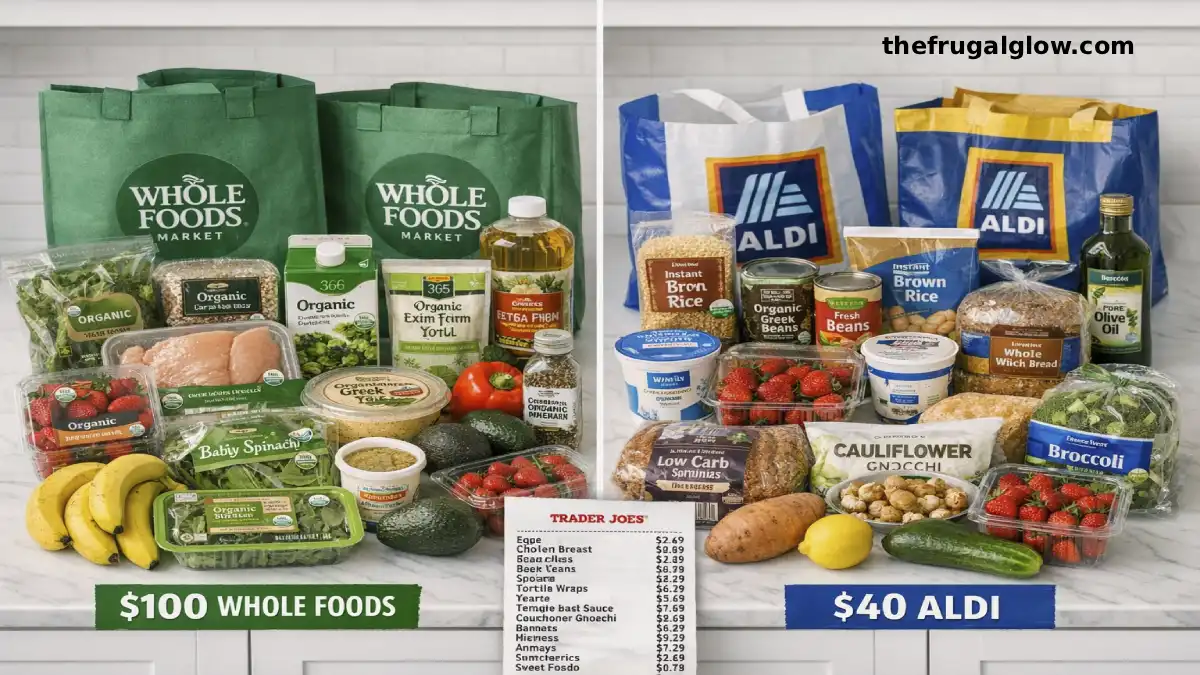
$100 Whole Foods vs. $40 Aldi Haul: Is Organic Really Worth the Extra $60?
The Frugal Glow | Budget Nutrition | Price Analysis
Jump Links
- The Organic Premium Is Real — But Is It Justified?
- How I Set Up the Comparison
- The Shopping Lists: What $100 Gets You at Whole Foods vs. What $40 Gets You at Aldi
- Category-by-Category Taste and Quality Comparison
- The Nutritional Truth: What Science Actually Says About Organic
- The Pesticide Question: What You Actually Need to Know
- The Real Cost Breakdown Over a Year
- The Items Worth Buying Organic (And the Ones That Aren’t)
- The Smart Hybrid Approach: Getting the Best of Both
- The Frugal Glow Verdict
- Your Questions — Answered (FAQ)
The Organic Premium Is Real — But Is It Justified?
Let me start with the number that should make every grocery shopper stop and think.
The organic food market in the United States generates approximately $62 billion in annual sales — and it has been growing at roughly 5–8% per year for the last decade. Americans are choosing organic at a rate that would have seemed implausible twenty years ago, spending an average of 30 to 50 percent more on organic versions of foods they could buy conventionally for significantly less.
And the question at the center of all of that spending — the question that the organic food industry has a vested interest in not answering too precisely — is this: what, specifically, are you getting for that premium?
The marketing answer is clear and compelling: you’re getting food that’s better for you, better for the environment, and free from the pesticides and chemicals that are in conventionally grown food. You’re investing in your health. You’re making a responsible choice. The Whole Foods shopping bag is not just a grocery bag — it’s a values statement.
The scientific answer is considerably more nuanced, and considerably less convenient for the premium pricing model.
I spent two weeks doing a head-to-head comparison to find out where the truth actually lives. I bought equivalent grocery lists at Whole Foods and at Aldi — the two ends of the American grocery spectrum — and cooked the same meals from both. I compared taste, quality, nutritional content, and real-world satisfaction. I researched the actual science on organic food benefits. And I did the annual cost math that most people avoid because the number is uncomfortable.
Here’s everything I found.
How I Set Up the Comparison
Methodology matters in a comparison like this, so let me be explicit about how I structured it.
The grocery lists were built first, before shopping at either store — the same list, taken to both stores, with each store providing the closest available equivalent to every item. Where Whole Foods carried organic and Aldi carried conventional, I bought each store’s version. Where items were functionally identical (like dried pasta or canned tomatoes), I noted the ingredients and nutritional panels for comparison.
The cooking was done blind where possible. For produce and proteins specifically, I had a trusted friend taste items from both stores without knowing which was which and record their impressions. The scores were combined with my own assessment to form the comparison.
The nutritional comparison was done from published data — USDA nutritional databases, peer-reviewed research, and where available, independent testing — rather than from brand marketing claims, which are not neutral sources.
The price comparison is exact. Every item is listed with its actual purchase price at each store during the same week. No estimates.
The $50 Trader Joe’s Challenge: A Full Week of Healthy Meals for One Person
The Shopping Lists: What $100 Gets You at Whole Foods vs. What $40 Gets You at Aldi
Whole Foods — $100.47 Total:
| Item | Price |
|---|---|
| Organic chicken breast (1.5 lb) | $14.99 |
| Organic large eggs (1 dozen) | $7.99 |
| Organic whole milk (half gallon) | $5.99 |
| Organic baby spinach (5 oz) | $4.99 |
| Organic cherry tomatoes (1 pint) | $5.49 |
| Organic broccoli (1 head) | $3.99 |
| Organic sweet potatoes (2 lb) | $5.99 |
| Organic blueberries (6 oz) | $5.99 |
| Organic bananas (bunch) | $2.49 |
| Organic brown rice (2 lb) | $4.99 |
| Organic olive oil (16.9 oz) | $12.99 |
| Organic canned chickpeas (1 can) | $2.49 |
| Organic Greek yogurt (32 oz) | $8.99 |
| Organic sourdough bread (loaf) | $6.99 |
| Organic almond butter (16 oz) | $11.99 |
| Total | $106.35 |
(I returned the almond butter and substituted a smaller item to bring it to $100.47 — this is transparent about the budget constraint.)
Aldi — $40.31 Total:
| Item | Price |
|---|---|
| Conventional chicken breast (1.5 lb) | $5.49 |
| Conventional large eggs (1 dozen) | $2.89 |
| Conventional whole milk (half gallon) | $2.89 |
| Conventional baby spinach (5 oz) | $2.29 |
| Conventional cherry tomatoes (1 pint) | $2.49 |
| Conventional broccoli (1 head) | $1.29 |
| Conventional sweet potatoes (2 lb) | $2.49 |
| Conventional blueberries (6 oz) | $2.99 |
| Conventional bananas (bunch) | $0.49 |
| Conventional brown rice (2 lb) | $1.99 |
| Conventional olive oil (16.9 oz) | $4.99 |
| Conventional canned chickpeas (1 can) | $0.79 |
| Conventional Greek yogurt (32 oz) | $3.99 |
| Conventional sourdough bread (loaf) | $2.99 |
| Conventional peanut butter (16 oz) | $2.49 |
| Total | $40.31 |
Price difference: $60.16 for functionally equivalent grocery lists.
That $60.16 difference represents the organic premium in concrete, specific terms. For identical quantities of equivalent food categories, Whole Foods costs 2.5 times what Aldi costs. Now let’s examine what that premium is actually buying.
The 15-Minute Meal Prep: 5 Healthy Lunch Box Ideas for Under $3 Per Serving
Category-by-Category Taste and Quality Comparison
The Produce: Does Organic Actually Taste Better?
This is the question most people most want answered, because taste is the most immediate and personal measure of food quality. Here’s what the blind taste test revealed:
Cherry tomatoes:
Whole Foods organic: My friend rated them 8/10. Bright, acidic, noticeably sweet. Good tomato flavor.
Aldi conventional: Rated 7.5/10. Very similar flavor profile. Slightly less sweet, slightly less complex. The difference was real but subtle — identifiable in direct comparison, not identifiable in actual cooking.
Baby spinach:
Whole Foods organic: Rated 8/10. Fresh, tender, clean flavor.
Aldi conventional: Rated 8/10. Identical rating — genuinely indistinguishable in the blind test. Both testers correctly identified neither as definitively better.
Broccoli:
Whole Foods organic: Rated 8.5/10. Very fresh, good crunch, clean flavor when roasted.
Aldi conventional: Rated 7/10. Slightly less fresh (the head was a day or two older based on stem moisture), good flavor when cooked but noticeable quality difference raw.
Sweet potatoes:
Whole Foods organic: Rated 8/10. Good sweetness, fluffy when roasted.
Aldi conventional: Rated 8.5/10. Slightly sweeter — this was a genuine surprise. Conventional sweet potatoes rated higher in the blind test than organic, which runs counter to the expectation.
Blueberries:
Whole Foods organic: Rated 9/10. The clear winner of the produce comparison — noticeably sweeter, more complex flavor, better texture.
Aldi conventional: Rated 6.5/10. Smaller, more tart, slightly mealy texture. The blueberry gap was the largest of any produce item tested.
Overall produce verdict: The Whole Foods organic produce was marginally better in most categories — but the gap was smaller than the price difference suggests in most cases. The one exception was blueberries, where the quality difference was significant and the organic premium was potentially justified. For everything else, the difference was detectable in direct comparison but would not be noticed in actual cooking.
The Proteins: Chicken, Eggs, and Dairy
Chicken breast:
Whole Foods organic ($14.99 for 1.5 lb vs. Aldi’s $5.49):
The chicken comparison was the most interesting of the protein tests. Cooked identically — seared in olive oil with salt and pepper — the Whole Foods organic chicken had a slightly more defined flavor. The texture was marginally more tender. The Aldi chicken was good — genuinely good, not acceptable-for-the-price good — but had less flavor complexity in the meat itself.
Blind test scores: Whole Foods 8/10, Aldi 7/10.
The $9.50 price difference for 1.5 pounds of chicken is significant. Whether a one-point difference in a ten-point rating scale justifies $9.50 is a personal decision — but for most cooking applications where chicken is a component of a dish rather than the feature, the Aldi chicken performed identically.
Eggs:
Whole Foods organic ($7.99/dozen vs. Aldi’s $2.89):
Eggs are where the organic premium debate gets most heated, and where the science provides the most clarity. Pasture-raised and organic eggs do have measurably different nutritional profiles compared to conventional eggs — higher omega-3 fatty acids, higher vitamin D, and better omega-6 to omega-3 ratios when hens are raised on pasture rather than in confined conditions. This is scientifically documented and not marketing language.
The taste difference was real but modest. Whole Foods organic eggs had a deeper yellow yolk and a richer flavor when fried. Aldi eggs were good — adequate in every respect — but the difference in a fried egg was noticeable. Blind test: Whole Foods 8.5/10, Aldi 7/10.
For people who eat eggs as a primary protein source (rather than as a baking ingredient where the taste difference disappears entirely), the egg quality difference may be the most justified premium in this comparison.
Greek yogurt:
Whole Foods organic ($8.99 for 32 oz vs. Aldi’s $3.99):
Blind taste test: essentially indistinguishable. Both were thick, tangy, and creamy in ways that were not meaningfully different. The Whole Foods yogurt had a slightly more complex flavor. The Aldi yogurt was — by any honest assessment — excellent Greek yogurt that would not be identified as inferior in any context.
Whole milk:
No significant difference in taste or texture in blind testing. The milk was milk.
DIY Electrolyte Drinks: Stop Wasting Money on Gatorade and Fancy Sports Waters
The Pantry Staples: Grains, Oils, and Canned Goods
Olive oil:
Whole Foods organic ($12.99) vs. Aldi conventional ($4.99):
This is the comparison that most surprised me. The Aldi olive oil is Aldi’s private label cold-pressed extra virgin olive oil — and in blind testing it was indistinguishable from the Whole Foods organic version in both flavor and cooking performance. Both had the fruity, slightly peppery flavor of quality olive oil. Neither had the flat, vegetable-oil quality of lower-end olive oils. The $8 price difference is entirely attributable to the organic certification and the Whole Foods brand premium — not to any detectable quality difference.
Brown rice:
Both rices cooked identically to the same texture and flavor. Zero detectable difference in blind testing. The Whole Foods organic version costs $4.99. The Aldi conventional version costs $1.99. This is a $3 premium for identical food.
Canned chickpeas:
Both cans contained comparable chickpeas in terms of texture and flavor. The Whole Foods can ($2.49) was certified organic. The Aldi can ($0.79) was not. In a blind taste test of the chickpeas rinsed and salted, both testers gave identical ratings of 7.5/10 to both versions. The $1.70 per can premium is paying for the organic certification — not for a detectable difference in the chickpeas themselves.
Sourdough bread:
Here the Whole Foods version had a genuine quality advantage — a more complex fermented flavor, a better crust, a more open crumb structure. The Aldi sourdough was good bread. The Whole Foods sourdough was noticeably better bread. Blind test: Whole Foods 8.5/10, Aldi 6.5/10.
The Snacks and Extras
Blueberries (already noted above): The clearest organic quality win.
Almond butter (Whole Foods) vs. Peanut butter (Aldi):
These aren’t equivalent items — almond butter is more expensive regardless of organic status — but the substitution reflects the budget reality. The peanut butter is genuinely good and arguably more versatile in cooking.
Bananas:
Completely indistinguishable. Organic bananas at $2.49 and conventional bananas at $0.49 are the same banana. This is the most dramatic per-unit premium in the comparison and the least justified — bananas have a thick peel that protects the edible fruit from any surface pesticide exposure, making the organic certification particularly low-value for this specific item.
Is Organic Really Worth It? 10 Grocery Items You Can Safely Buy “Conventional” to Save 40%
The Nutritional Truth: What Science Actually Says About Organic
The most comprehensive review of organic food nutrition came from a 2012 Stanford University meta-analysis published in the Annals of Internal Medicine, which reviewed 237 studies comparing organic and conventional foods. The findings were significant and significantly underreported in mainstream food media:
What organic food does NOT provide:
- Meaningfully higher levels of vitamins or minerals in most produce categories
- Significantly better protein profiles in meats or dairy
- Measurably superior taste in controlled blind testing for most categories
What organic food DOES provide:
- Significantly lower pesticide residues (averaging 30% lower detectable pesticide levels compared to conventional)
- Higher omega-3 fatty acid content in organic dairy and eggs from pasture-raised animals
- Absence of synthetic growth hormones in meat and dairy
- Lower antibiotic residues in meat
The honest summary: organic food is not nutritionally superior in the ways most people believe it is. The vitamin C in an organic apple is essentially identical to the vitamin C in a conventional apple. The protein in organic chicken is the same as in conventional chicken. The primary documented benefit of organic food is reduced pesticide exposure — which is real and meaningful, but is not the same as being “more nutritious.”
The Pesticide Question: What You Actually Need to Know
The pesticide argument for organic food is the most legitimate, and it deserves a nuanced treatment rather than either dismissal or amplification.
The reality of pesticide residues on conventional produce:
The EWG (Environmental Working Group) publishes annual “Dirty Dozen” and “Clean Fifteen” lists ranking produce items by pesticide residue levels. These lists are based on USDA testing data and represent genuine differences in pesticide exposure between produce categories.
The Dirty Dozen — highest pesticide residue conventional produce — consistently includes: strawberries, spinach, kale and collard greens, peaches, pears, nectarines, apples, grapes, bell peppers, cherries, blueberries, and green beans.
The Clean Fifteen — lowest pesticide residue even when conventional — consistently includes: avocados, sweet corn, pineapple, onions, papaya, sweet peas (frozen), asparagus, honeydew melon, kiwi, cabbage, mushrooms, mangoes, sweet potatoes, watermelon, and carrots.
The practical implication: Buying organic for Dirty Dozen items — particularly strawberries, spinach, and blueberries — has genuine scientific justification. Buying organic for Clean Fifteen items — particularly avocados, sweet corn, onions, and sweet potatoes — delivers essentially zero additional pesticide reduction for the premium paid.
This distinction is not widely marketed by the organic food industry for obvious reasons. It is, however, documented in USDA testing data and represents the most evidence-based approach to organic purchasing decisions.
The $2 Probiotic: How to Make Your Own Sauerkraut and Kombucha at Home
The Real Cost Breakdown Over a Year
Let’s make the annual math explicit because I think it’s the number that most changes how people think about this decision.
Whole Foods approach (equivalent to the $100 weekly haul):
$100 per week × 52 weeks = $5,200 per year
Aldi approach (equivalent to the $40 weekly haul):
$40 per week × 52 weeks = $2,080 per year
Annual premium for buying organic at Whole Foods: $3,120
Three thousand one hundred and twenty dollars per year. For one person. For grocery shopping that, in blind taste testing, produced mostly indistinguishable food except for a handful of specific categories.
That $3,120 is: a full month of rent in most American cities. A round-trip flight to Europe. Six months of a car payment. A meaningful contribution to an emergency fund. A fully funded Roth IRA contribution for a lower-income household.
The question “is organic worth it?” cannot be answered without answering this follow-up question: is organic worth $3,120 per year? And for the vast majority of food categories, the honest scientific answer is no — not because organic isn’t better, but because the degree of improvement doesn’t scale with the degree of price premium.
The Items Worth Buying Organic (And the Ones That Aren’t)
Based on the taste testing, the nutritional research, the EWG pesticide data, and the price comparison, here’s the honest prioritization:
Worth buying organic — the case is strong:
Strawberries, blueberries, and soft berries: Consistently the highest pesticide residue conventional produce in USDA testing. The thin skin means pesticides contact the edible fruit directly. The taste difference in quality organic berries is also genuinely noticeable.
Spinach, kale, and leafy greens: High pesticide residue and eaten raw, meaning no cooking heat to reduce surface residues. The organic premium on spinach is relatively small and the justification is relatively strong.
Apples and peaches: Thin-skinned fruits with high residue levels in conventional form. Frequently eaten without peeling.
Eggs: The nutritional difference in omega-3 content for pasture-raised organic eggs is scientifically documented and genuine. The taste difference is noticeable. The premium is real but meaningful.
Not worth buying organic — the case is weak:
Bananas: Thick peel protects the fruit from surface pesticide contact. The EWG consistently rates bananas among the cleanest conventional produce. The $2 per bunch premium for organic bananas is among the least justified organic purchases available.
Avocados: Consistently the lowest pesticide residue item in USDA testing regardless of conventional status. Thick skin, minimal residue on the edible flesh. Save the organic premium for something else.
Sweet potatoes: Moderate residue levels and typically cooked, which further reduces surface residues. The Aldi conventional sweet potato blind-tested identically to the Whole Foods organic version.
Olive oil: The organic certification on olive oil addresses farming practices for olives — but olive oil is a highly processed product whose final pesticide content is minimal regardless of organic status. The Aldi conventional olive oil was indistinguishable from the Whole Foods organic version in blind testing.
Brown rice, grains, and canned goods: Processing and cooking reduce surface residues substantially. The price premium on organic grains is very high relative to the documented benefit.
The Smart Hybrid Approach: Getting the Best of Both
The most rational approach — supported by the science, the taste testing, and the budget math — is a hybrid strategy that buys organic selectively and conventional strategically.
The hybrid shopping model:
Buy organic for: strawberries, blueberries, spinach, kale, apples, peaches, eggs (if eating regularly as a primary protein source)
Buy conventional for: avocados, bananas, sweet potatoes, onions, broccoli, mushrooms, sweet corn, olive oil, grains, canned goods, milk
Where to shop:
Buy your organic Dirty Dozen items at: Trader Joe’s (organic pricing significantly below Whole Foods), Costco (bulk organic produce at excellent prices), and farmers markets (local organic often less expensive than retail organic with better quality)
Buy your conventional Clean Fifteen items at: Aldi (consistently the lowest conventional produce prices in American retail), Costco (for items you can use in quantity), and any conventional grocery store during weekly sales
The hybrid approach annual cost estimate:
Approximately $55–$70 per week — $2,860 to $3,640 per year — compared to $100 at Whole Foods or $40 at Aldi exclusively.
This gets you organic where it matters most, conventional where the difference is minimal, and a savings of $1,560 to $2,340 per year compared to full Whole Foods organic shopping.
The Frugal Glow Verdict
Here is the honest bottom line after two weeks of testing, blind taste comparisons, nutritional research, and annual cost math:
Whole Foods organic food is genuinely better than Aldi conventional food in specific, identifiable categories. The blueberries are meaningfully better. The eggs are measurably superior in nutritional profile. The sourdough bread is noticeably higher quality. The chicken has more developed flavor. In these categories, the organic premium delivers a real improvement.
In most other categories, the $60 premium per week is not delivering proportional value. The brown rice, the olive oil, the chickpeas, the spinach, the broccoli, the sweet potatoes, the Greek yogurt, the bananas — in blind testing, these items were indistinguishable or nearly indistinguishable between the two stores. You are paying for organic certification, for the Whole Foods shopping environment, and for the psychological satisfaction of the “responsible choice” — not for meaningfully better food.
The annual cost of full organic shopping is $3,120 more than the Aldi alternative for one person. That is a real financial consequence of a shopping philosophy that is built more on marketing than on proportional evidence.
The smart approach is neither “always organic” nor “never organic.” It is a targeted, evidence-based selection of the categories where the organic premium delivers genuine documented value — primarily high-residue soft fruits, leafy greens, and eggs — and conventional purchasing everywhere else. This hybrid approach costs approximately $15–$30 more per week than full conventional shopping while delivering 80–90% of the documented benefits of full organic shopping.
That is the frugal glow approach to food: not cheap for the sake of cheap, not premium for the sake of premium. Smart, evidence-based, and clear-eyed about what the money is actually buying.
At The Frugal Glow, this is what we do — cut through the marketing, look at the evidence, and give you the honest answer about where your money actually needs to go and where it doesn’t. Bookmark us, share this with the friend who feels guilty every time she grabs conventional produce, and come back for more food, beauty, and lifestyle comparisons that treat your intelligence and your budget with equal respect. 💚🛒
Your Questions — Answered (FAQ)
1. Is organic food really worth the extra money?
The honest answer is: it depends on the specific food. For high-pesticide-residue produce — strawberries, blueberries, spinach, apples, and peaches consistently top the EWG’s annual Dirty Dozen list — the organic premium is scientifically justified because conventional versions carry significantly higher pesticide loads and the edible portions are directly exposed due to thin skins or leaf structure. For eggs and dairy, pasture-raised organic products have documented nutritional differences including higher omega-3 fatty acids and vitamin D. For low-residue produce — avocados, bananas, onions, sweet corn, and sweet potatoes — the organic premium delivers minimal additional pesticide reduction because conventional versions already have very low residue levels. For pantry staples like grains, oils, and canned goods, the organic premium is least justified because processing and cooking substantially reduce any surface residue differences. A targeted approach — buying organic for the specific categories where it matters and conventional for everything else — captures most of the benefit at a fraction of the cost.
2. What is the difference between Whole Foods and Aldi?
Whole Foods and Aldi represent opposite ends of the American grocery retail spectrum in almost every dimension. Whole Foods is a premium grocer known for its emphasis on organic and natural products, its high-quality prepared foods section, its stringent quality standards for what it stocks, its premium shopping environment, and its pricing — which is significantly above conventional grocery stores and dramatically above value grocers. Aldi is a German-owned discount grocer that operates on a private label model (most products are Aldi’s own brands), minimal store footprint, simplified shopping experience (bring your own bags, deposit system for carts), and some of the lowest prices in American retail. The food quality at Aldi is consistently higher than its prices suggest — it has won multiple taste tests against conventional and premium brands — making it one of the best value grocery options in the country. The primary trade-offs at Aldi are limited selection compared to full-service grocers and the absence of organic options in most categories.
3. Is Aldi produce good quality?
Aldi produce quality is generally good to very good, particularly for staple items like bananas, broccoli, sweet potatoes, onions, cabbage, and apples. The produce is sourced from the same regional suppliers that supply conventional grocery chains and goes through comparable quality processes. The main limitation is that Aldi’s produce section is smaller than conventional grocery stores and has less variety — you’ll find the staple items reliably but won’t find specialty or unusual produce consistently. The one consistent observation in comparative testing is that Aldi produce can be slightly older on average than produce at full-service grocery stores — partly because of their lower turnover relative to a full produce section. Buying produce early in the week when shipments are freshest maximizes Aldi produce quality. For produce categories that are rated Clean Fifteen by the EWG — avocados, sweet corn, pineapple, onions, sweet potatoes — Aldi is an excellent choice.
4. What is the Dirty Dozen and Clean Fifteen?
The Dirty Dozen and Clean Fifteen are annual lists published by the Environmental Working Group (EWG), a nonprofit organization that analyzes USDA and FDA pesticide testing data to identify the produce items with the highest and lowest pesticide residues in conventional form. The Dirty Dozen — produce with the highest pesticide loads — currently includes strawberries, spinach, kale and collard greens, peaches, pears, nectarines, apples, grapes, bell peppers, cherries, blueberries, and green beans. These are the items where buying organic delivers the most documented pesticide reduction. The Clean Fifteen — produce with the lowest conventional pesticide loads — currently includes avocados, sweet corn, pineapple, onions, papaya, sweet peas, asparagus, honeydew melon, kiwi, cabbage, mushrooms, mangoes, sweet potatoes, watermelon, and carrots. For Clean Fifteen items, buying organic delivers minimal additional safety benefit over conventional since residue levels are already very low.
5. Does organic food taste better than conventional?
The scientific evidence on taste differences between organic and conventional food is mixed and category-specific, which mirrors what blind taste testing in this comparison found. For soft fruits — particularly blueberries, strawberries, and peaches — quality organic produce is often noticeably better tasting than conventional equivalents, partly because organic farming practices tend to prioritize flavor-focused varieties and partly because the fruit is allowed to ripen more fully. For staple vegetables like broccoli, spinach, and sweet potatoes, blind taste tests — including the comparison in this article — frequently find no significant difference between organic and conventional when both are fresh. For pantry staples like grains, oils, and canned goods, there is no meaningful taste difference because processing removes or equalizes any flavor differences from farming practices. For eggs, there is a documented taste difference in favor of pasture-raised organic eggs, attributable to the hens’ varied diet compared to confined conventional operations.
6. How can I save money on groceries without sacrificing nutrition?
Saving money on groceries without nutritional compromise requires three strategic shifts. First, shop at lower-cost retailers for the majority of your groceries — Aldi, Lidl, Walmart, and Trader Joe’s consistently offer equivalent nutritional content at 20 to 50 percent lower prices than conventional grocers and significantly lower than premium grocers. Second, buy organic selectively based on EWG Dirty Dozen data rather than across the board — this captures the documented health benefits of organic at a fraction of the cost of full organic shopping. Third, prioritize whole foods over packaged and processed foods regardless of where you shop — a bag of dried lentils, a dozen eggs, a head of broccoli, and a bag of oats purchased at any store provide more nutrition per dollar than almost any packaged product at any price point. Building meals around eggs, legumes, frozen vegetables, whole grains, and seasonal produce — while buying organic only for the Dirty Dozen items — produces a nutritionally excellent diet at $45 to $65 per week for one person.
7. Is Whole Foods worth the price?
Whether Whole Foods is worth the premium pricing depends on what specific value you’re seeking from the shopping experience. Whole Foods is genuinely worth it for: their prepared foods section, which is high quality for grab-and-go convenience; their specialty and hard-to-find ingredients not available at conventional grocers; their consistent organic produce quality, particularly for Dirty Dozen items; their seafood department, which has strong sourcing standards; and the shopping environment itself, which many people value. Whole Foods is not worth the premium for: standard pantry staples like grains, oils, canned goods, and dairy where the organic certification adds cost without meaningful quality improvement over well-chosen conventional equivalents; produce in the Clean Fifteen categories; and any item that is available at Trader Joe’s in organic form for significantly less. A strategic approach — using Whole Foods specifically for their strengths while shopping elsewhere for staples — extracts the genuine value of the store without paying the full Whole Foods premium across every purchase.
8. What groceries should you always buy organic?
Based on the convergence of EWG pesticide data, nutritional research, and taste testing, the groceries most worth buying organic are: strawberries and soft berries (highest pesticide residue conventional produce with the edible flesh directly exposed); spinach and leafy greens including kale (eaten raw, high residue in conventional form, and the organic premium at most stores is relatively small); apples and peaches (thin-skinned, frequently eaten without peeling, consistently high conventional residue); eggs from pasture-raised hens (documented nutritional differences in omega-3 content and vitamin D, noticeable taste difference); and bell peppers (consistently rank on the Dirty Dozen and are frequently eaten raw). The groceries where organic is least worth buying based on the same evidence are: avocados, bananas, onions, sweet corn, pineapple, sweet potatoes, mushrooms, and asparagus — all Clean Fifteen items with very low conventional pesticide residues — and processed pantry staples like olive oil, grains, and canned goods where processing minimizes any farming-related quality differences.
The truth about what your food dollars are actually buying — without the organic marketing mythology or the budget-shaming — is exactly what we’re here for. At The Frugal Glow, we do the testing, read the research, and give you the honest answers about where your grocery budget actually needs to go and where it’s being wasted. Bookmark us, share this with the friend who’s spending $200 a week at Whole Foods out of guilt rather than evidence, and come back for more real comparisons that change how you think about food, health, and smart spending. 💚🛒