I started counting hairs in the shower. Not in a cute, mindful way. In a panic way. Every time I ran my fingers through my hair to rinse out conditioner, I’d look at my hands and see a small clump of strands that seemed way too big. It was never a bald spot or a dramatic reveal. Just a slow, steady drip of hair that made me dread wash days.
I did what any reasonable person does: I googled. And I found a thousand articles telling me to buy a $40 serum, a $60 supplement, or a $300 laser comb. I also found a smaller, quieter corner of the internet talking about fenugreek seeds. A bag of them costs about a dollar at an international grocery store or the spice aisle . People were soaking them in water and using the resulting gel as a scalp rinse. They claimed it reduced shedding, strengthened roots, and made hair feel thicker.
I was skeptical. But for a dollar, I was willing to test it. I spent eight weeks using a homemade fenugreek rinse once a week, tracking my shed count, and reading every piece of actual science I could find. Here is the honest breakdown of what fenugreek can and cannot do, the exact recipe that worked for me, and the real math on whether this is a genuine budget hack or just another internet myth.
Jump Links
- What Is Fenugreek (And Why Is It In My Kitchen?)
- The Science: What Fenugreek Actually Does for Hair
- The $1 Recipe: How to Make the Rinse
- My 8-Week Shedding Test: What Actually Changed
- The Side Effects Nobody Warns You About
- When Fenugreek Isn’t Enough (And You Need a Doctor)
- The Real Cost: Fenugreek vs. Drugstore Treatments
- Frequently Asked Questions
- Final Thoughts: The Frugal Glow Verdict
What Is Fenugreek (And Why Is It In My Kitchen?)
Fenugreek, also known as methi, is a small, yellowish-brown seed used in Indian, Middle Eastern, and Mediterranean cooking. It’s the secret ingredient that gives curry powder its distinctive maple-syrup-like smell. It’s also been used in traditional medicine for centuries, primarily for digestion and blood sugar management .
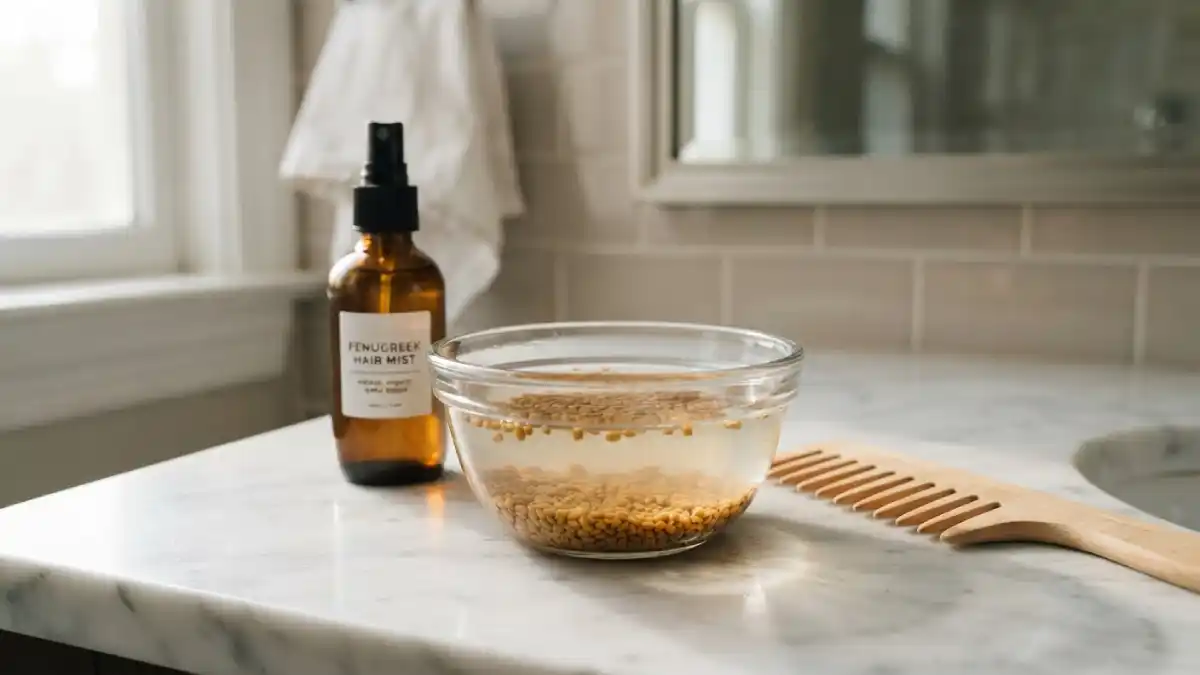
The part that matters for hair is what happens when you soak the seeds in water. They release a slippery, gel-like substance called mucilage. If you’ve ever made a chia seed pudding or a flax egg, you know the texture. It’s slimy, and it coats whatever it touches. In hair care, that mucilage acts as a natural conditioner and detangler. It seals the hair cuticle, locks in moisture, and gives the hair a smoother, shinier appearance .
But the claim that fenugreek stops shedding is a different beast entirely. To understand whether that’s real, we have to look at what the science actually says.
The Science: What Fenugreek Actually Does for Hair
Let’s be clear about the evidence. The National Center for Complementary and Integrative Health (NCCIH) states plainly that there isn’t enough scientific evidence to support using fenugreek for any health condition . That’s a sobering starting point.
However, there are some promising signals. A Harvard-trained integrative health specialist told NDTV that fenugreek seeds are rich in mucilage, iron, zinc, niacin, and amino acids that can “strengthen the hair root and reduce breakage” . The mechanism is thought to be twofold: the nutrients support the hair shaft itself, while the massage involved in applying the rinse boosts circulation to the scalp, which can improve follicle health.
There is also one clinical trial that mentioned fenugreek. A systematic review of herbal remedies for hair loss noted that a 2024 study on women with PCOS reported “a significant improvement in hair loss with fenugreek,” though it was a secondary finding, not the primary focus of the trial . That’s not a ringing endorsement, but it’s not nothing.
The honest interpretation: Fenugreek is not a cure for pattern baldness, hormonal hair loss, or telogen effluvium (the temporary shedding that happens after stress, illness, or a major life change). What it can do is improve the health of the hair you have. By conditioning the shaft, reducing breakage, and soothing the scalp, it can make your hair appear thicker and reduce the amount of hair you lose to mechanical damage (brushing, washing, styling). If your shedding is caused by breakage or a dry, irritated scalp, fenugreek might genuinely help. If your hair is falling out from the root due to an internal issue, a topical rinse won’t fix it.
The $1 Recipe: How to Make the Rinse
The recipe is embarrassingly simple. I bought a 3.5-ounce bag of fenugreek seeds from a local Mediterranean grocery store for $0.99 . You can also find them at Indian grocers, Whole Foods, or online. A 7-ounce bag runs about $3.79 , and even a 400-gram bag from a UK retailer is only £1.50 . The cost per use is essentially pennies.
What you need:
- 1 tablespoon of fenugreek seeds
- 1 cup of water
- A small bowl or jar
- A strainer or cheesecloth
- A spray bottle or applicator bottle (optional)
The method:
- Soak: Put the seeds in the bowl and cover them with the water. Leave them at room temperature overnight, or for at least 8 hours. The water will turn slightly yellow and the seeds will become soft and slippery.
- Strain: Pour the mixture through a strainer or cheesecloth into a clean container. You want the liquid, not the seeds. The liquid should feel slightly slimy between your fingers.
- Apply: After shampooing and rinsing, pour the fenugreek water over your scalp and hair. Massage it in gently for 2-3 minutes. Focus on the scalp and roots.
- Wait: Leave it on for 5-10 minutes. You can put on a shower cap if you want to keep it from dripping.
- Rinse: Rinse thoroughly with cool water. Follow with your regular conditioner (or use the fenugreek water as a final rinse and skip the conditioner if your hair is fine).
A note on the gel: If you want a thicker, more conditioning treatment, you can blend the soaked seeds with a little water to make a paste. Apply it as a mask for 20-30 minutes, then rinse. This is messier but gives a more intense conditioning effect .
My 8-Week Shedding Test: What Actually Changed
I’m a woman in my early thirties with fine, wavy hair that I wash every other day. My shedding was moderate—not alarming, but noticeable. I committed to using the fenugreek rinse once a week for eight weeks, immediately after my regular shampoo.
Weeks 1-2: No difference in shedding. My hair felt soft after the rinse, but the amount of hair in my drain was the same. I almost quit.
Weeks 3-4: This is where I noticed something. The breakage was down. When I brushed my hair after washing, I was seeing fewer short, broken pieces on the brush. The long strands were still shedding at the same rate, but the little snapped-off bits were reduced. The mucilage was clearly doing something to strengthen the shaft.
Weeks 5-6: My scalp felt less itchy. I hadn’t realized how much my scalp had been bothering me until it stopped. The anti-fungal and anti-inflammatory properties of the saponins in fenugreek seemed to be calming things down .
Weeks 7-8: The overall shed count in the shower dropped by maybe 20-30%. Not a dramatic, hair-transplant-level change, but a real one. More importantly, my hair felt thicker because there was less breakage and the strands were smoother.
The honest verdict: Fenugreek didn’t stop my hair from shedding at the root. What it did was reduce the secondary shedding caused by breakage and improve the health of my scalp. For a dollar, that was a win.
The Side Effects Nobody Warns You About
This is the part where the internet gets a little too enthusiastic about natural remedies. Fenugreek is generally safe when used topically, but there are real risks, especially if you decide to drink the water as well as apply it.
Topical use: Some people are allergic to fenugreek, particularly those with allergies to peanuts, chickpeas, or soybeans, because it belongs to the legume family. If you have a legume allergy, do a patch test on your inner arm before putting this anywhere near your scalp .
Internal use (drinking it): This is where things get tricky. The Harvard-trained expert quoted by NDTV specifically warns that people with IBS, severe bloating, low blood sugar, thyroid issues, or who are pregnant should avoid drinking fenugreek water . It can cause gas, bloating, diarrhea, and in high doses, it can lower blood sugar to dangerous levels. It can also interfere with thyroid medication and diabetes medication .
My recommendation: Stick to the topical rinse. You still get the conditioning and scalp benefits without the digestive risks. If you want to drink it, talk to a doctor first, especially if you’re on any medication.
When Fenugreek Isn’t Enough (And You Need a Doctor)
I need to be very clear about this. Fenugreek is a cosmetic and scalp-health tool. It is not a treatment for medical hair loss.
If you are experiencing any of the following, skip the kitchen remedies and see a dermatologist:
- Sudden, dramatic shedding (clumps of hair coming out, visible thinning patches)
- Shedding accompanied by scalp pain, redness, or scaling
- Hair loss that is concentrated at the crown or hairline (potential pattern baldness)
- Shedding that started after a major illness, surgery, or medication change
- Hair loss combined with fatigue, weight changes, or other systemic symptoms (potential thyroid or hormonal issue)
The NCCIH’s position is clear: there isn’t enough evidence to support fenugreek for any health condition . For genuine hair loss, the evidence-based treatments are things like minoxidil and finasteride, not spice-aisle remedies . Fenugreek is a supplement to a healthy routine, not a replacement for medical care.
The Real Cost: Fenugreek vs. Drugstore Treatments
Let’s do the budget math, because that’s the whole point of this experiment.
| Treatment | Cost | How Long It Lasts | Cost Per Month |
|---|---|---|---|
| Fenugreek seeds (3.5 oz bag) | $0.99 | ~12-15 rinses (3 months) | ~$0.33 |
| Drugstore minoxidil (generic) | $20-$30 | 1 month | $20-$30 |
| Biotin supplement | $10-$15 | 1 month | $10-$15 |
| “Hair growth” shampoo | $8-$15 | 1-2 months | $4-$15 |
The fenugreek rinse costs about 33 cents a month. Even if you buy a larger, organic bag for $3.79 , you’re still looking at under a dollar per month. That is, without exaggeration, the cheapest hair care experiment I have ever run.
Is it as effective as minoxidil for pattern baldness? Absolutely not. But for reducing breakage, soothing an irritated scalp, and improving the feel of your hair? It’s a remarkably good deal.
📌 YOU MIGHT ALSO LIKE:
Frequently Asked Questions
Does fenugreek seed rinse actually stop hair shedding?
It can reduce shedding caused by breakage and scalp irritation, but it does not stop hair loss caused by genetics, hormones, or medical conditions. The evidence for fenugreek as a hair loss treatment is limited .
How often should I use a fenugreek rinse?
Once or twice a week is sufficient for most people. Using it more frequently isn’t necessarily better and can be drying if you’re not conditioning afterward.
Can I leave fenugreek water in my hair?
You can, but it’s not recommended. The mucilage can leave a residue that feels sticky when it dries. Rinse it out after 5-10 minutes for the best results.
Does fenugreek water smell bad?
It has a mild, earthy, slightly maple-syrup-like scent. It’s not unpleasant, but it’s noticeable. The smell fades after rinsing and doesn’t linger in dry hair.
Can I use fenugreek powder instead of seeds?
Yes. Mix 1-2 tablespoons of fenugreek powder with warm water to make a paste or a thin rinse. The powder is more concentrated, so start with a smaller amount.
Is fenugreek safe for color-treated hair?
Yes, it’s generally safe. It won’t strip color or change your hair color. The mucilage actually helps seal the cuticle, which can make color last slightly longer.
Can I drink fenugreek water for hair growth?
You can, but be cautious. It can cause digestive issues and interact with medications for diabetes and thyroid conditions. Talk to a doctor before drinking it regularly .
Where can I buy fenugreek seeds?
Indian grocery stores, Middle Eastern markets, Whole Foods, and online retailers. A small bag costs about $1 .
Final Thoughts: The Frugal Glow Verdict
The $1 fenugreek seed hair rinse is not a miracle. It will not regrow your hairline or reverse pattern baldness. If you are experiencing serious hair loss, put down the spice bag and make a dermatologist appointment.
But if your shedding is the slow, frustrating kind—the breakage, the dry scalp, the hair that feels weaker than it used to—then this is a genuinely useful, absurdly cheap tool to add to your routine. It conditions, it soothes, and it costs less than a gumball.
I still use it once a week. My shower drain is less clogged, my scalp is calmer, and my hair feels softer. For 33 cents a month, I’ll take that trade.
For more honest cost breakdowns, real-world experiments, and practical ways to spend smarter on your beauty routine, visit The Frugal Glow. We do the math so you don’t have to.