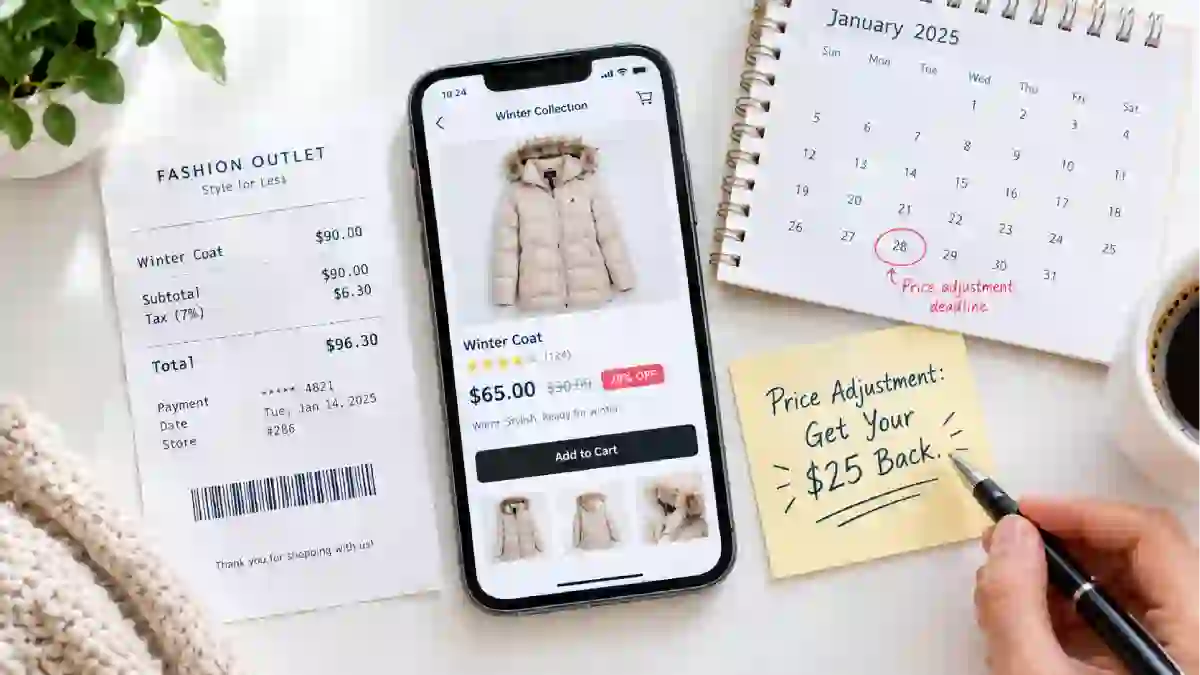
You buy a coat on Tuesday. On Friday, it’s 30 percent off. It’s one of the most irritating small moments in shopping, and most people just shrug and move on. But many retailers have a policy that will refund the difference if the price drops soon after you buy, and a lot of shoppers never use it because they don’t know it exists or assume it takes too much effort.
It isn’t really a “trick.” It’s a store policy, and it costs nothing to use. What makes it feel like a trick is that nobody does it automatically: you have to notice, you have to ask, and you have to ask within a limited window. This guide explains how price adjustments work, the major stores that offer them (with an honest caveat about how much the policies vary), a simple seven-step system to claim refunds, the scripts to use, and the situations where it won’t work.
Jump Links
- Price Adjustment vs. Price Match vs. Price Protection
- An Honest Warning About Policies
- Store-by-Store Policy Table
- The 7-Step System
- Scripts You Can Copy
- Your Record-Keeping Template
- What Usually Doesn’t Qualify
- Return and Rebuy: The Backup Plan
- Using Adjustments Around the Holidays
- Mistakes That Cost You the Refund
- How Much Can You Actually Save?
- FAQ
- The Bottom Line
Price Adjustment vs. Price Match vs. Price Protection
These three terms get mixed up constantly, and the difference matters because it determines what you’re allowed to ask for.
| Term | What it means | Example |
|---|---|---|
| Price adjustment | The same store lowers its own price after you buy, and refunds the difference | You buy a sweater for $60, and it goes on sale for $40 at the same store a week later |
| Price match | A store lowers its price to match a competitor’s lower price | You find the same item cheaper at another retailer |
| Price protection | Often refers to a credit card or retailer benefit that refunds a price drop after purchase | Historically offered by some credit cards, though many issuers have dropped it |
This article focuses on price adjustments: the store’s own price drop after you’ve already bought. As one retailer comparison puts it, a price adjustment refunds the difference when the same store lowers its own price after you buy, while a price match lowers the price to match a competitor.
An Honest Warning About Policies
Before the policy table, an important caution. Retail price adjustment policies change often, and sources don’t always agree. In researching this guide, we found conflicting information on several stores. For example, one source says Walmart doesn’t offer price adjustments after purchase, while another lists a 14-day window with some items excluded. Target’s window appears as 14 days in most sources, with one saying 7 days for non-members. Nordstrom’s window is reported as 10 days in one source and 14 days in another.
That means two things:
- Treat the table below as a starting point, not a guarantee. It reflects what recent third-party guides report.
- Always check the store’s own current policy page before you rely on it, and keep your receipt and screenshot of the policy if there’s any doubt.
Store-by-Store Policy Table
Here’s what recent guides report about common retailers. “Verify” means the sources disagree or the policy has recently changed, so check the store’s current terms.
| Store | Reported adjustment window | Notes |
|---|---|---|
| Target | 14 days (some sources say 7 days for non-Circle members) | Target stopped matching competitor prices in July 2025 but still refunds its own price drops, per a bank-affiliated consumer finance article |
| Costco | 30 days | Warehouse and Costco.com are tracked separately, and you generally need to buy and claim within the same channel |
| Best Buy | 15 days for most products | Some paid membership tiers are reported to get longer windows, up to 60 days; verify your plan |
| Home Depot | 30 days | Request by phone, chat, or in store with proof of purchase |
| Lowe’s | Accepted, but no fixed published window in one source | Verify with the store |
| Walmart | Sources conflict | One source says no price adjustments; another reports a 14-day window with some items excluded; verify |
| Nordstrom | 10–14 days (sources differ) | Anniversary Sale items are reported to be excluded from adjustments |
| Macy’s | 10 days (older source) | Verify current policy |
| Kohl’s | 14 days (older source) | Verify current policy |
Windows and policies change frequently. Check each retailer’s current terms before you buy or request an adjustment.
A few patterns are worth noticing. Home improvement and warehouse stores like Home Depot and Costco tend to offer the longest windows, while department stores and big-box retailers usually give one to two weeks. Electronics retailers also tend to be relatively friendly to this kind of claim.
The 7-Step System
Most missed refunds happen because shoppers forget to check, not because the store refuses. A simple system fixes that.
Step 1: Keep your proof of purchase
Save the order confirmation email, the receipt, or a photo of the paper receipt. For in-store purchases, many retailers can look up your purchase through a loyalty account, a phone number, or the card you paid with, but having the receipt makes it easier.
Step 2: Write down your deadline
The moment you buy, calculate the last day to claim an adjustment and put it on your calendar. If a retailer’s window is 14 days and you bought on the 3rd, your last day is the 17th. Add a reminder a few days before.
Step 3: Check the price a few times
You don’t need to check daily. A realistic routine is to check once or twice in the first week and again a day or two before your deadline. One guide suggests checking on day five or six, then again near the end of the window. Many stores’ apps and wish-list features can also alert you when a price changes, which saves effort.
Step 4: Capture the evidence
If the price drops, take a screenshot that shows the item name, the new price, and ideally the date. Save the product page link as well. For in-store sale prices, snap a photo of the tag or the ad.
Step 5: Contact the store the right way
Use whichever channel the retailer recommends: online chat, a customer service phone line, the app, or in-store at the customer service desk. For online orders, chat is often the fastest. Keep your tone friendly and direct.
Step 6: Be specific
State your order number, the item, the date you bought it, the price you paid, and the new price. Ask for a refund of the difference, and ask them to send it to your original payment method.
Step 7: Confirm and follow up
Ask how long the refund will take and note the confirmation or reference number. If you don’t see it within the timeframe they gave you, follow up with your documentation.
Scripts You Can Copy
You don’t have to invent the words. Here are three simple scripts.
Chat or email
“Hi, I purchased [item] on [date], order number [number], for $[price paid]. It’s now listed for $[new price]. Could you please apply a price adjustment and refund the difference to my original payment method? I’ve attached a screenshot of the current price. Thank you!”
Phone
“Hi, I bought [item] on [date] and paid $[price]. I noticed the price dropped to $[new price] within your price adjustment window. I’d like to request a price adjustment for the difference. My order number is [number].”
In store
“I bought this [item] on [date], and I see it’s on sale now for $[price]. I have my receipt. Can I get a price adjustment for the difference?”
If the first person says no, politely ask whether there’s a supervisor or a different department that handles price adjustments. Sometimes policies depend on the channel, and a different team may handle the request differently.
Your Record-Keeping Template
A simple table in a notes app or spreadsheet keeps everything in one place.
| Item | Store | Date bought | Price paid | Window ends | Price checked (date) | New price | Refund requested? | Refund received? |
|---|---|---|---|---|---|---|---|---|
| Example: Winter coat | Store A | Nov 3 | $90 | Nov 17 | Nov 9, Nov 15 | $65 | Yes, Nov 15 | Pending |
This takes about thirty seconds per purchase and prevents most missed deadlines.
What Usually Doesn’t Qualify
Even at stores with generous policies, some purchases are excluded. Common exceptions reported across guides include:
- Final sale or clearance items. Some stores won’t adjust items already marked as clearance, and some policies specifically exclude certain sale events.
- Special sale events. For example, Nordstrom Anniversary Sale items are reported to be excluded from its price adjustment policy, and some stores exclude Black Friday and Cyber Monday pricing from matching or adjustments.
- Marketplace sellers. Items sold by third parties on a retailer’s website may not be covered by the retailer’s policy.
- Bundles, gift cards, and special promotions. These often have separate terms.
- Price drops outside the window. Even one day late can disqualify a claim.
- Prices that required a coupon or special membership you didn’t use. If the lower price depends on a coupon you didn’t have or a member-only offer, the store may decline the adjustment.
- Limited-time doorbuster deals. Some stores won’t adjust to prices that were available only for a short window or in limited quantities.
Always read the fine print on the policy page. When in doubt, ask before you buy, because some stores will tell you whether an item is eligible.
Return and Rebuy: The Backup Plan
If the store doesn’t offer a price adjustment, or if your window has closed, there’s one more option: return the item and buy it again at the lower price. This works best when the store’s return window is longer than its adjustment window. For example, an older Consumer Reports article noted that a retailer’s price-adjustment window could be much shorter than its general return policy, so returning and rebuying could still capture the lower price.
A few cautions:
- Check the current return policy first. Return windows differ by product category, and electronics often have shorter windows.
- Make sure the item is in resellable condition, with all packaging and accessories.
- Confirm the sale price is still available before you return the original, since sale items can sell out.
- Don’t do this repeatedly. Some stores monitor patterns of frequent returns and rebuys.
- Be mindful of restocking fees and non-returnable items.
Using Adjustments Around the Holidays
The holiday shopping season is when price drops happen most often, which makes it the best time to use this strategy. In 2026, Black Friday falls on November 27 and Cyber Monday on November 30.
Here’s how to think about it:
- If you need something now, consider buying at a store with a 14- or 30-day window, so a Black Friday price drop might still fall inside your claim period. For example, an item bought around mid-November at a store with a 14-day window would still be inside the window on Black Friday.
- Check for exclusions. Some stores exclude Black Friday and Cyber Monday prices from their matching policies, and some have special holiday price-match guarantees with their own terms.
- Ask about holiday-specific policies. Some retailers extend return or adjustment windows during the holidays, so check the store’s current holiday terms.
- Use alerts. Set price drop notifications on items you’ve already bought and are tracking.
| Timing | What to do |
|---|---|
| Early to mid-November | Buy needed items from stores with 14–30 day adjustment windows; calendar your deadlines |
| Black Friday (Nov 27) and Cyber Monday (Nov 30) | Check prices on items you’ve purchased; request adjustments if eligible |
| Late November to early December | Make a final price check before windows close |
Mistakes That Cost You the Refund
- Waiting until the last day. A small delay or an unexpected tech problem can cost you the claim. Ask early.
- Not saving proof. Without a screenshot of the lower price, you may have to wait while the store verifies it.
- Assuming it’s automatic. Retailers rarely refund the difference unless you ask.
- Assuming a policy applies to everything. Check exclusions, especially for sale events, clearance, and third-party sellers.
- Contacting the wrong channel. If an online order requires chat or phone, going to a store may not work, and vice versa.
- Not following up. If a refund doesn’t arrive, bring your confirmation details back to the store.
- Relying on outdated information. Policies change often, so check the current terms before you buy and before you ask.
- Forgetting small purchases. A $5 refund isn’t big, but over many purchases, those small refunds add up.
How Much Can You Actually Save?
The savings are unpredictable, but they can be meaningful. One shopper quoted in a consumer finance article described saving about $180 on a laptop by checking the price after purchase and requesting a refund through a quick chat once the price dropped. Not every purchase will go that smoothly, but the process takes only a few minutes per claim.
| Purchase | Price paid | Later price | Potential refund |
|---|---|---|---|
| Winter boots | $120 | $90 | $30 |
| Small appliance | $80 | $60 | $20 |
| Laptop | $700 | $500 | $200 |
| Kids’ clothing | $40 | $28 | $12 |
These are illustrative examples. Actual price drops and eligibility vary.
Even if you only claim a refund once or twice a year, it can easily cover the cost of another item you wanted.
📌 YOU MIGHT ALSO LIKE:
The Best Times to Shop Ulta & Sephora: A Calendar for Paying Less Than Full Price
How to Shop the Nordstrom Anniversary Sale Without Early Access (and Still Get the Best Deals)
The Reverse Image Search Hack: How to Find the Exact Same Boutique Dress for 50% Less
FAQ
What is a price adjustment?
It’s a refund of the difference when a store lowers its own price on an item you recently bought, usually within a short window. You typically have to request it with proof of purchase, and it’s different from a price match, which involves a competitor’s lower price.
How long do I have to ask for a price adjustment?
It depends on the store. Recent guides report windows of about 14 days at Target, 15 days at Best Buy for most products, and 30 days at Costco and Home Depot, while sources differ on other stores. Always check the current policy.
Does Walmart offer price adjustments?
Sources conflict. One recent guide says Walmart doesn’t offer price adjustments after purchase, while another reports a 14-day window with some exclusions. Because the information varies, check Walmart’s current policy or ask customer service before relying on it.
Do price adjustments apply to Black Friday deals?
It depends on the store. Some retailers exclude Black Friday and Cyber Monday prices from their price match or adjustment policies, while others have special holiday programs. Read the store’s current terms before you assume a holiday price qualifies.
What if the store says no?
Politely ask whether there’s another channel or a supervisor who can review it. If the return window is longer than the adjustment window, returning and rebuying at the sale price is another option, as long as the item is returnable and the sale price is still available.
Do I have to ask, or will the store refund me automatically?
You generally have to ask. Retailers rarely refund the difference on their own, so track the price and contact the store within the window.
The Bottom Line
A price adjustment is one of the simplest ways to save money, because you’re not hunting for a coupon or chasing a flash sale. You’ve already bought the item, and all it takes is paying attention, saving your proof, and asking within the window. Keep your receipts, calendar your deadlines, check prices once or twice, and use a short, friendly script when you find a lower price. Policies vary and change, so confirm the current terms before you rely on them, but the habit is worth building: over a year of regular shopping, a few small refunds can add up to real money.
For more budget-friendly shopping strategies and money-saving guides, check out more posts over at The Frugal Glow.
This article is for general informational purposes. Store policies change frequently, so check each retailer’s current terms before you shop or request an adjustment. It isn’t financial or legal advice.